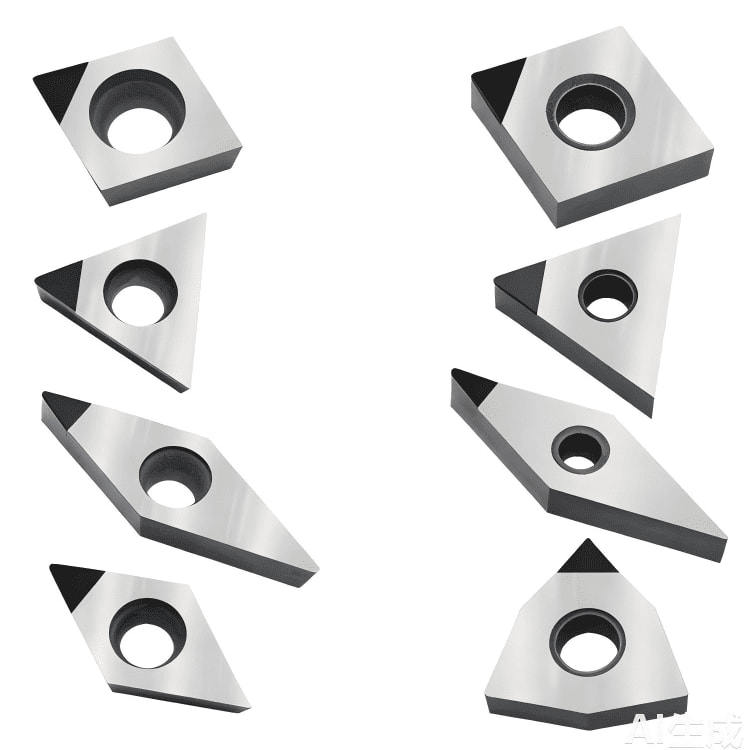
Several Issues and Answers Regarding Solutions for Air-Resistant Materials Processing/PCD tool
Question: What are the differences between processing titanium alloy blades with coatings and without coatings? Is a coating optional when machining titanium alloys?
Answer: Titanium alloys exhibit highly reactive chemical properties and readily react with other coating materials, such as aluminum (Al). Therefore, coating tools should not be used for components requiring specific surface characteristics—this primarily applies to military-grade products. For applications without such requirements, coating tools are permissible, provided that the coating demonstrates superior wear resistance compared to non-coated tools.
Question: The machining of ceramic tools must be quite challenging, particularly regarding the formation of grooves. What exactly is this ceramic material referring to? Is it alumina or silicon nitride?
Answer: The grinding process of ceramic tools is essentially similar to that of hard alloy tools, with the only difference being the type of grinding wheel used. There are various types of ceramics; integral ceramics primarily consist of SiAION and are often coated.
Question: In tube sheet manufacturing, there is a type of composite plate known as an explosion plate, which is formed by high-temperature bonding of stainless steel and titanium alloy plates into a single unit—with one side made of stainless steel and the other of titanium alloy. In such cases, should two different tools be used or can it be processed with a single tool? The primary machining methods involved are vertical lathe turning and high-speed drilling.
Answer: Typically, only one type of cutting tool can be selected for this machining process, as it is necessary to accommodate all materials. Stainless steel and titanium alloys are quite similar in properties and relatively easy to machine, requiring a sharp cutting edge.
Question: Regarding the milling tool vibration issue at the turning angle of titanium alloy T15 during milling, are there any better solutions?
Answer: For corner machining, it is recommended to use tools with a smaller diameter rather than those matching the corner size. Alternatively, initial milling or cycloidal machining followed by chamfering can be performed first, followed by precision contour grinding to avoid tool overutilization.
Question: Is the material of ceramic cutting tools composed of ceramic cemented carbide?
Answer: Ceramic materials differ fundamentally from hard alloys. Hard alloys primarily consist of carbides, whereas ceramics include silicon nitride and aluminum hydride.
Question: When processing difficult materials, what key considerations should be emphasized regarding how to balance processing quality and efficiency?
Answer: For difficult-to-process materials, the cost value is generally high; therefore, the focus should be on improving efficiency while ensuring quality, with quality being the paramount consideration. Rough machining and finish machining should be considered separately: rough machining primarily aims at enhancing efficiency, whereas finish machining seeks to improve efficiency under the premise of maintaining quality.
Question: How can surface vibration be prevented during the machining of thin-walled impellers?
Answer: There are various factors contributing to vibration, primarily the inherent rigidity of the parts themselves and the cutting forces during machining that cause deformation at both macroscopic and microscopic levels. First, the clamping rigidity of the part requires corresponding support at the machining stress points; second, the cutting force should not resonate with the natural frequency of the part. This can be achieved by using tools with non-uniform cutting edges, which vary the cutting force frequency—for example, Kennametal's Havi series of non-uniform angle milling cutters. When machining titanium alloys, adhere to the 8:1 principle for cutting depth, meaning the cutting depth should never exceed eight times the remaining material thickness; for aluminum alloys, this ratio is reduced to 4:1.
Question: This processing method is prone to thermal cracking if water cooling is used.
Answer: Cooling fluid must not be used during ceramic tool iron machining to avoid thermal shock, which may cause blade cracking. However, during turning operations—being continuous processes—thermal shock is absent, allowing the use of cooling fluid provided that its concentration remains stable.
Question: Was any new material added? Has the impact resistance increased?
Answer: The use of new materials can enhance impact resistance.
Question: Re-cutting is not recommended, as batches sintered from different batches exhibit varying performance, sometimes significantly.
Answer: Compared to other materials, Kennametal ceramics exhibit stable performance and follow a well-defined manufacturing process, which represents our competitive advantage.
Question: What cutting tools are suitable for carbon-carbon composites?
Answer: Among carbon-carbon composites, PCD is generally the most wear-resistant material. Kennametal offers PCD-coated drills and milling cutters, as well as PCD tools for welding edges—including milling cutters, drills, and reamer bits.
Question: How should a monolithic ceramic milling cutter be ground after edge passivation?
Answer: For integral ceramic milling cutters, grinding is not recommended. After processing with integral ceramics, the tool exhibits significant wear, including chipping of the cutting edge. Although the tool itself can be ground, the process is costly and economically unviable.
Question: How effective is this tool for machining aluminum parts? Does anyone have experience with it?
Answer: Aluminum part processing is relatively well-established technologically and typically involves high-speed machining.
Question: Is this ceramic milling cutter made of metal-ceramic or non-metallic ceramic?
Answer: The ceramic milling cutter is not a metal-ceramic but rather SiAION ceramic.
Question: What are the advantages of this deep-hole drill compared to a shot hole drill?
Answer: The efficiency of deep-hole drilling is significantly higher than that of shot blasting drilling, typically 2 to 3 times greater.
Question: When can a ceramic blade be cooled with coolant?
Answer: Ceramic cutting tools should not be used with coolant, whereas turning tools may employ coolant primarily to prevent thermal shock. Turning involves continuous cutting, whereas iron processing is intermittent.
Question: Does Kennametal offer T-shaped machine tools with cutting tools? And how can one predict the tool's service life in advance?
Answer: Kennametal offers T-type milling cutters suitable for both indexable and integral hard alloys. Generally, tool life is determined by the wear width Vb on the back face, typically around 0.2 mm; however, in practice, manufacturers primarily assess it based on workpiece surface quality, considering the tool as having reached its service life if the requirements are not met.
Question: Is the spindle of a standard CNC machine tool properly supported?
Answer: Conventional machine tools are generally not suitable, as they require specific power and torque specifications!
Question: We sharpen knives by hand; may I ask what type of blade is used?
Answer: This depends on the material being processed and the condition of the equipment; for identical materials, the appropriate cutting tools differ between high-speed and low-speed machine tools.
Question: For machining parts with a hardness exceeding HRC 65 using a machining center, what type of tool material should be selected?
Answer: The properties of HR65's superhard material depend on the processing method (milling or turning); CBN tools are typically employed.
Question: During TC4 and TC6 machining, apart from making minor adjustments to the linear speed, what else should be noted?
Answer: The wire speed of titanium alloys generally should not be too high, as titanium itself is flammable; higher speeds and temperatures may lead to combustion. During machining, it is essential to ensure the cutting tool is sharp yet capable of withstanding significant cutting forces and possessing adequate strength. Additionally, the cutting depth and feed rate must exceed the hardening layer thickness of the workpiece surface. Coolant quality is critical—it should have a higher concentration than that required for processing ordinary materials. For milling operations, the machine tool must deliver high torque output at low speeds, with efficiency primarily achieved through increased feed rate rather than higher speed.
Question: I have gained valuable insights from observing that ceramic tooling undergoes extremely high temperatures during processing, with sparks flying. For thin-walled components, could the elevated temperature induce thermal deformation, thereby compromising machining accuracy?
Answer: Generally, ceramic milling cutters are primarily used for rough machining or semi-finishing; for precision machining, hard alloy tools are preferred to ensure part quality.
Question: For nickel-based alloys used in ceramic rough machining, coolant must not be employed to prevent thermal shock. In the video demonstrating titanium alloy machining, cutting fluid was utilized; what type of cutting blade was used? Is cutting fluid also prohibited for CBN applications?
Answer: Ceramic-based nickel alloys cannot be cooled using coolant; only air blowing is applicable. In contrast, titanium alloys can be cooled with coolant, preferably under high pressure and at high concentrations. CBN (carbon-boron-nitride) can also be cooled with coolant. Nickel-based alloys and titanium alloys are two distinct types of materials.
Question: I just noticed that drill bits with a length-to-diameter ratio of over 70 are designed for vertical use; would using them horizontally cause significant circular runout? Is it necessary to first drill a centering hole with a centering drill?
Answer: Deep-hole drilling requires numerous technical specifications. It necessitates the use of a guide drill rather than a centering drill; the entire drill bit must be guided into the hole before commencing machining. Both feed-in and feed-out operations should be performed at low rotational speeds, with normal speed only achieved during actual machining.
Question: Could you elaborate on how to address the following characteristics of high-alloy steel machining? 1. Poor machinability; 2. Significant cutting deformation; 3. Strong work hardening tendency; 4. Surface quality and accuracy issues. Please discuss these from the perspective of tool cutting forces.
Answer: Composite materials vary significantly in composition, and their combined properties differ depending on the constituent materials. There are several types of laminated plates: C2 (composite material + non-ferrous metal), C3 (composite material + superalloy), C4 (composite material + stainless steel), and C5 (composite material + non-ferrous metal + superalloy), with corresponding recommended tools shown in the figure below.
Question: What are the differences between processing titanium alloy blades with coatings and without coatings? Is a coating optional when machining titanium alloys?
Answer: Titanium alloys exhibit highly reactive chemical properties and readily react with other coating materials (as mentioned in Example 1). Therefore, coated tools should not be used for components requiring specific surface characteristics—this primarily applies to military-grade products. For applications without such requirements, coated tools are permissible, as their wear resistance exceeds that of uncoated tools.
Question: The machining of ceramic tools must be quite challenging, and the grooves are difficult to grind. What exactly does this ceramic material refer to? Is it alumina or ammoniated silicon?
Answer: The grinding process of ceramic tools is essentially similar to that of hard alloy tools, with the only difference being the type of grinding wheel used. There are various types of ceramics; integral ceramics primarily consist of SiAION and are often coated.
Question: In tube sheet manufacturing, there is a type of composite plate known as an explosion plate, which is formed by high-temperature bonding of stainless steel and titanium alloy plates into a single unit—with one side made of stainless steel and the other of titanium alloy. In such cases, should two different tools be used or can it be processed with a single tool? The primary machining methods involved are vertical lathe turning and high-speed drilling.
Answer: Typically, only one type of cutting tool can be selected for this machining process, as it is necessary to accommodate all materials. Stainless steel and titanium alloys are quite similar in properties and relatively easy to machine, requiring a sharp cutting edge.
Question: Regarding the vibration issue of the milling cutter at the 15° turning angle in the unified-cutting titanium alloy T-15, are there any better solutions?
Answer: For corner machining, it is recommended to use tools with a smaller diameter rather than those matching the corner size. Alternatively, initial milling or cycloidal machining followed by chamfering can be performed first, followed by precision contour grinding to avoid tool overutilization.
Question: Is the material of ceramic cutting tools composed of ceramic cemented carbide?
Answer: Ceramic materials differ fundamentally from hard alloys. Hard alloys primarily consist of carbides, whereas ceramics are composed of silicon nitride and may also include aluminum oxide.
Question: When processing difficult materials, what key considerations should be emphasized regarding how to balance processing quality and efficiency?
Answer: Difficult-to-process materials generally exhibit high cost-effectiveness; therefore, the focus is typically on improving efficiency while ensuring quality, with quality being the paramount consideration. Rough machining and finish machining should be considered separately: rough machining primarily aims at enhancing efficiency, whereas finish machining seeks to optimize performance under the premise of maintaining quality.
Question: How can surface vibration be prevented during the machining of thin-walled impellers?
Answer: There are various types of vibrations, primarily caused by the inherent rigidity of components and the cutting forces during machining, which induce deformation at both macroscopic and microscopic levels. First, component clamping rigidity requires corresponding support at stress-bearing areas during machining; second, the cutting force should not resonate with the component's natural frequency. Using tools with non-uniform cutting edges can vary the cutting force frequency—for example, Junna's Havi series tools with unequal angles. When machining titanium alloys, adhere to the 8:1 principle, ensuring the cutting depth never exceeds eight times the remaining thickness; for aluminum alloys, this ratio should be reduced to 4:1.
The Soft Force Plus T model is designed for use with water cooling systems and is suitable for handling hot foods.
Answer: In ceramic tool ironworking, cooling liquid must not be used to avoid thermal shock, which can cause blade cracking or fissuring. However, during turning operations—being continuous processes without thermal shock—cooling liquid may be employed provided its flow remains stable.
Question: Was any new material added? Has the impact resistance increased?
Answer: The use of new materials can enhance impact resistance.
Question: This method is not suitable before re-cutting, as batches sintered from different batches exhibit varying performance—with sometimes significant differences.
Answer: Compared to other materials, Kennametal ceramics exhibit stable performance and follow a well-defined manufacturing process, which represents our competitive advantage.
Question: What cutting tools are suitable for carbon-carbon composites?
Answer: Among carbon-carbon composites, PCD is generally the most wear-resistant material. Kennametal offers PCD-coated drills and milling cutters, as well as PCD tools for welding edges—including milling cutters, drills, and reamer bits.
Question: How should a monolithic ceramic iron blade be ground after passivation?
Answer: For integral ceramic cutting tools, grinding is not recommended. After processing, the tools exhibit significant wear, including edge chipping in some cases. Although the tools themselves can be ground, the procedure is costly and economically unviable.
Question: How effective is this tool for machining aluminum parts? Does anyone have experience with it?
Answer: Aluminum part processing is relatively well-established technologically and typically involves high-speed machining.
Question: Is this ceramic cutting tool made of metal-ceramic or non-metallic ceramic?
Answer: The ceramic integrated knife is not a metal-ceramic product, but rather SiAION ceramic.
Question: What are the advantages of this deep-hole drill compared to a shot hole drill?
Answer: The efficiency of deep-hole drilling is significantly higher than that of shot blasting drilling, typically 2 to 3 times greater.
Question: When can a ceramic blade be cooled with coolant?
Answer: Ceramic cutting tools must not use coolant, whereas turning tools may employ coolant primarily to prevent thermal shock. Turning involves continuous cutting, whereas milling is an intermittent process.
Xinrui Zhi (Shenzhen) Precision Machinery Co., Ltd. has decades of expertise in the research, development, production, and service of precision tools. Products: standard tools, custom-made tools, PCD tools. Services: turnkey solutions, tool management services, tool grinding services – helping you overcome technical challenges in machining while reducing costs and improving efficiency.
PCD Reamers#PCD Tool#PCD Drills#PCD Milling Cutters