Technology for manufacturing cutting tools made from carbon fiber composites (CFRP)
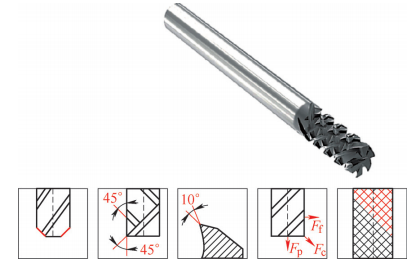
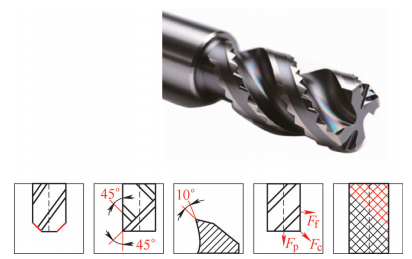
Given the anisotropic and high-hardness characteristics of carbon fiber reinforced plastics (CFRP), milling processes often face significant technical challenges such as severe cutting force fluctuations, rapid tool wear, surface delamination, and burr formation. A newly designed vertical milling cutter featuring a rhombic-toothed topological cutting edge structure has been developed and integrated with chemical vapor deposition (CVD) technology. Through comparative cutting experiments, the tool's overall performance—including cutting force, operating temperature, tool life, and workpiece surface quality—was quantitatively evaluated, effectively addressing the core challenges in efficient and high-quality CFRP machining and providing essential technical solutions for high-precision processing of CFRP components.
Analysis of the Properties of CFRP Materials and Their Processing Challenges
The T300 carbon fiber fibers in CFRP have a diameter of 5–7 μm, with a tensile strength of up to 3500 MPa and an elastic modulus of approximately 230 GPa, exhibiting significantly higher hardness than conventional brittle materials measured by the HRC scale. Commonly used epoxy resin matrices exhibit viscoelastic behavior at room temperature, with phase transition temperatures typically ranging from 120 to 200 °C. The heterogeneous structure formed by the combination of rigid and flexible components gives CFRP pronounced macroscopic anisotropy: along the fiber direction (0°), high tensile strength is primarily provided by the fibers; perpendicular to the fiber direction (90°), strength depends on the shear strength of the resin matrix and the bonding strength between fibers and the matrix, resulting in a substantial reduction in strength [9, 10]. This anisotropy significantly complicates the cutting mechanism as the fiber orientation angle varies. The microstructure of CFRP is illustrated in Figure 1.
Design and Selection of Tool Material Systems
To match the rhombic-tooth structure and leverage all the advantages of CFRP, a gradient composite system combining a strong matrix with an ultra-hard coating was developed. For the matrix material, ultrafine-grained cemented carbide was selected. This matrix must not only support complex rhombic-tooth geometries but also withstand high-frequency impact loads under intermittent cutting conditions; thus, cemented carbide with WC grain sizes <0.5 μm was chosen. This alloy exhibits a microhardness>92.5 HRA and a flexural strength exceeding 4000 MPa. The fine-grain strengthening effect confers excellent toughness and impact resistance to the matrix, effectively preventing micro-cracking at the cutting edge under complex loading conditions while providing robust support for the diamond coating.
It enhances machining efficiency by over 30%, effectively controls layering and burr formation, and ensures both fatigue strength of structural components and assembly airtightness. In the new energy vehicle sector, lightweight components such as carbon fiber battery pack housings and body panels impose stringent requirements for both sealing performance and aesthetic appearance. This tool achieves nearly burr-free cutting results, reducing manual grinding operations by more than 50%. In wind power equipment manufacturing, large wind turbine blade molds (typically made of CFRP or composite materials) demand high surface precision and require extended processing times. The tool's long service life significantly reduces tool change downtime on large five-axis machines, improves equipment utilization rates, lowers per-unit mold production costs, and delivers surface quality with Ra ≤ 0.8 μm roughness and dimensional accuracy meeting IT7 standards—fully meeting the demands of high-end equipment manufacturing.
PCD Reamers#PCD Tool#PCD Drills#PCD Milling Cut