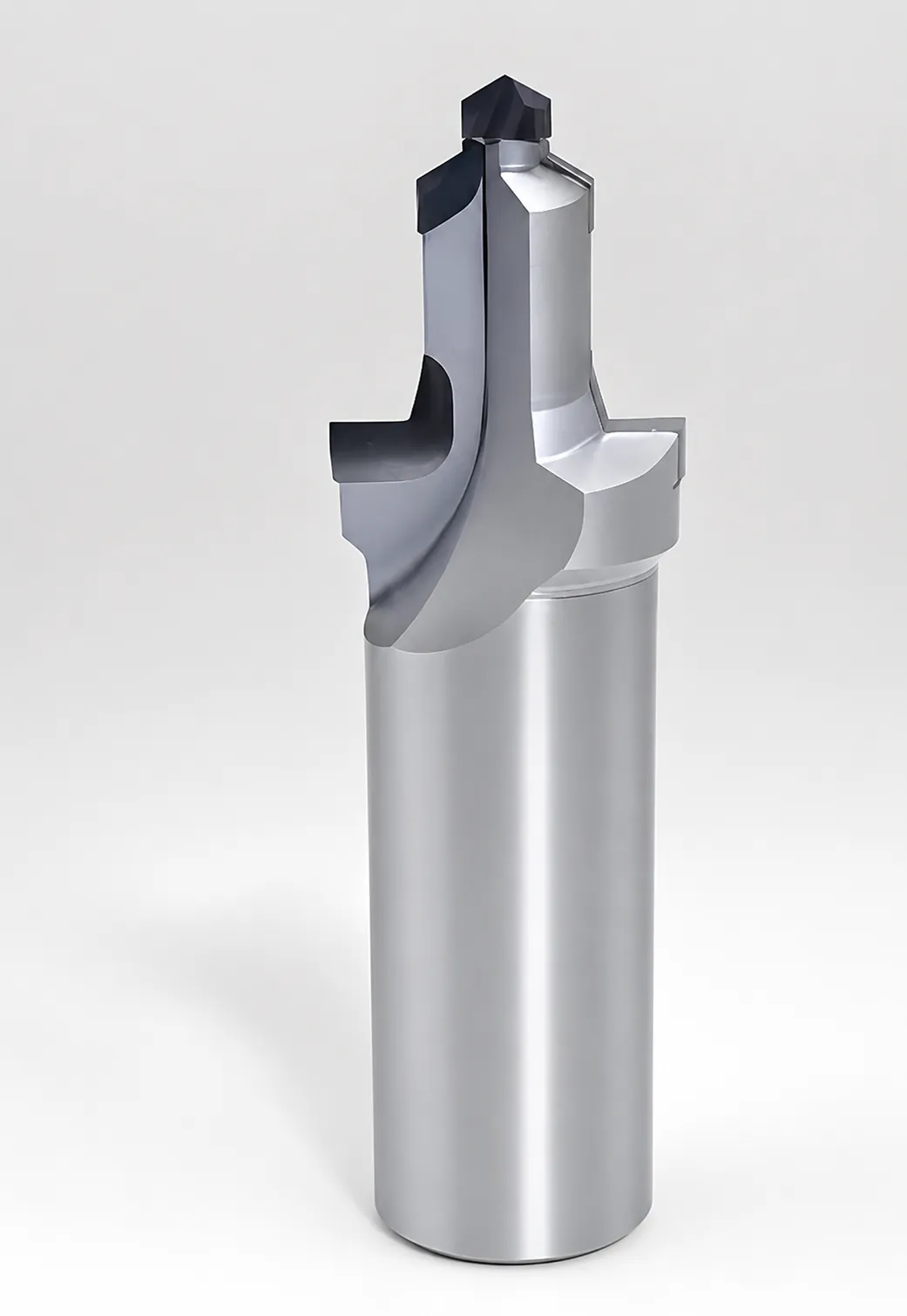
Why can PCD cutting tools improve the machining accuracy and tool life of automotive part holes?
A Comprehensive Analysis Framework for Global Distributors: Bridging Technological Excellence with Supply Chain Efficiency
Chapter 1: Short Answer: Why does the PCD lathe cutter dominate in automotive hole machining?
In the mass production of automotive powertrains and components, the machining capability of standard monolithic hard alloy tools has reached its limits. Modern automotive engineering extensively employs lightweight high-silicon aluminum alloys (e.g., A356 or A390) and bimetallic components. The silicon particles embedded in these components act as powerful abrasives, wearing down tungsten carbide cutting edges over hundreds of cycles.
In summary, polycrystalline diamond (PCD) represents a qualitative leap in both hardness and thermal conductivity. While carbide tools are prone to wear, PCD tools maintain an exceptionally sharp cutting edge for tens of thousands of cycles. Its friction coefficient with non-ferrous metals approaches zero, completely eliminating chip accumulation (BUE) or the phenomenon known as "chip welding."
For automotive manufacturers, this process ensures strict IT6 / IT7 dimensional accuracy and mirror-like surface roughness when machining critical components such as valve guides, brake cylinders, and steering knuckles ($R_a <0.4$: from the first to the 50,000th hole, with consistently maintained hole diameters in micrometers).
Chapter 2: Transparency: Our Pricing Matrix, Tool Types, and Distributor Targets
To dispel public misconceptions about high-quality diamond tools, we have systematically broken down our production cost structure and target market positioning within our own manufacturing facility.
Chapter 3: How do we define "cost" within the procurement lifecycle?
Actual costs are divided into three key procurement stages:
1. Early bidding and prototype development phase (implied friction costs)
Engineering discrepancies: If the OEM manufacturer misinterprets customized 3D drawings or fails to identify geometric conflicts, distributors will face weeks of communication delays and lost engineering time.
Sample/tool procurement costs: If the manufacturer imposes a high minimum order quantity (MOQ), the cost of creating rapid physical prototypes for customer-approved production line trials may skyrocket.
2. Mid-term Production and Supply Chain Phase (Hold Cost)
Safety stock lock-in: Unreliable production and delivery timelines from overseas suppliers compel Western distributors to maintain substantial safety stocks in local warehouses, significantly tying up working capital.
Logistics and agility costs: The factory's slow response time makes it unable to quickly address unexpected and sudden changes in mold requirements from automotive customers.
3. Final Implementation Phase (Key factor determining final profit outcome)
Downtime and Liability Claims: On automotive Just-In-Time (JIT) assembly lines, unexpected tool failures causing production line stoppages can trigger catastrophic financial claims against distributors.
Single-hole cost (CPH): The true metric for measuring success.
The mathematical principles of Copenhagen:
A $400 PCD file can perfectly machine 40,000 holes at a cost per hole of $0.01.
A hard alloy reamer priced at $100 failed after machining 400 holes, with a cost of CPH = $0.25 per unit.
This increases the cost of carbides in actual production by 25-fold.
Chapter 4: Core Science: Precision of Mechanical Drive Systems and Extended Tool Life
To achieve micron-level precision, merely procuring high-quality diamond blanks is insufficient. The exceptional performance of PCD can only be fully realized with state-of-the-art equipment. Through substantial capital investment, our proprietary manufacturing facility ensures precision control at every micrometer level.
Precision electrical discharge machining (VOLLMER wire cutting and disc EDM): We utilize VOLLMER machine tools compliant with German industry standards, ensuring defect-free, ultra-sharp cutting edges with exceptionally low surface roughness and control accuracy below 2 μm, effectively eliminating micro-cracks that may form before tool contact with the workpiece.
Laser ablation technology: For complex multi-step geometric shapes, our multi-axis laser cutting machines can produce microgeometric features and chip evacuation grooves that cannot be replicated by traditional mechanical grinding.
Rigid carbide tool core and H6 shank: All tool bodies are manufactured from high-quality ultra-fine-grained carbide blanks. Final cylindrical grinding ensures that the shank tolerance remains within 0–3 μm (H6), guaranteeing optimal runout stability on high-speed CNC spindles.
Chapter 5: Case Study: How We Help Clients Reduce PCD Reamer Costs
Last year, a renowned industrial tool distributor headquartered in Ohio, USA, sought our assistance as they faced a challenging issue. They were bidding for a contract with a secondary automotive parts supplier that involved multi-step boring operations on valve stems. Their previous supplier had quoted as high as $620 per tool, citing the extreme complexity of the manufacturing process. These exorbitant costs severely threatened the distributor's profitability and even jeopardized the entire contract agreement.
Our engineering team reviewed the design drawings and immediately identified a "overdesign trap." The previous manufacturer had blindly adopted the client's unoptimized design, which included an unnecessary 45-mm continuous solid PCD segment and excessively narrow geometric clearances in non-critical areas—artificially doubling both raw material costs and EDM processing time.
Solutions and Results
By replacing individual long PCD strips with an optimized multi-segment interlaced block design and upgrading the non-critical tolerance from 3 μm to the standard 12 μm, we significantly reduced manufacturing cycle time while maintaining 100% tool cutting performance.
What were the results? We reduced the production cost per tool from $620 to $370—a 40.3% decrease. The tool successfully passed customer assembly line testing and achieved an impressive service life of 42,000 holes before requiring initial regrinding. Beyond delivering the tools, we secured long-term business contracts for distributors through proactive engineering consulting services.
Chapter 6: Business Strategies – The Hidden Secrets Behind Cost-Saving Custom Mold Solutions
To establish a foothold in the high-end mold market, strategic insight is essential. The following three practical business recommendations are specifically designed for Western distributors to help reduce custom production costs:
Engage our engineers early in your design process: don't wait until the client's drawings are finalized before communicating with us. Share preliminary sketches with us—our factory engineers can often provide subtle contour adjustment suggestions that significantly reduce EDM processing time and lower unit costs immediately, without compromising the final part's functionality.
Using off-the-shelf cemented carbide blanks: Custom tool bodies require specialized steel or pre-formed cemented carbide components. Our factory maintains extensive stock of standardized internally cooled blanks sourced from high-quality industrial parks. By selecting these ready-made blanks, we eliminate all costs associated with custom casting and rough machining.
Design lock before initial ignition: Since PCD machining relies on precise computer-controlled corrosion profiles, modifying designs after the VOLLMER machine has begun cutting results in significant waste of valuable raw materials. Establishing a strict "drawing confirmation freeze" process with end users ensures zero cost waste.
Chapter 7: Frequently Asked Questions
Question 1: What is the minimum order quantity (MOQ) for customized PCD reamers?
Answer 1: For standard straight-flute reamers, our minimum order quantity is only 5 pieces. For highly complex multi-step custom tools, we accept initial trial orders of 2 to 3 pieces to support your production line validation process.
Question 2: How long does it typically take from drawing confirmation to delivery in Europe or the United States?
Answer 2: We have a fully integrated in-house production system and can complete customized production within 14 to 21 working days. Air shipment to your distribution center in Europe or North America typically requires an additional 5 to 7 days.
Q3: Do you offer regrinding and refurbishment services for old-type distribution switch handles?
A3: Yes. We offer comprehensive refurbishment and resanding services. Thanks to our high-quality blade handle materials, our blades typically withstand 3 to 5 refurbishment cycles, reducing your long-term replacement costs by up to 50%.
Question 4: How can we ensure the safe transportation of high-value diamond drill bits?
Answer 4: Each tool is individually packaged in oil-resistant, thick-walled suspended plastic tubes and secured with custom foam linings. The outer packaging employs high-strength reinforced corrugated cardboard boxes to ensure 100% impact protection during global transportation.
Xinrui Zhi (Shenzhen) Precision Machinery Co., Ltd. has decades of expertise in the research, development, production, and service of precision tools. Products include standard tools, custom-made tools, and PCD tools. Services cover comprehensive turnkey solutions, tool management services, and tool grinding, helping you overcome technical challenges in machining while reducing costs and improving efficiency.
PCD Reamers#PCD Tool#PCD Drills#PCD Milling Cutters