
The drawing calls out C0.5 on one hole and a 90° countersink on the next. At the machine there is a countersink, a chamfer mill and a 90° spot drill, and any of them will cut a cone at the hole mouth. Pick the wrong one and the flat-head screw rocks on the rim of its seat, the chamfer comes out a different size on every hole, or the first thread carries a burr after tapping.
Use a countersink when the hole needs a seat for a screw or rivet head. It plunges, and the tool sets the seat angle. Use a chamfer mill for edge breaks and for chamfers that change size from hole to hole. It interpolates, and the size can be compensated. Drill first, then chamfer or countersink, then tap or ream; a step drill can cut the hole and the chamfer together.
If the burr you are dealing with is at the hole exit, see exit breakout and burr control. Everything below is about the entry edge.
Seat or Edge Break: Read the Callout First
The callout tells you which job the edge has. A seat carries a fastener head, so its angle and major diameter are checked, usually with a flush gauge or the screw itself. An edge break only has to remove the sharp corner and keep the chamfer within its size.
| Callout on the drawing | What the edge is for | Usual tool | What gets checked |
|---|---|---|---|
| Countersink symbol with angle and major diameter, or a screw standard | Seat for a screw or rivet head | Countersink, plunged | Seat angle, major diameter, head flush or below flush |
| C0.5, 0.5×45°, "break sharp edges" | Edge break, lead-in for a tap or a mating part | Chamfer mill, interpolated | Chamfer leg or width at 45° |
When the seat is the requirement, the countersink range covers fastener seats in steel, stainless and cast iron, with the angle and diameter taken from your fastener standard.
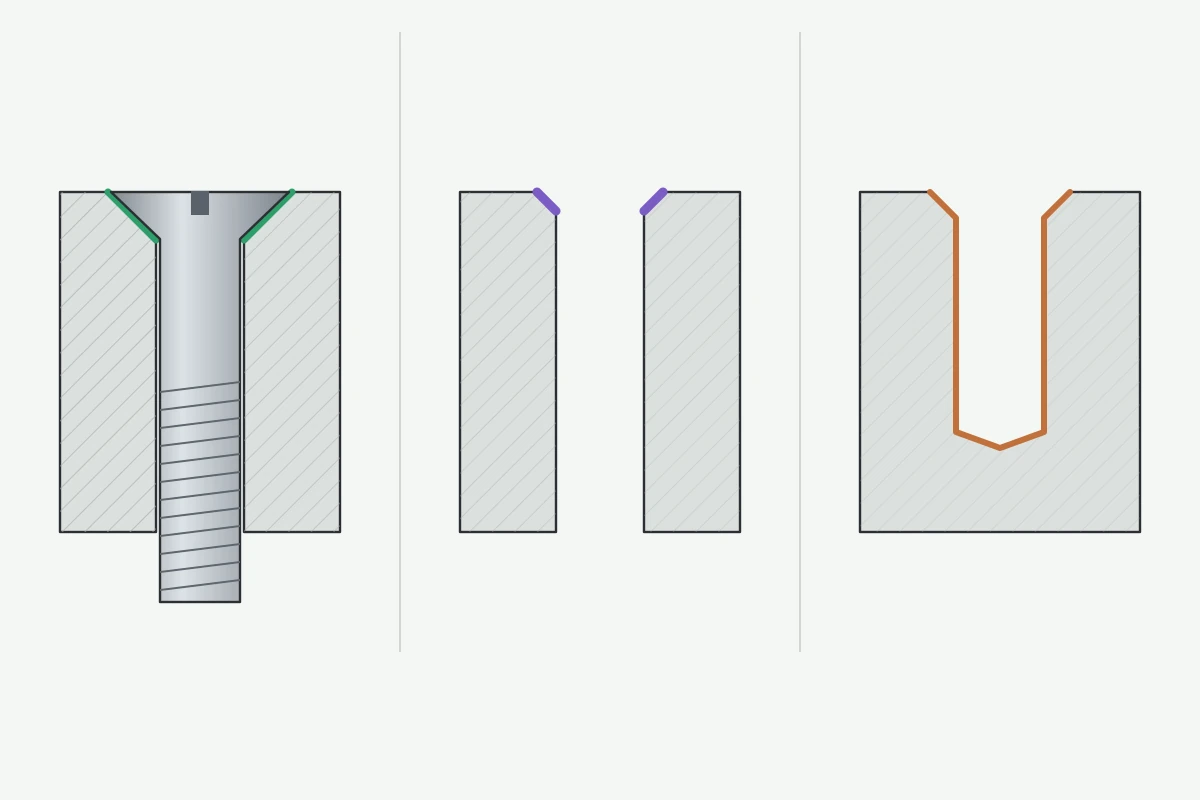
Plunge or Interpolate
A countersink plunges. It goes straight down into the drilled hole, the tool's included angle becomes the seat angle, and the Z depth sets the major diameter. That makes it quick on a run of identical seats: one plunge per hole, and the angle cannot drift with the program. It also means the seat diameter is only as repeatable as the Z reference. If the part surface sits higher or lower from part to part, so does the seat. The seat can only be as concentric as the drilled hole is on position; a countersink does not correct a hole that wandered.
A chamfer mill interpolates. It runs a circular path around the hole edge, and the chamfer size comes from the radial offset and Z depth in the program. One tool can cut several chamfer sizes on several hole diameters, and the size can be compensated in X, Y or Z as the tool wears or the drawing changes. The same tool breaks edges on slots, pockets and outside contours, which a countersink cannot reach. Two limits apply. The tip has to fit inside the hole with clearance, which sets the smallest hole a given chamfer mill can work in. And a chamfer mill is not designed for plunging: its flutes and clearances are laid out for a sideways cut, so a straight plunge leaves a rough chamfer and loads the tip.
A chamfer mill can cut a seat by interpolation if its included angle matches the seat angle, for example 90°. Check the seat against the same gauge you use for plunged seats, because roundness now depends on the machine's circular path. For a few seats among many edge breaks, that saves a tool position in the magazine. For a long run of identical seats, the countersink plunge is simpler.
For edge breaks on steel and stainless parts, the carbide chamfer mill range is quoted from the angle, the land size and the list of edges on your drawing.
Sequence After a 140° Carbide Drill
The usual order is drill, then chamfer or countersink, then tap or ream.
Chamfer before you tap. The chamfer gives the tap a lead-in. Tapped through a sharp edge, the first thread is a thin sliver of material, and the tap pushes it up into a burr. If you chamfer after tapping, the chamfer tool cuts across the start of the thread and raises a burr on the first thread, and the tap often has to go back in to clear it. Size the chamfer so its major diameter is just over the thread's major diameter, which puts the first full thread below the edge.
Chamfer before you ream. For a reamed hole, the chamfer usually goes in before the reamer. The reamer then starts on a clean edge, and nothing touches the finished bore afterward.
Using the Spot Drill as the Chamfer
Running a 90° spot drill deep enough to leave the chamfer before drilling saves a tool, and it is a common habit. Ahead of a 140° carbide drill, that 90° cone meets the drill's outer corners before the point has centered. The spot drill can still cut the chamfer if it runs after the drill, as a plunge into the finished hole. Any spot used before drilling stays matched to the drill point. Spot drill vs center drill before a carbide drill shows how to pair the spot angle with the drill point.
Step Drill: Hole and Chamfer in One Tool
A carbide step drill with a chamfer step drills the hole and cuts the chamfer in one pass. The chamfer comes out concentric with the hole, and the separate chamfer operation and its tool change disappear. In return, the chamfer size is fixed by the step, so each combination of hole size and chamfer needs its own tool. That pays on repeat holes of one size, such as tap drills used over and over on the same part. A step carbide drill is quoted from the diameter stack on your section view, including which steps carry a chamfer.
Reamed Aluminum Holes: Drill, Ream and Chamfer on One Body
For precision bores in aluminum, the chamfer can be folded into a PCD combination drill-reamer that drills, reams and cuts the entry chamfer in one controlled path, when the axial positions and the chip path allow it.
Aluminum Hole Mouths: When PCD Pays
XRZ's carbide countersinks and chamfer mills are built for ferrous parts. Low-volume parts in wrought aluminum may still run well on carbide. On high-volume aluminum lines, and especially in high-silicon castings, the carbide edge wears, built-up edge appears on the chamfer, and the chamfer drifts out of size. That is the point where a PCD edge earns its cost, either as a separate tool or built into the reamer: see PCD chamfer and spotface tools for aluminum.
What to Send With the Hole-Edge Callout
To choose between a countersink, a chamfer mill, a step drill or a combined tool, we need:
- The hole-edge callout: chamfer size, or countersink angle and major diameter
- The fastener standard, if the edge is a seat
- Drill diameter and point angle, and what follows the chamfer: tapping, reaming or nothing
- Material: steel, stainless, cast iron, aluminum or high-silicon aluminum
- How many hole sizes on the part carry the same edge callout
- Batch size or annual volume
- Whether you want the hole, the chamfer and any reaming combined in one tool
Send the hole-edge callout with the drill size through the custom cutting tool RFQ; we check whether one tool can do both.
Frequently Asked Questions
Can a chamfer mill be used as a countersink?
Yes, when its included angle matches the seat angle and it is run on a circular path around the hole. Check the seat with the same gauge as a plunged seat. A chamfer mill is not designed to plunge straight down, and for a long run of identical seats a countersink is the simpler tool.
Should I chamfer before or after tapping?
Before. The chamfer gives the tap a lead-in and keeps the first thread from lifting into a burr. Chamfering after tapping cuts across the thread start, raises a burr on the first thread and often means running the tap again.
What countersink angle do metric flat-head screws need?
Metric countersunk flat-head screws seat on 90°. Inch flat-head screws use 82°, and many flush-head rivets use 100°. Confirm the angle and the major diameter against the fastener standard on your drawing before the tool is chosen.
Can one tool drill the hole and cut the chamfer?
Yes. A carbide step drill with a chamfer step cuts both in one pass and keeps the chamfer concentric with the hole. The chamfer size is fixed by the tool, so it suits repeat holes of one size. For reamed aluminum holes, a PCD combination drill-reamer can include the entry chamfer.