
Product Detail
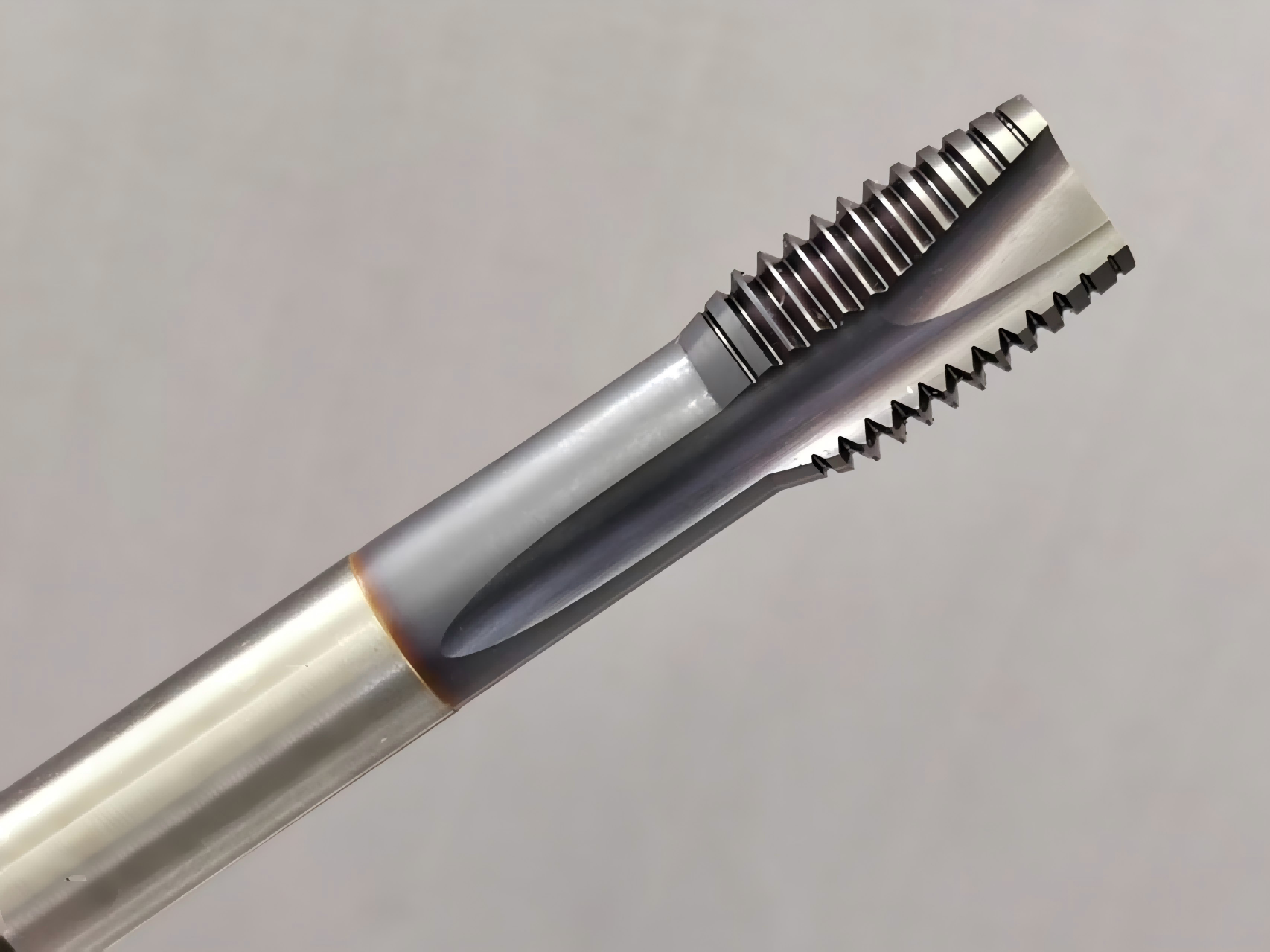
Solid Carbide Thread Mills
Solid carbide thread mills for aluminum, steel, stainless steel and high-temperature alloys. Compare single-form, triple-tooth and multi-form designs, then confirm the model against your thread, material and depth.
Compare cutter types, check catalogue sizes or send your drawing for selection.
Choose the cutting geometry
Choose single-form, triple-tooth or multi-form
Side-view schematics, not to scale. Axial teeth are shown; flute geometry is omitted. Model-specific counts are listed below.
| Your production task | Candidate to evaluate | Check before choosing |
|---|---|---|
| Several compatible pitches or changing thread depths | Single-form | Actual pitch coverage, profile and reach for each thread. |
| Matching pitch with fewer axial teeth engaged | Triple-tooth | Pitch, effective length, clearance and pass strategy. |
| Repeated threads with the same form and pitch | Multi-form | Cutting length, tooth spacing, holder clearance and trial cycle. |
| Long projection or limited setup stability | Reassess reach and engagement before fixing the geometry | Overhang, fixture rigidity and radial/axial pass strategy. |
Select within the actual profile, pitch and reach limits. [1] [2] For abrasive aluminum-silicon production, compare PCD thread milling against carbide using trial acceptance and batch requirements.
Practical benefits for your production
Six reasons to consider thread milling
Reduce dedicated-tool requirements
Machine several compatible thread diameters with one suitable cutter, helping simplify mixed-part tooling and changeovers.
Thread form, pitch coverage, cutter diameter and clearance must match each feature. [1] [10]
Adjust thread size through the CNC path
Use toolpath or cutter compensation to refine pitch diameter after trial gauging.
Check wear, runout and thread form first; compensation cannot repair a damaged edge. [10]
Distribute the cut across several passes
Split engagement to manage tool deflection and cutting load in difficult materials or less rigid setups.
Choose the pass strategy for the actual cutter, material and overhang. [3] [5]
Plan depth and chip removal together
A cutter smaller than the bore provides space to plan entry, cutting, chip evacuation and retraction.
Full thread depth, drilled depth and bottom clearance must be checked separately. [1] [3]
Benefits depend on the cutter and application; verify accuracy, tool life and productivity in a controlled trial.
Selected catalogue specifications
Compare representative thread mill sizes
Read the dimensions before selecting
D: shank diameter — match the holder.
D2: cutting diameter — check entry clearance and thread-profile compatibility.
L1: catalogue effective length — confirm its limits on the model drawing.
L: overall tool length — review holder projection and machine clearance.
L1 is not the full thread depth or flute length; confirm usable reach and clearances on the model drawing.
Eight ISO metric catalogue examples.
AL — aluminum & non-ferrous
UM — steel
SUS — stainless steel
GHS — high-temperature alloys
Catalogue application groups, not interchangeable grades. Confirm the workpiece grade, condition and hardness before selection.
All dimensions in mm. Scroll the table horizontally on smaller screens. These are catalogue examples; availability and application suitability are confirmed in the quotation.
| Series / geometry | Product code | Thread | Shank Ø D | Cutting Ø D2 | Effective length L1 | Flutes R / F | Overall length L | Axial teeth Z |
|---|---|---|---|---|---|---|---|---|
| AL · Single-form | CTMS03005004AL | M3 × 0.5 | 4 | 2.40 | 7.5 | 3 | 50 | 1 |
| AL · Single-form | CTMS08012508AL | M8 × 1.25 | 8 | 6.50 | 20.0 | 4 | 60 | 1 |
| UM · Triple-tooth | CTMT03005004UM | M3 × 0.5 | 4 | 2.40 | 6.2 | 3 | 50 | 3 |
| UM · Triple-tooth | CTMT08012508UM | M8 × 1.25 | 8 | 6.50 | 16.6 | 4 | 60 | 3 |
| SUS · Multi-form | CTMF06010006SUS | M6 × 1.0 | 6 | 4.80 | 12.0 | 4 | 50 | 12 |
| SUS · Multi-form | CTMF10015010SUS | M10 × 1.5 | 10 | 8.20 | 21.0 | 4 | 75 | 14 |
| GHS · Multi-form | CTMF08012508GHS | M8 × 1.25 | 8 | 6.50 | 16.25 | 4 | 60 | 13 |
| GHS · Multi-form | CTMF12017510GHS | M12 × 1.75 | 10 | 9.90 | 24.5 | 4 | 75 | 14 |
Counts: R/F = flutes; Z = axial teeth. Dimensions are defined in the diagram above.
Source: supplied HENTRY English catalogue, printed pages 2 (AL single-form), 11 (UM triple-tooth), 20 (SUS multi-form) and 28 (GHS multi-form). Other available catalogue families include G/Rc, NPTF/NPT and UN threads; each requires its own matching model.
Complete English catalogue
Need the full thread mill range?
Full dimensions for all four material series and three tooth arrangements.
English PDF · 36 pages · 3.87 MB. Includes ISO metric, G/Rc, NPTF/NPT and UN catalogue families.
Drawing-based supply
What to confirm in your thread mill proposal
For a custom or modified tool, agree these items before ordering.
| Specification | Provide or choose | Confirm in the quotation |
|---|---|---|
| Thread form | Full standard/designation, pitch or TPI, tolerance class, hand and number of starts. | Profile compatibility and the exact thread covered by the proposed tool. |
| Geometry | Preferred tooth arrangement; internal or external thread. | Cutter/neck/shank diameters, effective reach, cutting length and overall length. |
| Material and configuration | Material grade, condition, measured hardness and coolant arrangement. | Substrate/geometry, coating and coolant features for the proposed tool. |
| Supply status | Quantity, repeat demand and required delivery date. | Standard-item availability or custom manufacture, commercial terms and delivery. |
| Acceptance | Drawing revision, critical dimensions and finished-thread requirements. | Inspection scope, sample acceptance and repeat-order identification. |
Use the catalogue dimension key above; define any additional neck or reach dimensions on the approved drawing. Selection fields: [7].
Substrate, coating & edge preparation
Match the AL, UM, SUS or GHS series to your material
All four catalogue families use solid carbide. Confirm the coating and edge specification against the selected tool code.
| Series / workpiece | Catalogue coating | Substrate & cutting edge | Selection check |
|---|---|---|---|
| AL Aluminum extrusions, die-cast aluminum, brass, copper and PVC | Multilayer DLC nano-coating | Solid carbide; fully ground and honed edges. | Identify the alloy, silicon content where relevant, adhesion and chip-removal conditions. |
| UM General, alloy and hardened steels; stainless steel also listed | Nano-composite coating; chemistry not specified | Solid carbide; fully ground and honed edges. | Supply the grade, heat treatment and measured hardness. No universal HRC limit is specified. |
| SUS 304, 316 and duplex stainless steels | Nano-coating; chemistry not specified | Solid carbide; fully ground and honed edges. | Confirm stainless grade and condition, burr limits, coolant access and edge wear. |
| GHS Nickel-, cobalt- and iron-based high-temperature alloys | Nano-coating; chemistry not specified | Solid carbide; helical multi-row cutting-edge geometry. | Identify the alloy and condition; review engagement, projection and pass strategy. |
Product source: HC thread mill catalogue, printed pages 1, 9, 17 and 25 (PDF pages 3, 11, 19 and 27). Material lists identify candidate families, not interchangeable cutting data.
Which substrate and coating details should the order specify?
For a controlled specification, agree the carbide grade, WC grain size and cobalt content; coating chemistry and thickness; and edge-hone requirement where relevant. The current catalogue does not publish those values. DLC is identified for AL; the other coating descriptions do not establish TiAlN, AlTiN or TiSiN chemistry.
Substrate, coating and edge preparation are separate specification fields. Record the approved combination on the drawing or order for repeat supply and reconditioning.
What if my material falls between families?
Send the exact alloy, hardness and thread drawing. UM and SUS both list stainless steel, so the material name alone does not resolve the choice. Cast iron and other unlisted materials require a matched proposal. For aluminum production, compare PCD thread milling where justified; retain a proven tapping process when a controlled comparison does not justify changing it.
Cutting speed, chip load & CNC feed
Set cutting data for the actual cutter and toolpath
Choose cutting speed and chip load for the tool code, workpiece grade and setup first. Then calculate spindle speed and the feed required by the CNC or CAM system. The catalogue dimensions are not a material-specific starting-parameter chart.
Spindle speed
n = 1000 × Vc / (π × Dc)
n: rpm · Vc: m/min · Dc: effective cutting diameter in mm. Use the cutting diameter, not the shank diameter. The catalogue identifies cutting diameter as D2.
Peripheral feed
vfm = fz × zc × n
vfm: mm/min · fz: mm/tooth · zc: effective circumferential cutting-edge count. Confirm the applicable flute count; do not substitute axial tooth count Z from the size table.
Formula basis: [9]. These relationships calculate values from selected inputs; they do not select a suitable Vc or fz for an HC tool.
Internal threads: check centre-path feed before programming
The cutter periphery travels faster than its centre during internal circular interpolation. A peripheral feed calculated above may therefore exceed the centre-path feed required by the control. Confirm the CAM/postprocessor convention and circular/helical compensation; do not apply the correction twice. [3] [6]
Do not confuse fz with fn: fz is feed per tooth; fn is feed per spindle revolution. Thread pitch controls the axial advance of the helical toolpath, not feed per spindle revolution as in synchronous tapping. [9] [3]
Inputs needed for an application-specific starting-data sheet
| Provide | Define before the trial |
|---|---|
| Tool code, D2, flute count, axial tooth count and projection | Vc, fz, calculated rpm and feed convention; stay within machine and tool limits. |
| Material grade, hardness/condition, thread size, tolerance and full thread depth | Radial stock per pass, number of passes and finishing allowance. |
| Pre-hole diameter, drilled depth and bottom clearance | Entry/exit path, usable reach and collision clearance. |
| Holder, mounted runout, machine/control and coolant delivery | Clamping, chip evacuation, lubrication/cooling and posted program checks. |
More passes may be appropriate for difficult materials, long projection or deflection. Validate the actual solid-carbide application rather than transferring insert-tool settings. [3]
First-piece checks before releasing the batch
Verify the posted path and clearances, then record the actual speed, feed convention, passes and coolant setup on a trial part. Check the drawing-specified thread gauge, full thread depth, burrs and required finish; inspect the edge and chip evacuation. Change one identified process variable at a time and retain the accepted setup for repeat orders. See the sample validation process →
Manufacturing & acceptance
Check both the cutter and the trial thread


Agree inspection before supply
Use the checklist below to define tool and finished-thread acceptance.
View manufacturing & quality →| What is checked? | Agree the method | Evidence to request |
|---|---|---|
| Cutter dimensions and profile | Drawing-defined dimensions and an appropriate optical/profile measurement method. | Identified results against the agreed nominal dimensions and limits. |
| Mounted tool runout | Holder, projection, measurement position and setup. | A setup-specific record; a loose-tool dimension is not a mounted-runout result. |
| Finished thread | Drawing-specified thread gauging and any additional dimensional checks. | Results tied to material, tool, program revision and sampling plan. |
| Repeat order or reground tool | Drawing revision, tool identity, changed dimensions and trial release. | Agreed change record and acceptance before production use. |
Workshop photos are not product inspection reports. ZOLLER’s measurement reference [8] explains a method, not HENTRY project results.
Regrinding and repeat supply
For reconditioning assessment, send the original tool identification, drawing and wear photographs. Agree feasibility, changed dimensions, recoating, offsets and sample acceptance before reuse. For repeat supply, retain the approved drawing revision and inspection requirements. Review custom thread mill design and manufacturing or the private-label program.
Your problem → a practical response
Thread milling problems and solutions
Expand your symptom to review causes, corrective options and trial checks. These are diagnostic steps, not validated cutting instructions.
01 / MACHINING CHALLENGEBroken tools, downtime or a high-value part at risk
Possible causes: Excessive engagement, poor chip evacuation or an unstable setup.
Solution to assess: Check cutter-to-hole clearance; use a smooth entry and staged cuts where appropriate. Inspect holder seating, runout and projection.
Validate: Record accepted threads, tool damage, downtime and any part damage. Thread milling still carries breakage and scrap risk.
02 / MACHINING CHALLENGEChips trapped in a blind hole
Possible causes: Chips remain in the cutting zone or coolant/air does not reach the cut.
Solution to assess: Improve the evacuation route; match coolant or air delivery to the material and cutter. Assess a through-coolant option only where available and suitable. Consider additional passes.
Validate: Check chip recutting, thread finish, full thread depth and bottom clearance.
03 / MACHINING CHALLENGEInconsistent gauge results or thread-size drift
Possible causes: Tool deflection, wear, runout, measurement variation or an unsuitable offset.
Solution to assess: Check the gauge and tool/setup condition first. Refine diameter compensation within the cutter’s limits; assess additional cutting passes.
Validate: Use the specified thread gauges and any drawing-required profile checks. A diameter offset alone does not prove the correct form.
04 / MACHINING CHALLENGEVibration, taper or poor finish in a deep thread
Possible causes: Excessive projection, weak clamping or too many axial teeth engaged.
Solution to assess: Minimize overhang while retaining safe reach. Improve clamping, assess fewer teeth engaged and divide the cut into suitable passes.
Validate: Record size and finish over the required thread depth, plus holder, projection and cutting conditions.
05 / MACHINING CHALLENGEBuilt-up edge, burrs or edge chipping in stainless steel or aluminum
Possible causes: Material adhesion, unsuitable cutting data, chip recutting or a worn edge.
Solution to assess: Inspect the actual wear pattern. Match edge preparation and coating to the material; adjust speed, feed and lubrication from the tool’s recommended starting data. Do not simply reduce feed for every defect.
Validate: Compare edge photographs, burr condition, finish and gauge results after each controlled change.
Technical basis: [5]
06 / MACHINING CHALLENGEToo many tools for small-batch, mixed-specification work
Possible causes: A dedicated tool is assigned to every thread without checking compatible coverage.
Solution to assess: Assess single-form options and create a coverage list by thread form, pitch, diameter and usable reach. Multi-form tools retain their specified tooth spacing.
Validate: Verify every thread on the coverage list; one cutter cannot produce arbitrary pitches or profiles.
07 / MACHINING CHALLENGEThreading cycle time is too long
Possible causes: The selected geometry or pass strategy does not suit repeated same-pitch work.
Solution to assess: Compare triple-tooth or multi-form candidates against the current single-form or tapping process. Retain extra passes where stability or material requires them.
Validate: Compare total cycle time, accepted threads, tool cost, gauging, programming and changeovers.
08 / MACHINING CHALLENGEA seemingly correct CNC program still overloads the tool
Possible causes: Tool-centre feed is confused with peripheral feed, entry is abrupt or interpolation is unsuitable.
Solution to assess: Check the control’s feed convention and calculate the correct centre-path feed. Verify thread hand, pitch, entry/exit and machine XYZ interpolation capability before cutting.
Validate: Review the program and postprocessor, confirm clearance, then validate the actual thread on a trial part.
Apply the diagnosis to the actual cutter. Insert-specific remedies do not automatically apply to solid carbide; coolant strategy depends on material and tool design. [5]
Agree how success will be measured
Compare tools on the same material, thread and acceptance criteria. Record approved conditions, accepted threads, cycle time and rejects; include programming, inspection and changeover costs.
Review sample validation →Thread milling requires suitable simultaneous XYZ control and a prepared hole for internal threads. For troubleshooting, add wear photos and inspection results to your enquiry.
HC customer application
Customer case: hydraulic valve body threads
HC thread milling in 1Cr17Ni2 valve bodies. Conditions and outcomes below are reported in the company-supplied customer case summary.
M8 and M10 blind holes
- Material: 1Cr17Ni2, 28–32 HRC.
- Threads: 10 × M8 × 1.25; 8 × M10 × 1.5.
- Hole depth: 20 mm, blind.
- Machine: Haitian vertical machining center.
- Target: 6H threads; Ra < 1.6 μm.
Improve the threading process
The shop reported tap-breakage risk, difficult chip evacuation and too many dedicated tap sizes.
Approach: HC thread-milling tooling with helical interpolation. Match the cutter profile and pitch coverage separately to the M8 and M10 requirements.
Tool label: HC thread mill (case tooling). No catalogue model substitution or universal pitch coverage is implied.
100-part batch
- 6H thread acceptance.
- Surface roughness at or below Ra 1.2 μm.
- No observed accuracy drift over 100 consecutive parts.
- No tool breakage or scrap reported in this run.
Customer-reported batch outcomes, not a measured tool-life limit or zero-breakage guarantee.
Source: HC customer case summary supplied by the company. Confirm thread gauging, roughness measurement location and sampling method before using these results as a procurement benchmark. Revalidate material, depth, holder, coolant and program on your setup. Sample validation →
Before you choose
Thread mill questions
Can one thread mill produce several thread diameters?
Often, within the tool’s specified thread form, pitch and diameter limits. A multi-form cutter remains tied to its tooth spacing. A single-form cutter may cover a pitch range, but its profile, root clearance and reach still need checking. [1] [2]
How do I choose the cutter diameter for an internal thread?
Check the pre-hole and minimum thread diameter, pitch, permitted profile deviation and tool reach together. The cutter needs entry and exit clearance; choosing the largest cutter that fits is not enough. Confirm the actual cutter geometry and toolpath before release. [3]
Can I use a thread mill in a blind hole?
Yes, subject to usable thread depth, bottom clearance, pre-hole geometry and chip removal. Specify full thread depth separately from drilled depth; do not assume that the thread can extend to the physical bottom. [4]
What thread details are needed for a tool proposal?
Start with the complete thread designation and tolerance class, material and condition, full thread depth, internal or external thread, blind or through hole, and quantity. Add a drawing when available; identify any missing dimensions for clarification. [7]
What is needed for hardened steel?
Send the steel grade, heat-treatment condition and measured hardness, together with thread form and depth. Tool geometry, coating, reach and cutting strategy require application review; this page does not specify a universal hardness range. [1]
Does thread milling prevent a scrapped part if the tool breaks?
No. A cutter smaller than the bore can offer more removal space than a tap, but broken fragments or a damaged thread can still make the component unusable. Assess recovery risk and inspect the part before release.
Technical basis
Technical references
10 technical sources. Expand a row for its scope.
Harvey — Thread mill types
Single-form, multi-form and usable-depth considerations.Sandvik — Cutter selection
Single-row and multi-row selection principles; includes insert-based systems.Sandvik — Application tips
Cutter diameter, profile deviation, entry paths and tool-centre feed.Sandvik — Thread milling basics
Process principle, simultaneous-axis requirement and application considerations.Sandvik — Troubleshooting
Wear observations, holder/runout checks and chip-removal diagnosis; includes insert wear.Guhring — CNC programming
Thread, material, cutter, strategy and postprocessor inputs for Guhring tools.SCT — Thread mill selector
Selection by thread standard, internal/external thread, family and thread size.ZOLLER — Tool measurement
Optical measurement of threading tools on the stated ZOLLER system.Sandvik — Milling formulas
Metric speed/feed units, effective cutting diameter, effective teeth and circular-interpolation feed distinctions; not HC starting values.Advent — Benefits & flexibility
Thread-diameter adjustment, compatible size coverage and application considerations; general claims require process validation.
Compare with PCD thread milling cutters for aluminum · Threading tools · CNC taps · Solid carbide end mills
Thread mill enquiry
Request a thread mill quote
Send your thread size, material, depth and quantity. Attach a drawing if available.