
Product Detail
Custom End Mill Manufacturer
Custom solid carbide end mills ground to your drawing for steel, stainless steel and cast iron, with feasibility checked before quoting.
The slot on the drawing runs deeper than any catalog end mill can reach, or the wall carries a draft angle that a straight tool can only approach in stepped passes. Adding stick-out to make up the reach invites chatter and a wall that tapers where it should not; stepping down a draft leaves ridges that need another pass. Sometimes no stock tool fits at all.
HENTRY grinds custom solid carbide end mills from your drawing for steel, stainless steel and cast iron. We review feasibility first and send you a tool drawing to approve. Then we grind the form and check it before anything ships.
Milling tools are a supporting line for us. Our core is holemaking, with PCD reamers and solid carbide drills.
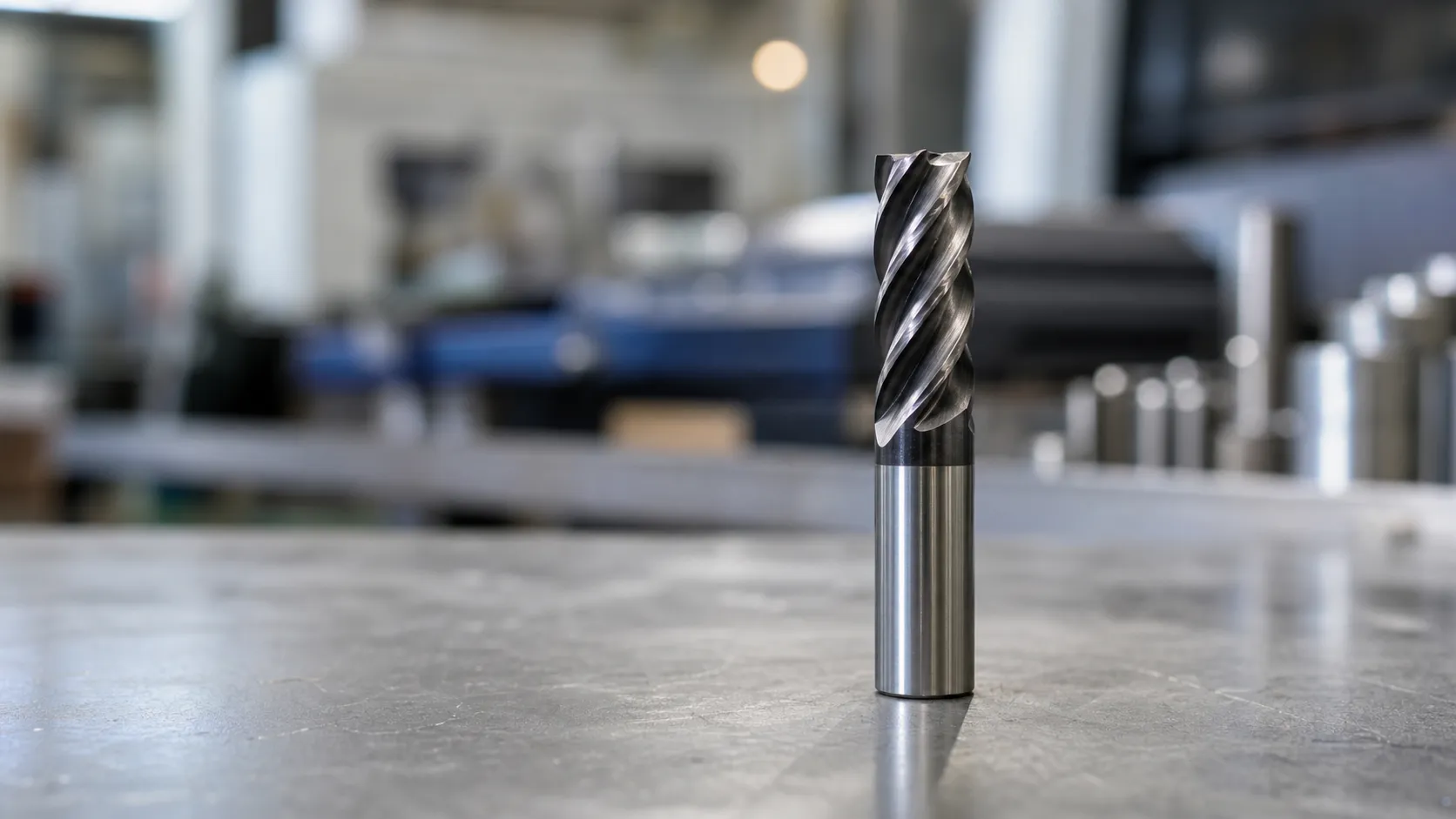
What we can change on a custom end mill
Tell us which dimensions the part fixes and which are open. We propose the rest and explain any trade-off before you approve the tool drawing.
| Parameter | Why you would change it | What we need from you |
|---|---|---|
| Cutting diameter | The slot or wall calls for a size that catalog tools skip | Nominal size and its tolerance from the part drawing |
| Flute length against reach | Only the length that actually cuts needs flutes; extra flute length costs stiffness | Feature depth and the clearance above it |
| Neck relief and long reach | A relieved neck clears the wall above a deep feature, but every added length of neck makes the tool less rigid, so reach is kept to what the part needs | Wall height, clearances, and any clamp or fixture in the way |
| Flute count, helix, unequal pitch | More flutes for finishing in steel, fewer where slots need chip room; unequal pitch or helix to break up chatter | Operation (slotting, side milling, finishing) and any chatter you see now |
| Corner radius, chamfer or ball radius | The tool corner matches the fillet or edge break called out on the part | Radius or chamfer callouts from the drawing |
| Shank and overall length | The tool fits the holder you already run, with stick-out no longer than the part requires | Holder type, shank size, gauge-length limit |
| Coating | Chosen for the work material, e.g. AlTiN-type where heat builds up in steel | Material grade, hardness, wet or dry cutting |
Reach and stiffness pull against each other. A longer neck or a smaller core lets the tool get into the feature, but it also lets the tool deflect, and deflection shows up as a tapered wall or a form that cuts undersize at depth. That is why we ask about the wall above the feature as well as the feature itself.
Special end mill forms, reviewed per drawing
We grind five solid carbide special forms to customer drawings. Each is quoted after drawing review, because whether your version can be held depends on the form tolerance, the reach and the holder.
- Tapered end mills: for draft walls on molds and dies and for tapered slots, where the side angle is ground into the tool instead of built up from many CAM passes.
- Long-neck end mills: a short flute length on a relieved neck reaches a feature below a tall wall or deep in a pocket, without the flex of a full-length flute.
- Dovetail end mills: cut the angled sides of slideways, guides and dovetail locating features after the slot is roughed.
- T-slot cutters in carbide: cut the T-shaped slots in steel and cast-iron machine tables and fixture plates once a straight slot has opened the way for the neck. For the same form in aluminum, a PCD T-slot cutter is available.
- Lollipop end mills: a ball-shaped head on a slim neck reaches back-side edges and hidden faces that a straight tool cannot touch, often on five-axis machines.
When a standard series is the better buy
Order a custom tool only where a standard one would compromise the part. If the feature is plain, a standard series is quicker to source and simpler to restock. The full selection is on the carbide end mills page; the usual cases are below.
| If the job is | Start with |
|---|---|
| Flat floors and straight shoulders | Square end mill |
| Freeform surfaces and fillets | Ball nose end mill |
| A corner that needs a tougher edge than a sharp tip | Corner radius end mill |
| Internal or external threads | Thread mill |
| Deburring an edge or hole entry | Chamfer mill |
| Aluminum or other non-ferrous parts | PCD milling cutters |
Five steps from drawing review to repeat batches
| Step | What happens | Your part |
|---|---|---|
| 1. Drawing review | We check the form against reach, form tolerance, holder and machine, and flag anything that cannot be held | Answer open questions |
| 2. Tool drawing | We send a drawing of the tool with every dimension of the form | Approve it before grinding starts |
| 3. Grinding | Ground on an ANCA TX7+ CNC grinder from carbide rod sourced from CB Carbide, Sumitomo or Guhring; coating chosen for the work material, applied by Oerlikon Balzers | None |
| 4. Form and dimension check | Form, diameters and lengths measured on ZOLLER measuring equipment against the approved drawing | Ask for the check results with the shipment if you need them |
| 5. First tools, then repeats | First tools run on your machine; repeat batches are ground to the same approved drawing revision | Any change goes through a new revision you approve |
Each tool is checked against a drawing you signed off. If a form comes out wrong on the part, you can trace the cause to the drawing, the grind or the setup. If you want the first tools proven on your machine before a larger batch, our sample validation process sets out how we would propose that trial. When the edges wear, custom end mills can be reground at HENTRY. If you plan to regrind, say so in the RFQ so the form can be laid out with that in mind.
Only have the old tool?
A worn or discontinued tool can still be the starting point, and no tool drawing is needed. The tool carries its wear as well as its design, so if you have the part drawing it was cutting, send that too and we can tell one from the other. The route from sample to approved drawing is covered in our guide to replacing a special cutting tool from a sample.
For distributors and own-brand lines
If you resell custom end mills or sell them under your own name, each tool still goes through the same drawing approval. Labels, packaging and part numbers under your brand follow our private-label cutting tools terms; supply arrangements for resellers are set out in the distributor cutting tool program.
Custom end mill RFQ: what to include
Send what you have. Anything missing can be filled in at drawing review.
- Drawing or 3D model of the feature, with the tolerances on the form
- Material grade, hardness and heat treatment
- The current tool, or photos of it, if there is one
- Machine, holder and stick-out
- Operation: roughing or finishing, wet or dry
- Quantity for the first order, and whether repeats are expected
- What goes wrong today: chatter, form wear, breakage
Custom drills, reamers and other special tools that are not end mills start from our custom cutting tools overview. If your line also finishes bores in aluminum or other non-ferrous parts, the PCD reamer is the core of what we make. When the drawing is ready, send it through the custom cutting tool RFQ, and we come back with feasibility notes and a proposed tool drawing for your approval.
Manufacturer FAQ
Do you list retail end mill SKUs?
No. Each custom end mill is quoted from your drawing and process data.
Must I pick a series first?
No. Knowing the closest standard type helps, but the drawing alone is enough to start the review.
Can you make a custom end mill from a worn tool instead of a drawing?
Yes, no tool drawing is needed. Send the old tool, and if you have the part drawing, include it so we can tell wear from the original design. We then send a tool drawing for your approval before grinding.
Can you laser-mark our brand or part number on custom end mills?
Yes. At your request we laser-mark your brand or part number on the tool. Labels and packaging under your brand follow our private-label terms.