
Product Detail
4-Flute Solid Carbide End Mills, Ground to Your Drawing
Solid carbide 4-flute end mills for side milling and finishing in steel, cast iron and stainless, made to your drawing, with 2-, 3-, 5- and 6-flute options reviewed per job.
Solid carbide · 4 flutes · Steel, cast iron and stainless
On the last job the 4-flute end mill left a clean wall. On the next one it went into a full-width slot, chips packed the flutes, and the tool broke partway down.
A 4-flute solid carbide end mill has more edges and a thicker core than a 2- or 3-flute tool, so it holds a straighter wall and a better finish in side milling of steel, cast iron and stainless. The trade-off is chip room: deep full-width slots and aluminum roughing usually need fewer flutes. HENTRY grinds 4-flute end mills to your drawing and cut.
Jump to: Fourth flute · Jobs · Flute count · Geometry and specs · Stainless and reach · Custom · RFQ · FAQ
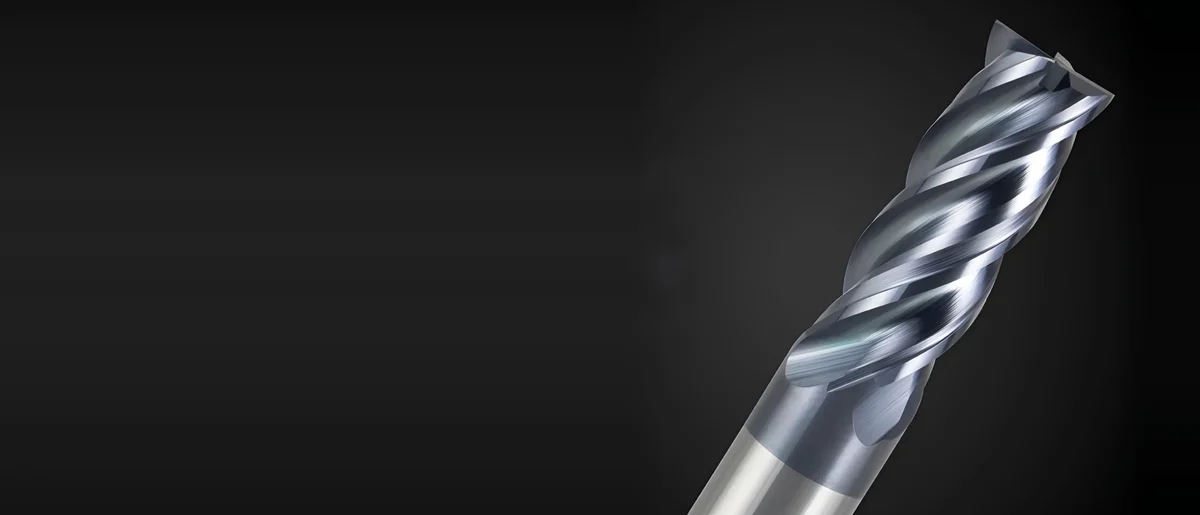
HENTRY chooses the flute count from three things: the material, how wide and deep the cut is, and the coolant on your machine. What ran well on the previous part is a useful data point, and the next part still gets its own review.
What the Fourth Flute Changes
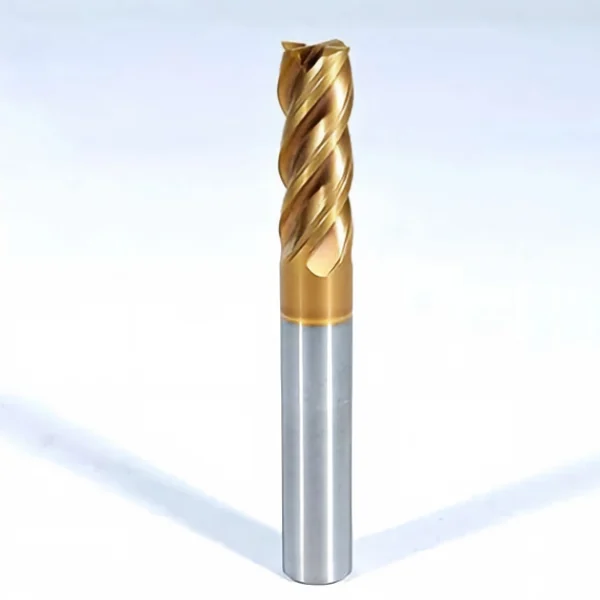
More edges per revolution. Hold the feed per tooth and the table travels faster; hold the table feed and every edge cuts a thinner chip. In both cases the wall is cut more often on each turn of the spindle, which usually leaves a smoother surface.
A bigger core. With four flutes, more carbide stays in the middle of the tool. It bends less when the cut pushes sideways and keeps the wall straighter as reach increases.
Smaller gullets. Each flute valley gets narrower. A side cut leaves one side open for the chip to escape. A full slot closes both sides, and that is the point where a 4-flute tool runs short of chip space.
Where a 4-Flute End Mill Is the Right Call
| Job | 4 flutes? | Watch for |
|---|---|---|
| Side milling and profiling in steel or cast iron | Yes | Moderate radial engagement on long reach |
| Finishing and semi-finishing of walls | Yes | Runout, which cancels the gain from the extra edges |
| Light radial, high-efficiency toolpaths in steel | Yes | Chip thinning; the CAM strategy sets the load on each edge |
| Slots in steel with good chip clearing | Possible | Slot depth, and coolant or air that really clears the slot |
| Aluminum roughing or deep slots | Not first choice | Large, sticky chips that need bigger gullets |
| Heavy full-width slots in gummy stainless | Not first choice | Fewer flutes give the chip room; mention it in the RFQ |
| Long-reach slotting where chips cannot escape | Not first choice | Recut chips and packed flutes |
| Bulk stock removal ahead of a finish pass | Not first choice | Chip load that a roughing profile handles better |
For bulk removal ahead of the finish pass, a roughing end mill breaks the chip up first. In aluminum, fewer and larger flutes work better, or a diamond tool such as our PCD helical end mill.
4 Flutes vs 2, 3, 5 and 6 Flutes
Each added flute brings another edge and a stronger core, and each one takes away chip room. The comparison is qualitative; the count for a given job comes from the material, the engagement and the coolant.
| Flutes | Where it fits | What limits it |
|---|---|---|
| 2 | Aluminum, plastics and full-width slots, where chips need the most space | Thinnest core, so more deflection in side cuts and on long reach |
| 3 | A middle ground for aluminum and for slotting that needs more rigidity | Less chip room than two flutes and fewer finishing edges than four |
| 4 | Side milling, profiling and finishing in steel, cast iron and stainless | Chip room in deep full slots and in aluminum roughing |
| 5 and 6 | Light radial finishing in hard material, where the chips are small | Little chip room, so heavy engagement and slots fall outside their use |
Five- and six-flute end mills are made to your requirements; tell us the material, the cut and the finish you need.
Geometry and Specifications We Set for Your Job
Choose the end shape before the flute count. Our square end mill gives the sharp corner that square shoulders and walls need. A radiused corner adds edge strength, as on our corner radius end mill. The flute count is then set for that shape and the material.
Helix and flute spacing

Equal flute spacing and a constant helix suit stable side cuts. On long reach or thin walls, unequal spacing or a variable helix breaks up the regular rhythm that builds chatter. Helix and spacing are selected to your workpiece material and process and confirmed at drawing review.
Center cutting and entry
Whether the tool is center cutting, and whether it can ramp or plunge, depends on the end geometry and is confirmed at drawing review. Tell us how the tool enters the cut: from the side, by ramping, by helical interpolation or by plunging.
Reach and neck
Rigidity drops quickly as reach grows, so check the stickout and holder first and keep radial engagement moderate. A reduced neck and other non-standard forms are made as custom end mills.
Coating
Coating is selected to your tool and workpiece, and uncoated tools are supplied when your process calls for them. When heat at the cutting edge is the main problem, our AlTiN coated end mill page covers how we choose the coating.
Standard, customizable and engineering-confirmed specifications
Four flutes and solid carbide are fixed. End form, shank, diameters, lengths, tolerance, helix and grade are set to your drawing and confirmed at drawing review.
| Feature | Standard range | Customizable range | To be confirmed by engineering |
|---|---|---|---|
| Flutes | 4 | 2 or 3 flutes where the cut needs them; 5 and 6 flutes made to your requirements | — |
| Tool material | Solid carbide | Grade selected to your workpiece material and process | Grade, grain size and cobalt content, confirmed at drawing review |
| End form | — | Square end, as pictured, or corner radius to your drawing; tapered, long-neck, dovetail, T-slot and lollipop forms as custom end mills | Corner radius sizes, confirmed at drawing review |
| Cutting diameter D | — | To your drawing | Confirmed at drawing review |
| Length of cut Lc and overall length L | — | To your drawing | Confirmed at drawing review |
| Shank diameter d and shank style | — | Plain cylindrical shank, as pictured, or other shank styles to suit your holder | Shank tolerance, confirmed at drawing review |
| Helix and flute spacing | — | Equal or unequal spacing, constant or variable helix, selected to your workpiece material and process | Helix values, confirmed at drawing review |
| Center cutting | — | To your drawing | Confirmed at drawing review |
| Diameter tolerance | — | To your drawing | Confirmed at drawing review |
| Coating | Selected to your tool and workpiece | Coated or uncoated, as you require | — |
| Workpiece materials | Side milling and finishing in steel, cast iron and stainless | Hardened material assessed from the measured hardness | Suitability for a hardened part, confirmed at drawing review |
| Laser marking | Your brand or part number, on request | — | — |
| Regrind and recoat | Regrinding at HENTRY | Recoating after the regrind, as you require | — |
- D: cutting diameter
- d: shank diameter
- Lc: length of cut
- L: overall length
- Reach: how far the tool extends from the holder face to the deepest surface it has to machine, which can be longer than Lc
Catalogs letter these dimensions in different ways, so your drawing is the reference.
Running a 4-flute end mill that packs, chatters or chips at the edge? Send the drawing, the material and the cut, and we propose the flute count and geometry for your approval.
Stainless Steel, Hardened Material and Long Reach
Stainless steel makes two competing demands. Because it work-hardens, every edge needs a chip thick enough to get under the layer the previous pass hardened, so the feed has to stay steady and the edge must never rub; four flutes keep the table feed up at that chip load. Because its chips are tough and sticky, it also needs space to clear them. The deciding factors are radial engagement, coolant and chip evacuation: a light side cut with good coolant suits four flutes, and a deep full slot often goes better with fewer.
On long reach, unequal flute spacing or a variable helix helps break up chatter. Tell us the stickout and the holder so the geometry can be set for them.
For hardened material, send the hardness and where it was measured. We then confirm whether a 4-flute tool suits the cut, or whether a 5- or 6-flute tool made to your requirements is the better fit. Other end shapes and tool types are listed in our full range of carbide end mills.
Custom 4-Flute End Mills, Own-Brand Lines and Repeat Supply
Non-standard diameters, lengths of cut, shanks and end forms are ground to your drawing. At your request we laser-mark your brand or part number on the tool, which suits distributors who sell under their own name. Worn tools can be reground at HENTRY, and whether they are recoated after the regrind is your call. New designs run through sample validation on your part before repeat orders.
Tapered, long-neck, dovetail, T-slot and lollipop cutters, and the steps from drawing to delivery for non-standard tools, are handled by our custom end mill manufacturer service. If the same part also needs drilled and reamed holes, the end mills can be quoted together with those tools; our article on milling on a hole-making line shows where milling fits around those operations.
4-Flute End Mill RFQ: What We Ask For
You can explain the job in plain words or send the CAM toolpath; cutting data is optional.
- Material being milled and its hardness
- Operation: slotting, side milling or finishing, with radial and axial engagement
- Slot width and depth, where there is a slot
- Coolant delivery: flood, MQL, air blast or none
- Flute count of the tool you run now, and the problem: packing, chatter, a broken tool or poor finish
- Machine, holder and stickout
- Dimensions D, d, Lc, L and reach, or the drawing if you have one
- End form: square or corner radius, with the radius value
- Whether you need laser marking, and whether you plan to regrind
- Batch size and expected repeat orders
4-Flute End Mill FAQ
Is a 4-flute end mill good for slotting?
In steel, yes for shallow slots where the chips are cleared by coolant or air. For deep full-width slots or sticky materials, a 2- or 3-flute tool gives the chips more room.
Is a 4-flute end mill good for stainless steel?
For side milling and finishing with steady feed and good coolant, yes. For heavy full slots in gummy stainless, fewer flutes usually clear the chips better. Tell us which cut you run.
Can I use a 4-flute end mill on aluminum?
For light finishing passes it can work. For roughing and slots, the chips are large and sticky, so fewer flutes or a PCD tool is the better choice.
What is the difference between a 3-flute and a 4-flute end mill?
A 3-flute tool has more chip room and is common for aluminum and slotting. A 4-flute tool has a thicker core and one more edge, which suits side milling and finishing in steel and cast iron.
Do you make 5- and 6-flute end mills as well?
Yes. Five- and six-flute end mills are made to your requirements, usually for light radial finishing in hard material. Send the material, the cut and the finish you need.
Send the Drawing or the Tool You Run Now
Send the drawing, or the tool you run now, with the material and the cut. We come back with a flute count and geometry, and you approve them before the order.
Related: 2-flute vs 4-flute end mills