
Short answer. CFRP (carbon-fiber reinforced polymer) fails by delamination, fraying and heat more often than by “not enough hardness.” PCD can help when abrasive fibers wear carbide too fast, but it is not a universal upgrade and it does not guarantee higher output. XRZ treats CFRP as custom / adjacent work; metal holemaking for automotive and EV remains the primary path.
Failure modes to name before choosing a tool
- Delamination at entry/exit
- Fiber splintering and poor edge quality
- Rapid abrasive wear on the cutting edge
- Heat and resin smear under poor chip or speed control
These are process conditions—not slogans. Fix support, geometry and parameters before swapping edge materials.
When PCD is considered vs carbide
Consider PCD when abrasive wear dominates and the operation (trim, mill, or drill) can keep a stable engagement. Stay on carbide for trials, unstable fixtures, or when the failure mode is mainly delamination from support—not edge wear. For aluminum NEV bores, do not use this page—open NEV pump bearing hole PCD reaming or aluminum EV housings.
What to send for a CFRP RFQ
- Operation type (trim / mill / drill / other)
- Layup thickness and fiber orientation notes if known
- Machine, holder, coolant or dust extraction
- Current tool and failure photos
- Tolerance / edge quality definition
General drawing-based tooling: custom cutting tools.
Boundary: metal EV holes stay on other URLs
Pump bearing seats, motor housings and powertrain holes are covered by Solutions and PCD reamer Knowledge—not this CFRP article. Start at PCD reamer technical center for metal precision holes.
CFRP/Al Stack Entry Risks: Delamination, Fiber Breakout, Al Smear
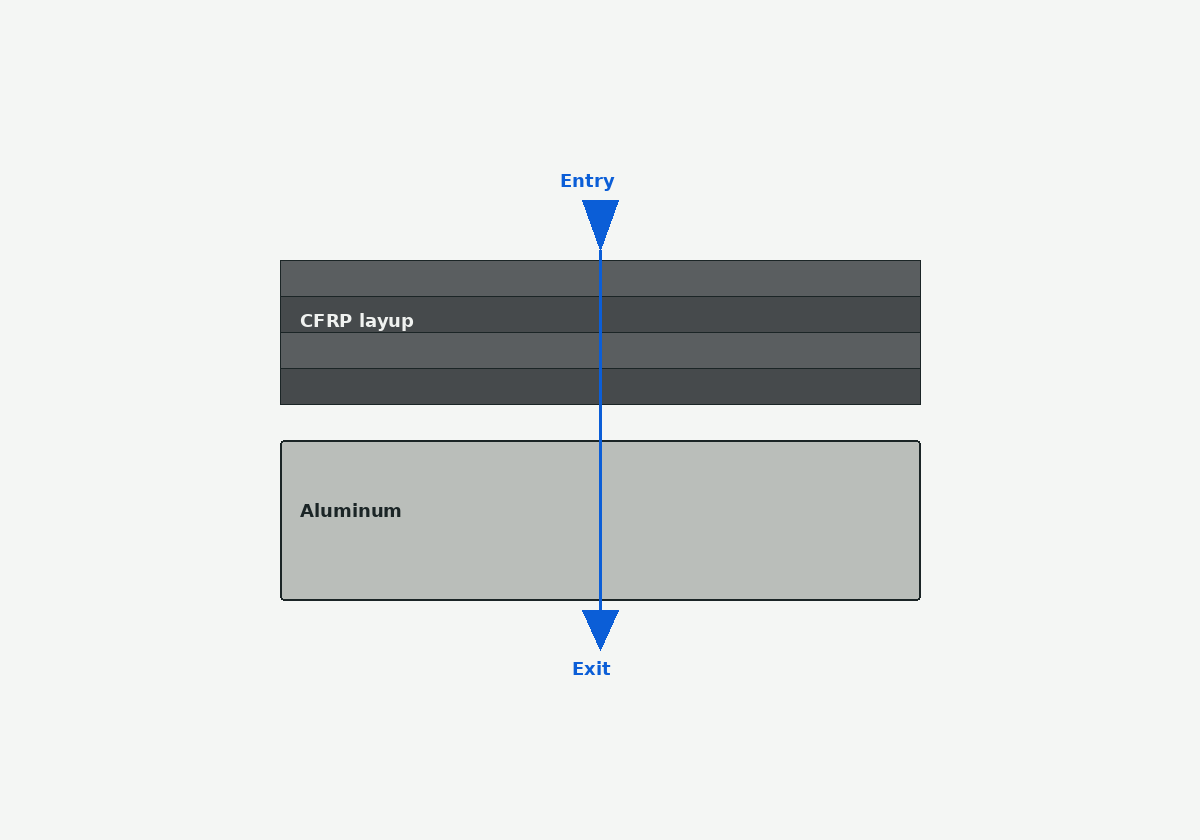
A CFRP/aluminum stack is not “CFRP plus a soft layer.” Entry and exit sides load the edge differently, and the aluminum face can smear while the composite face delaminates or breaks fibers out.
| Risk | What the part often shows | Process / tool note (boundary) |
|---|---|---|
| Delamination (entry or exit) | Ply lift, fuzzy rings, thickness swell at hole | Support the exit; control first-contact load; do not “push through” on hope |
| Fiber breakout | Uncut or fractured fibers at exit | Exit support, feed discipline, and edge sharpness matter more than brand name |
| Aluminum smear | Smeared Al on wall or tool face; size scatter | Adhesion/coolant and edge condition—stack order decides which face sees smear first |
When does PCD enter the discussion? When abrasive carbon wear, hole quality targets, and stable fixturing make carbide changeovers dominate—and the stack order is known. PCD does not erase bad exit support or unknown layup. Milling cutters, drills, and reamers are different tool families; pick the operation first, then edge material. Soft product path when finishing holes in composite/Al work: Custom PCD Reamer (finish) and application review via Custom Cutting Tool RFQ—not a full catalog dump.
Selection Tree: Pure CFRP vs Stack vs Metal Holes
| Workpiece | First question | Tooling direction (heuristic) | Soft link |
|---|---|---|---|
| Pure CFRP | Hole quality vs delam/breakout risk; volume | PCD or coated carbide per abrasion and support; RFQ with layup | This page + RFQ |
| CFRP/Al (or Al/CFRP) stack | Stack order, thicknesses, exit support, hole Ø | Treat as a system: entry face, interface, exit face—not one material grade | This H2 · RFQ fields below |
| Metal holes (Al / EV housings, etc.) | Si%, tolerance, create→finish route | Do not reuse CFRP rules—use metal bore map / Si% pages | Automotive Aluminum Bore Tool Map · Aluminum Silicon Content: PCD vs Carbide Reaming · EV components application |
Custom or mixed routes: Custom cutting tools overview (boundary only—do not dump that long page into this article).
RFQ Fields for Stack Work
Send at least:
- Layup / fiber type (or mark unknown) and stack order (which face is entry)
- Thickness of each layer and total stack height
- Hole diameter, tolerance, and through vs blind / countersink notes
- Exit support method (or “none—problem”)
- Machine, holder, coolant/MQL, and current defect photos (delam / breakout / smear)
- Annual volume intent and whether milling, drilling, or reaming is the primary op
Handoff: Custom Cutting Tool RFQ. Soft product CTA only where the op matches—e.g. Custom PCD Reamer for finish holes after a controlled create path.
Stack work fails in photos more often than in slogans. Send the layup and stack order; XRZ aligns the drawing, writes sample acceptance before first metal, and stays on the first-off until delam, breakout, or smear has a name (sample validation · RFQ).
---
Frequently asked questions
Can PCD tools machine CFRP?
PCD is sometimes considered for abrasive fiber wear in trimming or drilling, but geometry, support and heat control matter as much as the edge material. XRZ reviews CFRP as custom work with clear limits.
Will PCD double CFRP production efficiency?
Is CFRP XRZ’s primary focus?
No. XRZ’s core is precision holemaking in metals—especially aluminum automotive/EV bores with PCD reamers and carbide drills. CFRP is adjacent custom support.
How does CFRP/aluminum stack change tool choice vs pure CFRP?
A stack adds an interface and two exit/entry behaviors: composite delam/breakout plus aluminum smear. Tool choice follows stack order, support, and which face sees first contact—not a single “CFRP grade” rule. Pure CFRP still needs exit control; stacks need both faces described in the RFQ.
What stack data should an RFQ include?
Layup/thickness, stack order, hole Ø and tolerance, exit support, machine/holder/coolant, and defect photos (delam, breakout, smear). Send via Custom Cutting Tool RFQ.
Discuss a custom tool → · Contact · PCD milling cutters
Author: Kevin Zeng (CEO). Engineering review: Jiack Liu (Engineering Director). Updated 2026-09-13. Efficiency multipliers are intentionally omitted.