
Product Detail
PCD Indexable Face Milling Cutter
Staged PCD edges for wide aluminum deck coverage and crib logistics.
The deck is wider than any solid cutter your spindle can carry. Or it fits, but every re-tip sends the cutter out of the plant while the line waits for it to come back.
HENTRY builds PCD indexable face mills for wide aluminum faces: cartridge bodies with replaceable PCD edges, sized from face width, spindle interface and finish requirement. Your tool room replaces and sets the edges on site.
Within HENTRY, PCD milling supports the holemaking lines our business is built on; the PCD milling cutter page lists the full milling range.
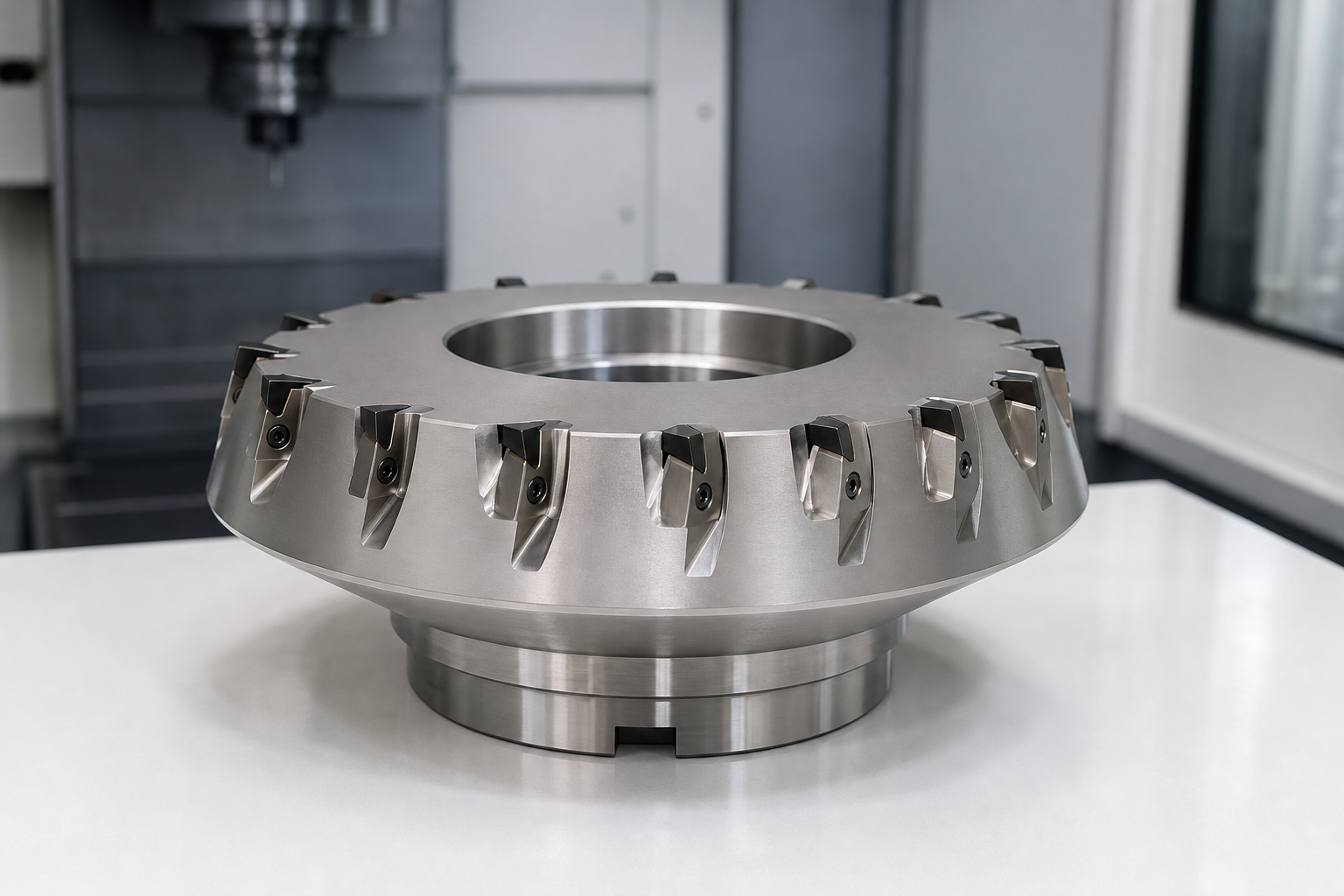
What sits on a PCD cartridge face mill
Body. Aluminum or steel. An aluminum body keeps a large diameter light enough for the spindle and tool changer; steel gives extra stiffness where the diameter allows the weight.
Cartridges. Each PCD-tipped cartridge sits in its own pocket, held by a clamp screw, with an axial adjusting screw and, on some designs, a radial one.
Finishing edge. A wiper cartridge, or several, handles the last pass over the deck.
Pitch. Cartridge count follows face width, spindle power and chip space: a close pitch for finishing, a wider one where chips need room or power is limited.
Coolant. Channels through the body to each pocket where the spindle supplies through-coolant.
Manufacture. Cartridge edges are wire-eroded on VOLLMER QWD760 machines and ground on EWAG, and bodies are inspected on ZOLLER.
Setting the edges: what your tool room needs
On this cutter type, the finish depends on how evenly the edges sit in the axial direction. The highest edge does the finishing, and a cartridge set high leaves a mark on every revolution.
Setting is done on a presetter. The cartridge is clamped lightly, its edge height is read against the reference edge, and the axial screw is turned until the two match. Then the clamp screw is tightened and the reading is taken again, because tightening can move the edge. Radial setting, where the design has it, matters less for the finish and more for sharing the chip load evenly around the body. We document the routine for each cutter: which cartridge is the reference, where the wiper sits, the tightening sequence, and the checks to repeat after a change.
The main reason to choose this tool is a shelf of spare cartridges. A chipped or worn edge is replaced in your tool room and the body goes back into the machine without leaving the plant. Worn cartridges return to HENTRY for re-tipping in batches, as part of our design-to-regrind service.
Balance and cartridge retention at high spindle speed
Aluminum face milling usually runs at high spindle speed, and a large-diameter body carries a lot of energy when it spins. Two things are reviewed on each design: balance of the assembled cutter with all cartridges fitted, and whether the clamping holds each cartridge against centrifugal force at the intended speed. Bodies are balanced on ZOLLER equipment. When your specification calls for a balance grade or the ISO 15641 safety requirements, the design is checked against it. Each body is marked with the maximum speed set for that design. When cartridges are changed one at a time, the balance check is repeated if your specification asks for it.
Configurations
| Item | What we can build | Set by |
|---|---|---|
| Cutting width | Sized to the deck on the print | How many passes you accept; spindle limits |
| Body | Aluminum for large, light bodies; steel where stiffness wins | Diameter and tool-changer load |
| Pocket layout | Close or wide cartridge spacing | Deck width, spindle power, chip room |
| Finishing edge | Wiper cartridges, one or several | Surface callout on the deck |
| Mount | Arbor bore (arbor data: see the shell-mill row below) or a spindle-specific shank such as HSK | Machine |
| Coolant route | Outside the body, or channels to each pocket | Whether the spindle delivers through-coolant |
| Diamond grade | Fine-grain for surface quality; wear-resistant grades for high-Si castings | Alloy |
| Spares | Cartridge sets for your tool room; returned cartridges re-tipped | Your stock plan |
Indexable or one-piece?
If the part is a sealing or joint face and the rejects point to edge-height variation between cartridges, a one-piece ground body removes that variable: see the PCD monoblock face mill, which also compares the two types. Wide structural decks, with spare cartridges kept in your tool room, stay on this page.
Faces this cutter does not cover
Diamond edges suit aluminum and similar nonferrous alloys only. Decks in steel or cast iron belong on carbide inserts.
| If the deck or part is… | Open |
|---|---|
| Steel or cast iron | Carbide indexable face milling cutter |
| Arbor bore, keys or bolt circle unknown | Shell mill |
| Face and bore on one part; sequence or datum question | Face milling with PCD reaming on the same part |
| Failing on hole diameter or bore finish | PCD reamer (see the closing paragraph) |
RFQ checklist for a wide-deck PCD face mill
- Deck width × length, and how much stock comes off per pass
- Aluminum grade; cast or wrought; Si content if you have it
- Print callouts for flatness, surface roughness and waviness, copied as written
- Ports, cross holes or thin walls that interrupt the cut
- Spindle interface, top speed and available power on the machine
- Coolant delivery or MQL
- How the part is fixtured and clamped
- Current cutter, plus photos of the finish and any burr where edges exit the deck
- Your tool room: who sets edges today, and whether there is a presetter
- Lot size or yearly quantity; whether you want a sample trial
A first cutter can be run on your own parts before any production order, following the steps in our sample validation process. Hole problems are handled on the PCD reamer page, which is HENTRY's core line. For the deck itself, upload the drawing and spindle details via the custom cutting tool RFQ; our engineers return a suggested body and pocket layout, and nothing is built until you approve it.
Deck logistics FAQ
Retail blister packs?
No. Cutter bodies are quoted from the deck drawing and spindle data, and spare cartridge sets can be quoted with each body.
Need arbor Ø first?
Only if the cutter mounts on an arbor and that data is missing. Confirm the arbor mounting data on the shell-mill page, then come back here to plan the PCD edges.
Can our tool room reset the PCD edges?
Yes, with a presetter and the setting instruction we supply for the cutter. Tell us in the RFQ what setting equipment your tool room has.
Is this cutter for steel or cast iron decks?
No. Diamond edges are limited to aluminum and similar nonferrous alloys. Steel and cast-iron decks go to the carbide indexable face milling cutter.