
Product Detail
PCD Bell & Profile Milling Cutter
PCD form cutters ground to one fixed profile, such as a bell-mouth entry or a radius stack, for repeat aluminum parts.
The contour checked out on the first workpiece. By the end of the batch, the radius where the bell mouth runs into the bore has moved, and a small step has appeared at the transition, one that nobody put on the drawing.
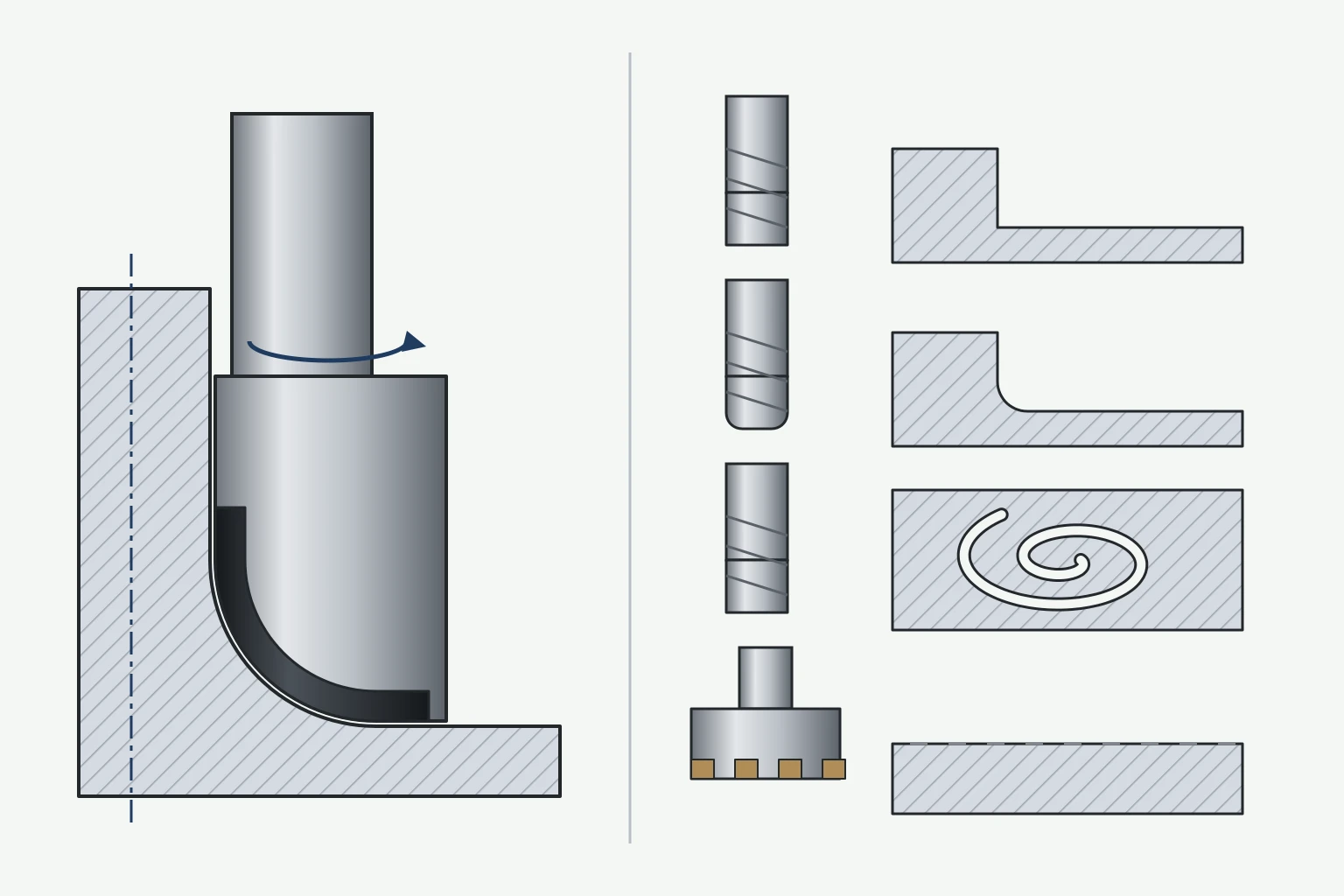
A PCD bell or profile milling cutter is a form tool. Its edges are ground to the finished contour on your drawing, so one pass around the feature cuts the entire profile. PCD holds that contour in abrasive aluminum, where carbide versions wear out of true. Each tool is built for one drawing and one feature.
Like the rest of our milling tools, these support the drills and reamers that are our main line.

Form cutter or CAM path
The alternative is to generate the contour with a standard ball or square end mill on a programmed 3D path. That works, and it is flexible, but the profile is assembled from many small passes. Each pass leaves a scallop or a step, smoothing them out means adding passes and cycle time, and the result depends on the program, how accurately the machine follows a long string of tiny motions, and the state of the tool's edge by the end of the batch.
A form tool carries the profile in its own edge. The machine only has to take it around the feature, so the contour repeats from part to part while the edge holds, and the cycle is short. What you give up is flexibility.

What a form tool commits you to
The tool carries one contour and only that one. Any revision to the profile on your drawing, such as a new radius, a step moved along it or a different angle where it meets the face, means grinding a new tool. That makes it worth it for repeat work in steady volume, and a poor choice for one-offs, prototypes or components whose design is still moving. For those, a PCD ball nose end mill on a 3D path keeps the design open.
Why the edge is PCD
Along a contoured edge, points farther from the axis travel faster and meet more abrasive silicon than points close to the center, so a carbide tool of this kind wears unevenly. Its outline distorts instead of simply growing or shrinking: one arc opens up while the rest stay true to the drawing. Polycrystalline diamond stands up to that abrasion, so the entire profile holds together better over the run, and less aluminum builds up on the edge.
PCD profile tools are limited to aluminum and other non-ferrous workpieces. They are not used on steel or cast iron, because at cutting heat the carbon in diamond diffuses into iron.
What the drawing must show
We grind the tool from your drawing, so it has to define the contour completely:
- the finished cross-section, with a dimension on every radius, angle and step
- tolerances on the profile itself, not only on the end dimensions
- the datum the profile is measured from
- how the profile runs into the surfaces on either side, such as a bore, a face or a wall
A photo or an old tool helps us understand the job, but wear has already changed its edge, so we work from a drawing or a measured contour; we explain that process in how to replace a special tool when you only have the old sample.
Information to include with the RFQ
- Cross-section drawing, or a 3D model with the profile dimensioned
- Alloy, with any silicon note from the drawing
- Volume, and how often the job repeats
- Machine, holder and spindle direction
- What is wrong with the current result: radius off, a step where surfaces meet, a burnished face
- The tool you use today, if any
Our other PCD series can be found in the PCD milling cutters overview. If the feature is the progressive wrap pocket of a scroll compressor plate rather than a single closed profile, the PCD scroll end mill is built for that path. Send the drawing and the alloy via our custom cutting tool RFQ, and we will put a tool design forward for your review.
PCD bell and profile milling cutter FAQ
What is a bell profile milling cutter?
A milling cutter whose edges are ground to one fixed profile, such as a bell mouth or a stack of radii, so it cuts that entire contour at once. A bell mouth is the flared, rounded entry of a bore or port.
Can you make a form cutter from a photo or an old tool?
Both help us understand the feature, but we need a drawing or a measured cross-section to grind from. Wear has usually changed an old tool's edge already.
When does a form cutter make more sense than a ball nose?
When the profile is settled on the drawing and the job runs in volume. The tool cuts the contour in a single pass, where a standard tool has to assemble it pass by pass. Designs still in development are better left to programmed 3D paths.
What happens if our part drawing changes?
If the profile itself changes, a new tool has to be ground to the revised contour. Changes to other features do not affect it.