
Product Detail
Countersink
Carbide countersinks for screw/rivet head seats that must gauge flush—not general deburr.
Screw / rivet head seats
Fastener seats that must gauge flush
Use a carbide countersink when a screw or rivet head must sit flush (or subflush) at the first-article gauge check, the print shows a countersink symbol tied to a fastener standard, and a general “break edges 0.2×45°” note is not enough.
A carbide countersink cuts a fastener seat, with the angle and major diameter controlled so the head passes flush inspection. It adds a seat to a hole that is already made; general deburring goes to a chamfer mill, and PCD hole-mouth work on aluminum goes to PCD tooling. If hole size or position is still causing scrap, fix that first with the solid carbide drill or PCD reamer.
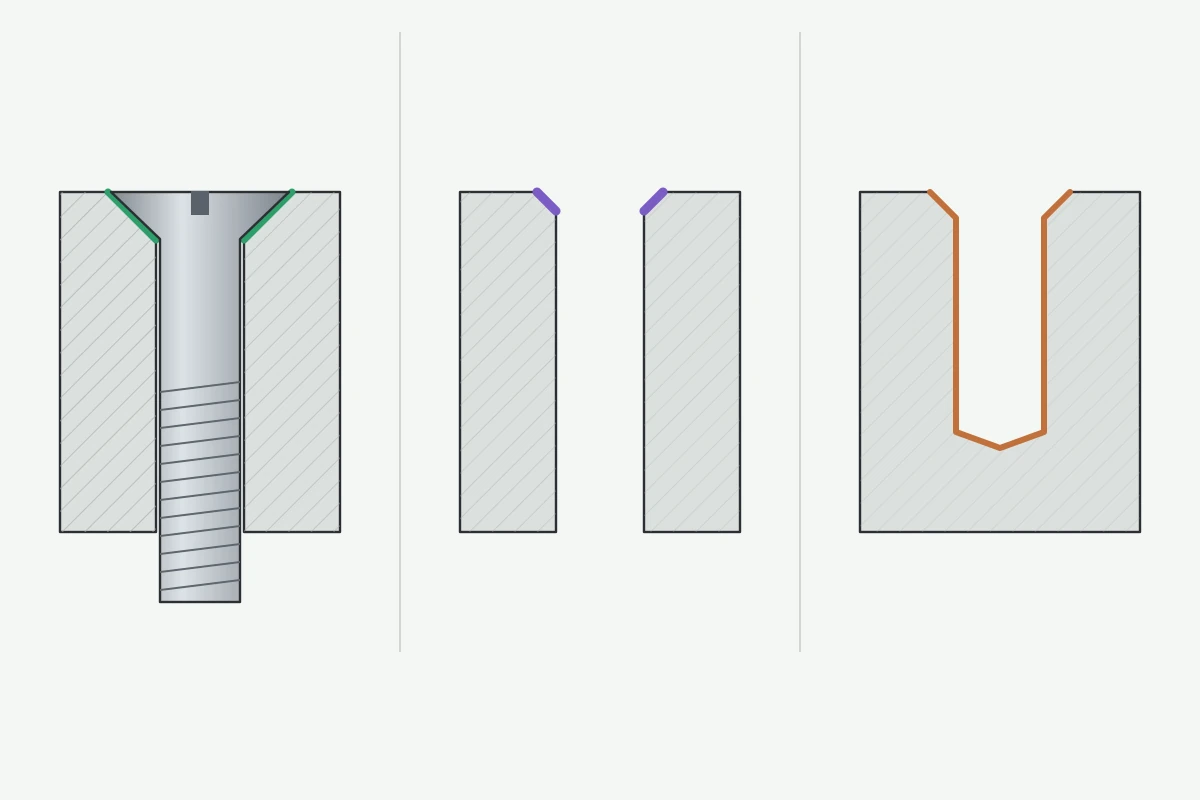
Countersinks exist so fastener heads seat to a screw/rivet standard. Acceptance is angle + major Ø / depth to flush—not a free-hand edge break. If the print only says “break edges,” open chamfer mill. If the job is aluminum hole-mouth PCD after drill/ream, open PCD chamfer & spotface.
Applications / when to use
Use a countersink when:
- Print shows a countersink symbol or fastener standard (82° and 90° seats are common; take the angle from your standard)
- Head must pass flush / subflush gauge or go/no-go on the line
- Pilot hole is already sized (or will be sized) for the fastener shank
- Material is typically steel, stainless, or CI seats on ferrous parts—state Al separately
- Seat chatter or angle-miss is the current failure—not bore diameter scrap alone
Related reading: Milling as a Supporting Process on Holemaking Lines.
When it is not the right tool
| Need | Go instead |
|---|---|
| 0.1–0.5 mm × 45° (or similar) edge break / deburr only | Chamfer mill |
| Aluminum hole mouth / clamp pad with PCD | PCD chamfer & spotface |
| Create the pilot / pierce | Solid carbide drill |
| Finish bore size / form | PCD reamer |
| Integrated drill + ream + edge on one custom Al body | Discuss via combination drill-reamer + RFQ |
A countersink cuts the seat a fastener head is gauged against; a plain edge break belongs on the chamfer mill. When heads fail the flush gauge, check the seat angle and depth first, because a sharper deburr will not fix it. To tell a seat callout from an edge-break callout, see countersink vs chamfer mill.
Materials gates
| Gate | Guidance |
|---|---|
| Steel / stainless / CI | Main use: seats on ferrous parts |
| Aluminum / high-Si Al | Consider PCD hole-edge tools when abrasive wear ruins carbide seats mid-shift. |
| Soft / gummy materials | Tell us about any built-up edge or chatter history |
| Heat-treated seats | Send the hardness with the RFQ |
We do not keep a catalog grid of every screw angle; the angle and Ø come from the fastener standard on your print.
Spec / geometry boundaries
| Boundary | What to confirm | Why |
|---|---|---|
| Head angle | From screw/rivet standard or explicit print angle | Acceptance criterion #1 |
| Major Ø / depth to flush | Print or gauge note | Sets seat envelope |
| Pilot Ø | Already drilled? tolerance? | The seat can only be as good as the pilot hole; a countersink will not fix a bad pilot |
| Gauge method | Flush gauge, go/no-go, optical | Quote matches how you accept |
| Single-flute vs multi-flute preference | If known from chatter history | Noted on the RFQ as a preference |
| Coolant / chip exit | Blind vs through; flood notes | Chatter and burn often start here |
Validation / RFQ fields
| Field | Acceptable evidence |
|---|---|
| Fastener standard or angle + Ø | Print callout, standard name, or sketch |
| Pilot Ø and depth to seat | Section; current drill size |
| Material being seated | Exact grade |
| Gauge / acceptance notes | Flush / subflush / go-no-go |
| Chatter or angle-miss history | Photos, scrap notes |
| Holder / runout | Assembled condition |
| Volume / sample intent | Batch or annual; sample validation yes/no |
Countersink FAQ
Print only asks for a 45° deburr—same tool?
No. A 45° deburr is a job for the chamfer mill; a countersink is accepted on fastener-seat geometry.
Aluminum PCD hole-edge after ream?
Use PCD chamfer & spotface. That page covers PCD hole-edge tools for aluminum.
Do you list every 82°/90° SKU with prices?
No. We quote each countersink through RFQ from the fastener seat geometry and pilot notes.
Pilot hole is wrong—will a countersink fix diameter?
No. Correct the drilled or finished hole first with the solid carbide drill or PCD reamer.
Screw standard or angle + Ø listed?
Start the Custom Cutting Tool RFQ. Countersink RFQs start from the fastener seat geometry. If the flush gauge or chatter shows a problem at first article, we follow it through the Sample Validation Process.