
Product Detail
Flat Bottom Carbide Drills for Blind and Interrupted Holes
Flat-bottom carbide drills for blind floors, inclined entries and interrupted holes, selected by material, L/D, coolant and chip-evacuation conditions.
APPLICATION SELECTION · CUSTOM SOLID CARBIDE
Quick Answer
Choose a flat bottom carbide drill when the finished hole needs a controlled flat or near-flat floor, when a conventional drill point would add unwanted depth, or when an application-specific flat drill can simplify an inclined-entry, counterbore or interrupted-hole operation. Start with the required floor shape, then check entry and exit conditions, workpiece material, hole L/D, coolant delivery and chip escape before selecting the tool.
A flat bottom drill is still an axial holemaking tool. It should not automatically replace a twist drill for ordinary through holes, an end mill for pocketing or lateral interpolation, or a spot drill for shallow starting and chamfering. HENTRY reviews drawing-based solid carbide designs around the complete application rather than treating a 180-degree point as a universal solution.
CTA: Send the hole drawing and machining conditions for an application review.

Choose the Tool from the Hole Feature
The first selection question is not “Do I need a 180-degree point?” It is “Which finished feature must the tool create, and how does the cutting edge enter and leave the material?”
| Hole or feature | Why a flat-bottom drill may fit | What must be checked first |
|---|---|---|
| Blind hole with a seating floor | Reduces the pointed-bottom remnant and may remove a secondary floor-finishing operation | Floor flatness definition, corner condition, usable depth and bottom clearance |
| Counterbore or spotface-like axial feature | Can create a cylindrical diameter and floor in an axial cycle | Whether lateral correction is required and whether an end mill is the better process |
| Hole entering an inclined or curved surface | A suitable flat drill can reduce the centering problem of a conventional point | Entry angle, first-contact load, tool rigidity, runout and reduced entry feed |
| Cross hole or interrupted exit | Application-specific edge geometry can manage the interrupted engagement | Breakthrough position, unsupported edge, burr direction, chip escape and feed transition |
| Pilot for a subsequent drill | A controlled pilot floor can support the next drill in the intended sequence | Pilot diameter, concentricity, contact sequence and downstream drill geometry |
| Ordinary through hole | Usually no floor benefit | A conventional carbide twist drill is often the simpler choice |
The drawing should state whether “flat bottom” means a functional seating surface, a maximum residual cone, a corner-radius limit, or simply less point depth. Those requirements lead to different cutting-edge and corner designs.
Flat Bottom Drill vs Twist Drill, End Mill and Spot Drill
| Tool | Primary job | Best-fit condition | Boundary |
|---|---|---|---|
| Flat bottom carbide drill | Axial holemaking with controlled floor geometry | Blind floors, axial counterbores, selected inclined entries and interrupted features | Not intended for general cross-feed or pocket milling |
| Conventional carbide twist drill | Efficient axial hole creation | General blind and through holes where a conical floor is acceptable | Leaves a point-shaped bottom and needs stable entry support |
| End mill | Pocketing, interpolation and lateral material removal | Flat floors that also require side cutting, diameter correction or open access | May be less efficient than drilling for a deeper enclosed axial hole |
| Spot drill | Starting location and optional chamfer | Shallow starting feature before a drill | Does not create the full-depth finished hole floor |
Use the carbide drill bits selection hub when the correct drill family is still unclear. Use the custom solid carbide drill page when the requirement has progressed to geometry, coolant, coating, inspection and manufacturing review.
Inclined and Curved Entry Surfaces
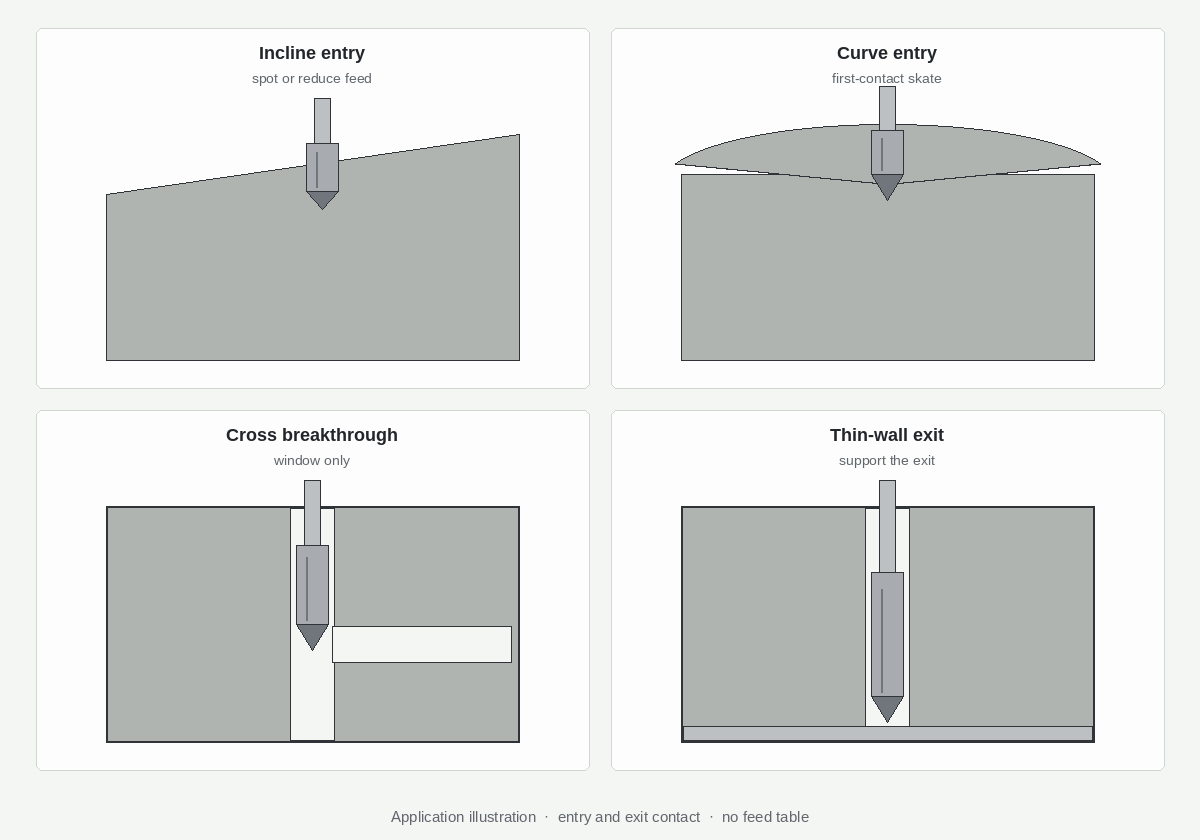
On an inclined or curved entry, one side of the cutting edge contacts the workpiece first. The initial asymmetric load can push the drill sideways, increase edge chipping risk and enlarge the entrance before the full diameter engages.
A flat-bottom geometry may help, but the safe process depends on the actual entry angle, diameter, stickout, machine rigidity and material. Entry feed commonly needs to be treated differently from the full-engagement feed; HENTRY should define that transition during application review instead of publishing one universal reduction. If the surface is highly irregular or the tool cannot establish stable axial contact, spot-facing or milling the entry may remain the safer route.
For a deeper treatment of entry, exit and thin-wall behavior, see Carbide Drilling on Inclines, Cross Holes and Thin Walls.
Blind Holes and Functional Hole Floors
Blind-hole depth must be defined from the functional floor rather than from the deepest point of a conventional drill cone. A flat-bottom tool can reduce unnecessary axial penetration, but it does not make bottom clearance, chip packing or corner geometry disappear.
Send these floor details with the drawing:
- finished diameter and usable cylindrical depth;
- floor flatness or maximum residual center feature;
- sharp corner, controlled radius or relief requirement;
- bottom-wall thickness and breakthrough risk;
- whether the floor seats a plug, fastener, seal or component;
- available coolant route and chip-evacuation direction.
If the hole is deep enough that chips must travel a long distance back through the flutes, floor geometry alone will not solve the process. Coolant delivery, flute volume and chip formation become the controlling questions.
Cross Holes and Interrupted Cutting
When the drill breaks into an existing bore, slot or cavity, the cutting edges lose support at different times. The tool may see a rapid change in cutting load while chips and burrs are pushed toward the intersection.
The review should identify the exact breakthrough window, intersection angle, wall thickness and burr-sensitive side. A flat-bottom drill may be appropriate when its edge support and corner design suit the interrupted contact, but the process may still require a controlled feed transition, internal coolant or a separate deburring operation. Do not assume that “flat” automatically means burr-free or immune to edge damage.
Select by Material
Aluminum Alloys
Aluminum drilling usually puts more emphasis on chip space, flute surface, edge sharpness and adhesion control. In a blind flat-bottom hole, long chips can collect at the floor unless they are broken and evacuated. Review alloy grade, silicon content, casting skin and coolant route rather than selecting only by diameter. See Aluminum Carbide Drills for CNC Holemaking for the material-specific route.
Carbon and Alloy Steel
Steel applications require a balance between cutting-edge strength, heat control, coating and chip formation. A sharp but weak corner can fail during inclined entry or interrupted breakout, while an overly protected edge can increase cutting forces. The correct compromise depends on hardness, surface condition and machine stability.
Stainless Steel
Stainless steel raises heat and work-hardening risk when the edge rubs or the feed becomes unstable. Coolant access, cutting continuity and chip evacuation must be reviewed together. A flat-bottom geometry is not a substitute for a stable feed and rigid setup.
Cast Iron and Hardened Materials
Cast iron and hardened-material applications need separate engineering review for substrate, edge preparation, coating, dust or chip behavior and machine capability. HENTRY should confirm commercial and manufacturing scope at quotation before presenting these as standard stocked items.
L/D, Coolant and Chip-Evacuation Selection
L/D is an application input, not a universal safe-depth promise. The same nominal ratio can behave differently in aluminum, stainless steel and an interrupted casting because chip shape, flute loading and coolant access differ.
| Process condition | Main risk | Selection direction |
|---|---|---|
| Short, open blind hole | Chips recut at the floor | Confirm flute space and external coolant access; internal coolant may still improve consistency |
| Moderate-depth blind hole | Chips travel farther against coolant and gravity | Review through-coolant, flute form and withdrawal strategy |
| Deep or restricted hole | Heat and chip packing dominate | Internal coolant and application-specific evacuation planning become increasingly important |
| Inclined entry | Side load before full engagement | Short rigid setup, controlled entry feed and verified edge support |
| Cross-hole breakthrough | Interrupted load and burr formation | Map the breakthrough window, feed transition and chip destination |
Use Deep-Hole Carbide Drilling: L/D, Peck and Chip Escape for the deeper process decision. If chips are already packing, follow the Carbide Drill Chip-Packing Checklist before changing geometry alone.
Flat-Bottom Drill Structure to Review
A nominal 180-degree point describes only the broad silhouette. The usable tool concept also depends on:
- center-cutting geometry and the residual feature it leaves at the floor;
- corner strength, corner radius or chamfer transition;
- flute count, helix and chip-space requirement;
- margin and guidance design;
- through-coolant outlet position where internal coolant is specified;
- carbide substrate, edge preparation and coating for the material;
- overall length, flute length and minimum practical stickout;
- shank, holder and measured runout in the intended machine.
For whole-floor contact, small alignment and runout errors can influence load distribution across the cutting edge. The tool, holder, spindle and workholding therefore need to be evaluated as one system.
Manufacturing and Inspection Evidence
HENTRY should support a custom flat-bottom drill quotation with evidence tied to the approved drawing revision. Depending on the project, that evidence can include the tool drawing, actual product photographs, a cutting-edge close-up, diameter and runout inspection, coolant-hole confirmation and first-article results.
Rendered or conceptual illustrations may explain contact conditions, but they must be labeled as illustrations and must not replace manufacturing evidence.

Standard Configuration vs Custom Flat-Bottom Drill
A standard configuration may fit when diameter, reach, material and floor requirement fall within an available series. Availability and stock must be confirmed at quotation.
Choose a custom review when the drawing includes an unusual floor feature, step diameter, chamfer, coolant outlet requirement, inclined entry, cross-hole breakthrough, thin wall, restricted stickout or inspection requirement. HENTRY develops drawing-based solid carbide drills after reviewing the complete process rather than promising one geometry for every application.
Information Required for an RFQ
Send:
- part drawing and revision, with the target hole marked;
- material grade, hardness and aluminum silicon content where applicable;
- hole diameter, functional depth, floor and corner requirement;
- entry and exit condition, including incline or cross-hole geometry;
- hole L/D, blind or through condition and wall thickness;
- machine, holder, stickout and measured runout;
- coolant type, delivery route, pressure and available flow;
- current tool, failure mode, cycle constraints and inspection method;
- sample quantity, annual volume and repeat-supply requirement.
Submit the marked drawing for a flat-bottom drill concept review.
Frequently Asked Questions
Does a flat-bottom drill make a perfectly flat floor?
The nominal point geometry can reduce or control the conical bottom left by a conventional drill, but the actual floor depends on center geometry, corner design, runout, alignment, material and process conditions. Define the acceptable floor on the drawing.
Can a flat-bottom drill replace an end mill?
It can replace a separate milling or floor-finishing step in some axial features. Use an end mill when the operation needs lateral cutting, pocketing, interpolation or diameter correction that a drill is not designed to perform.
Can it drill directly on an inclined surface?
Some flat-bottom drill designs can enter inclined or curved surfaces, but capability depends on the entry angle, first-contact load, rigidity and material. The entry-feed strategy must be validated for the specific tool and setup.
Is through-coolant always required?
No. Coolant choice depends on depth, chip behavior, material and access. Internal coolant becomes more valuable as chip travel, blind-floor congestion and heat-control difficulty increase.
Can HENTRY manufacture a flat-bottom drill from my drawing?
HENTRY reviews drawing-based solid carbide drill requirements, including point, corner, flute, coolant, coating, reach and inspection inputs. Final manufacturability and availability are confirmed during quotation.
Select the Process Before Freezing the Tool
A flat bottom carbide drill adds value when the hole floor or contact condition justifies it. Confirm the functional floor, entry and exit, material, L/D, coolant and chip path first. Then decide whether the correct route is a flat drill, conventional carbide drill, end mill, spot drill or a custom multi-feature tool.
Compare the wider carbide drill series, review custom solid carbide drill capabilities, or send the marked drawing to HENTRY.