
Product Detail
Carbide Drills for Stainless Steel: Work-Hardening and Chip Control
Solid carbide drills for 304, 316, duplex and martensitic stainless, selected from grade, condition and chip behavior, with RFQ support from HENTRY.
Solid carbide · Stainless steel · Work-hardening and chip control
A stainless hole runs well for as long as the edge keeps cutting. Once contact turns into rubbing, the wall hardens, chips stop breaking and the drill starts to wear or chip. Selection therefore begins with the grade and its supply condition, because a drill labeled "for stainless" says little about how it will behave in your alloy.
Choose the drill from the grade and its condition first, then from the chips. HENTRY selects carbide drills for 304, 316, duplex and martensitic stainless from the full designation, the supply condition and how the chips form and leave the hole, then confirms the choice on your production parts.
Jump to: Grade · Work-hardening · Stops cutting · Chip packing · Edge and coating · Validation · Applications · Standard or custom · RFQ · FAQ
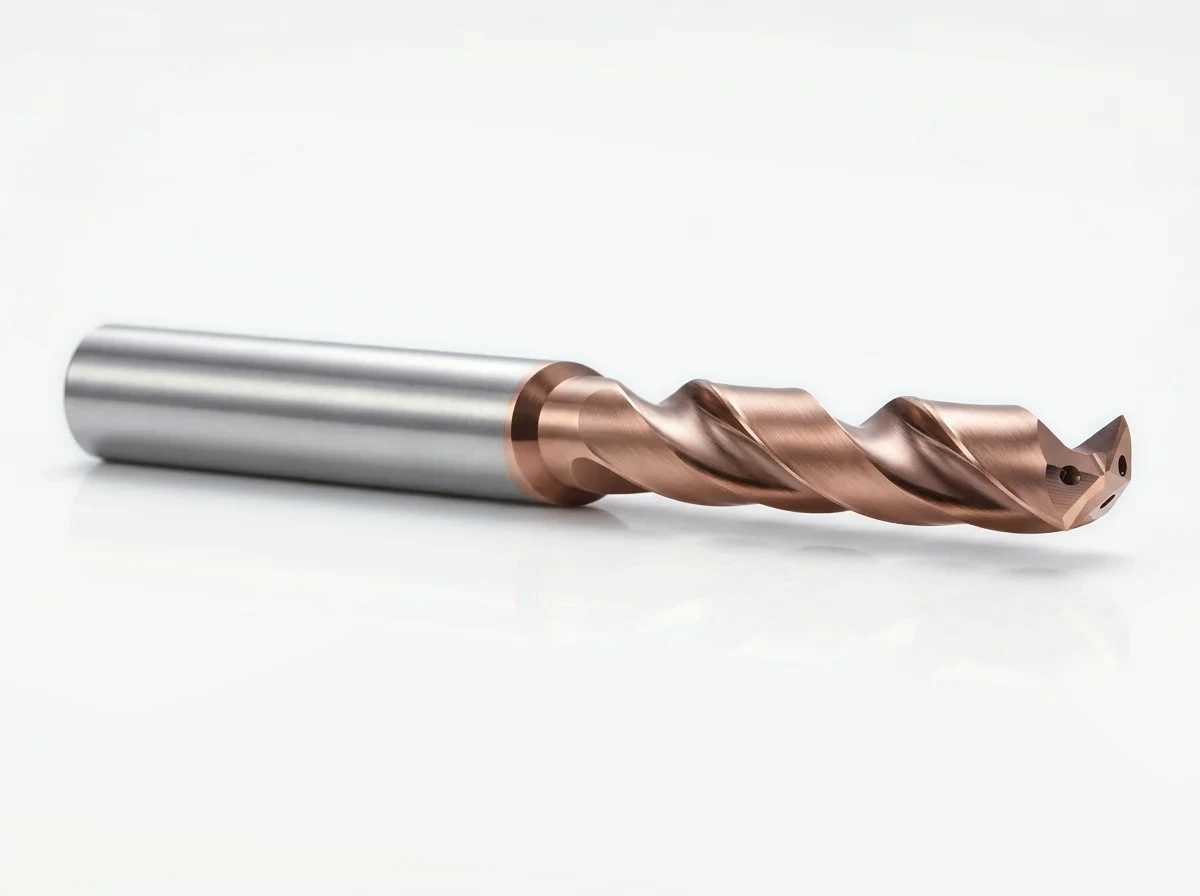
Start From the Grade: 304, 316, Duplex and Martensitic Stainless
Send the full designation and, where you have it, the hardness. Austenitic grades such as 304 and 316, ferritic, martensitic and duplex stainless can respond to the same drill in different ways, so the family name alone does not settle the geometry.
The supply condition matters as much as the grade. Annealed and cold-drawn stock load the edge differently, and a zone deformed by an earlier operation can change the cutting force within a single part. A setup proven on sheet should not be carried over to a heat-treated part from another stainless family.
Heat-treated martensitic or PH parts specified by HRC are reviewed in our carbide drills for hardened steel series, so send the hardness and heat-treatment condition with the drawing. For a broader comparison across workpiece materials, see how to choose a carbide drill series by material.
Work-Hardening at Entry and Feed
When the edge dwells, rubs or runs at too light a feed, the stainless surface hardens under it. The next cutting edge then meets that hardened skin, and the corner chips or the wall glazes.
Keep a positive feed through the entry and confirm runout before blaming the grade. Too heavy a feed brings its own risk: it can overload the corner at entry or at exit.
When the Drill Turns but Stops Cutting
If the drill keeps feeding but the chips stop and the spindle load or the noise climbs, stop the trial before you raise feed or thrust. Inspect the cutting edge and the worked zone first; a damaged edge or long contact without cutting makes the local hardening worse. Then check these points in order:
- Feed units. Is the program in mm/rev or mm/min, and does that match the value you intended?
- Rigidity. Can the part, fixture and holder resist the thrust without deflecting?
- Runout. Is the drill running true at the point?
- Coolant supply. Is coolant actually reaching the drill?
A hole that has already hardened needs its own recovery plan. Repeating the same cycle over the hardened zone without an evaluation invites a broken drill on re-entry, and our map of why solid carbide drills break covers that failure alongside the other break patterns.
Chip Packing and Edge Wear: Check the Entry First, Then the Depth
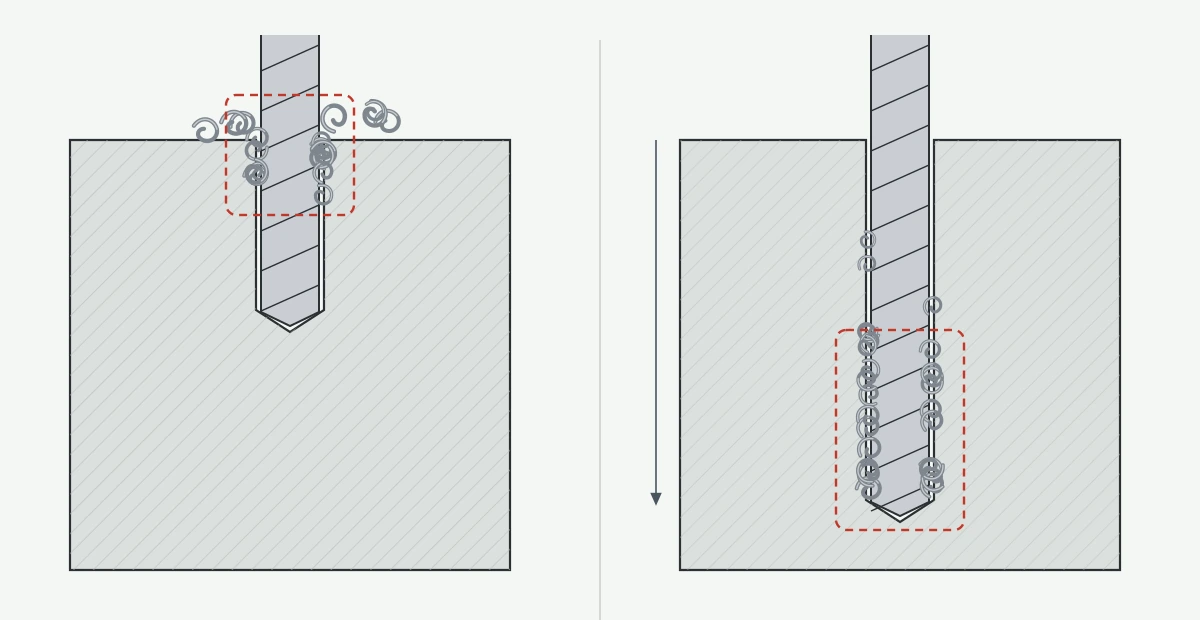
Note the depth at which the chips start to pack, then work through the checks in sequence.
First, chip form and edge geometry. When chips pack from the entry, look at how the chip forms and how the edge is ground. Long, stringy chips in the first part of the hole, material built up on the edge or heat marks near the entry all point back there.
Then the evacuation path and coolant. If chip form and edge geometry check out and the chips still pack as the hole gets deeper, check the evacuation path and coolant delivery as well. At that point the hole is reviewed with our deep-hole carbide drills, whose application records include a stainless medical instrument part.
Cutting the feed each time, or only turning up coolant pressure, does not cover every cause. The chip-packing checklist for carbide drills helps rule out the simpler ones before the drill changes, and whether internal coolant is the right next step is assessed with our through-coolant carbide drills. An interrupted or inclined entry has to be stated before a drill is chosen; our guide to inclined, cross-hole and thin-wall drilling explains why.
Edge Preparation and Coating
Stainless needs an edge tough enough to resist micro-chipping and sharp enough to cut cleanly. An over-honed edge rubs, while a fragile edge chips on an interrupted entry. HENTRY sets the edge preparation from the grade, any interruption in the cut and the runout measured on your machine.
A coating that reduces adhesion and heat can help in austenitic grades. It does not fix packed flutes, dry cutting or excessive stick-out. Choose the drill for the process it has to hold, and treat color and coating as part of that choice, never the reason for it. When you request a revision, include the current coating, wear photos and coolant type. Point and flute options by material are compared in our guide to carbide drill flutes and point angle selection.
Validate the Stainless Process in Production
Compare the first part with parts made close to your tool-change criterion. Measure the hole diameter, check the exit burr and look at the wall condition on both. If the wall starts to glaze or the burr grows toward the end of tool life, that trend tells you more than the first measurement.
Record material, setup and tool life against the same criterion for every drill, so results from different batches and machines can be compared on equal terms. The process is ready for production when those records stay consistent from batch to batch.
Where These Drills Sit in Typical Stainless Parts
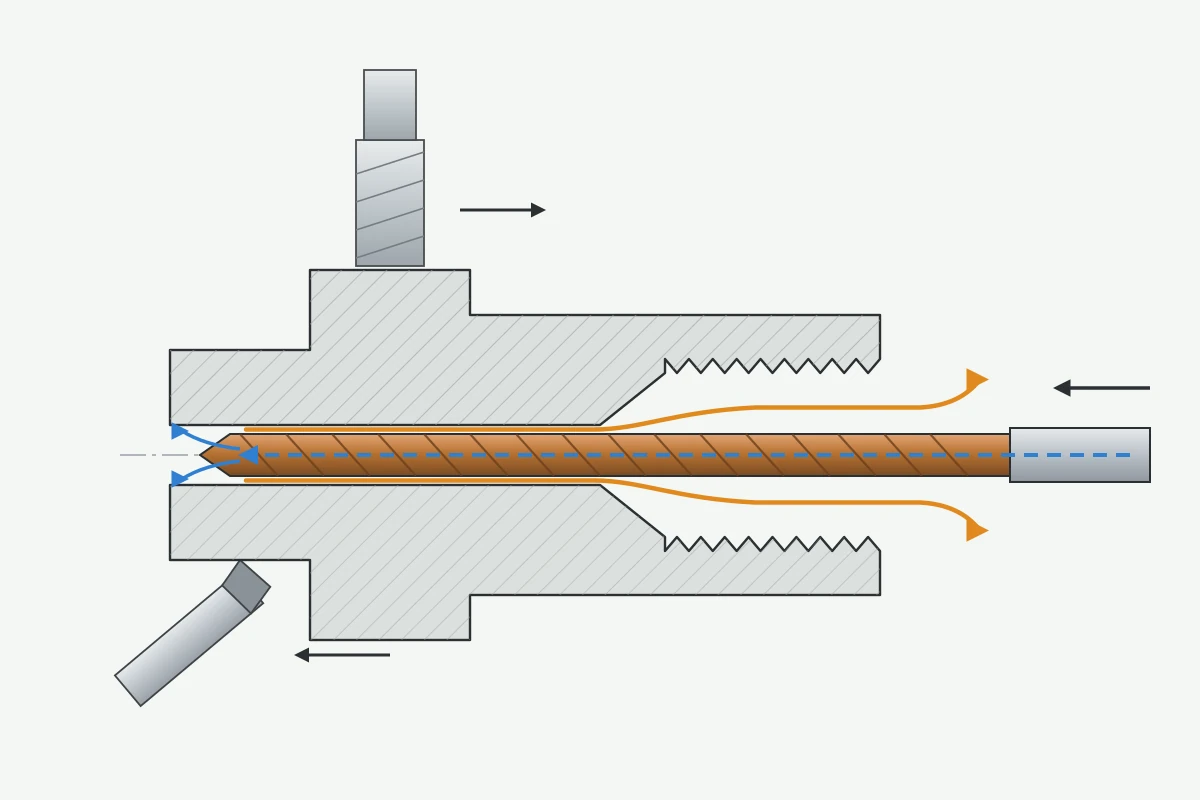
The parts below show typical operation sequences and where the drill sits in each. They do not represent a particular buyer's part or a measured outcome.
Compact sanitary manifold
A through-coolant drill opens the main galleries, and each one is checked for straightness and chip evacuation. A solid carbide drill then makes the connecting and cross holes once angle, intersections and tool access have been reviewed. Choose the cross-drilling order so that any burr left inside an intersection ends up where it can be reached or inspected, and check each key intersection by borescope or another agreed method. Hygiene compliance, the cleaning protocol and leak testing stay defined by you and the applicable standards.
Metering body
A micro drill makes the pilot hole first, checked for straightness and breakthrough. How runout eats into the tolerance at these sizes is covered under small-diameter holemaking. After reaming has settled the bore diameter, a standard solid carbide drill cuts the channels and each intersection is inspected; if the function depends on the whole bore profile, measuring only at the entry is not enough.
Sensor fitting
Turning, drilling, the sealing cone, the internal thread and flat milling all work around one axis and one sealing zone. A through-coolant drill opens the axial passage, which is checked for straightness, chip removal and coolant reaching the full usable length. Watch for long rubbing contact or chips building up in the passage, since either can harden or damage the profile.
Standard or Custom Stainless Drills
Production holes with open tolerances can often run on a standard stainless-oriented geometry. A custom drill is the better route when the grade is hard to cut, the depth or hole type is unusual, or the job needs a specific edge preparation or internal coolant. Our drills are made in HENTRY's own factory, and custom diameter, length, coolant outlets and steps follow your drawing.
| Parameter | Standard range | Customizable range | To be confirmed by engineering |
|---|---|---|---|
| Workpiece materials | 304 and 316; austenitic, ferritic, martensitic and duplex stainless (application scope) | Drill selected from the full grade and supply condition | Routing of heat-treated, HRC-specified parts to the hardened-steel series |
| Diameter, length and depth | — | Made to the drawing | All values, confirmed in drawing review |
| Edge preparation | — | Set from grade, interruption and runout | Specific parameters, confirmed in drawing review |
| Coating | — | Selected to your workpiece material and process | Coating type, confirmed in drawing review |
| Internal coolant | — | Through-coolant design available | Outlet layout, confirmed in drawing review |
| Lead time and quantity | — | Agreed in the quotation | Confirmed in the quotation |
What to Send With a Stainless Drill RFQ
- Grade: full designation, known hardness and supply condition
- Hole diameter and depth
- Hole type: blind, through, inclined entry or interrupted cut
- Coolant: flood, internal or both
- Photos of the damage or of the chips
- Your current cutting values, with their units
- The result you need and the problem you have now
Send current values with their units so we can read them against our process-first approach to carbide drill speeds and feeds. The remaining fields for drawing review are listed in the solid carbide drill RFQ checklist. Our proposal confirms the drill, its dimensions and the conditions of use for your part; lead times and quantities are agreed in the quotation. Drawings and photos can be sent to zwx@xrzpcd.com.
Stainless Drilling FAQ
Will a drill that works in 304 also work in 316?
Not automatically. Being in the same stainless family does not prove it. The alloy, its condition, the hole depth and the tool data all need checking before the same drill is approved for 316.
My stainless part is hardened by heat treatment and specified by HRC. Is this the right series?
Parts hardened by heat treatment and specified by HRC are evaluated in our hardened-steel drill series. Send the hardness and the heat-treatment condition with the drawing so the part is reviewed in the right series.
Does a deep stainless hole need a different drill?
It can. If the failure appears as depth increases, the evacuation path may call for another drill configuration, and the hole is then assessed as a deep-hole application.
Can I finish a damaged hole with the same drill and cycle?
We advise against it. The hardened zone has to be evaluated first, and a damaged hole needs its own recovery plan before a drill goes back in.
Why do you ask for my current cutting values with units?
No single speed suits every stainless grade. The drill, its diameter, the grade and the setup decide where a process starts, and values sent with their units let us rule out a feed-unit mix-up before anything else is changed.
Have the Grade and Chip Photos Ready?
Send the drawing with the grade, supply condition and photos of the chips or damage, and an HENTRY engineer checks the drill choice and the process for your stainless part.