
Cross-Hole Drilling & Finishing — Application Path and RFQ
The second hole broke into the first and the exit burr owned the gauge—or position wandered at the intersection because the create-hole was treated like a plain through hole.
This page owns cross-hole drilling and finishing at the application layer: drill-first path, short failure table, product cards, and RFQ with intersecting holes marked. Deep diagnosis stays on Inclined / cross / thin-wall drilling and Blind / through / cross reaming. Manifold scene: Hydraulic Manifold Drilling. XRZ quotes from your drawing with intersections marked (sample validation · Custom Cutting Tool RFQ).
Cross-hole application map (drill vs finish)
| Need | Typical posture |
|---|---|
| Create intersecting holes | Carbide drill primary — Solid Carbide Drill |
| Fit / gauge diameter after create-hole | Ream only when print demands — Custom PCD Reamer on compatible materials |
| Deep / coolant geometry boundary | Soft Helical vs straight coolant; deep-hole product boundary = RFQ note, not a second encyclopedia |
Do not open a peck-drilling encyclopedia on this URL.
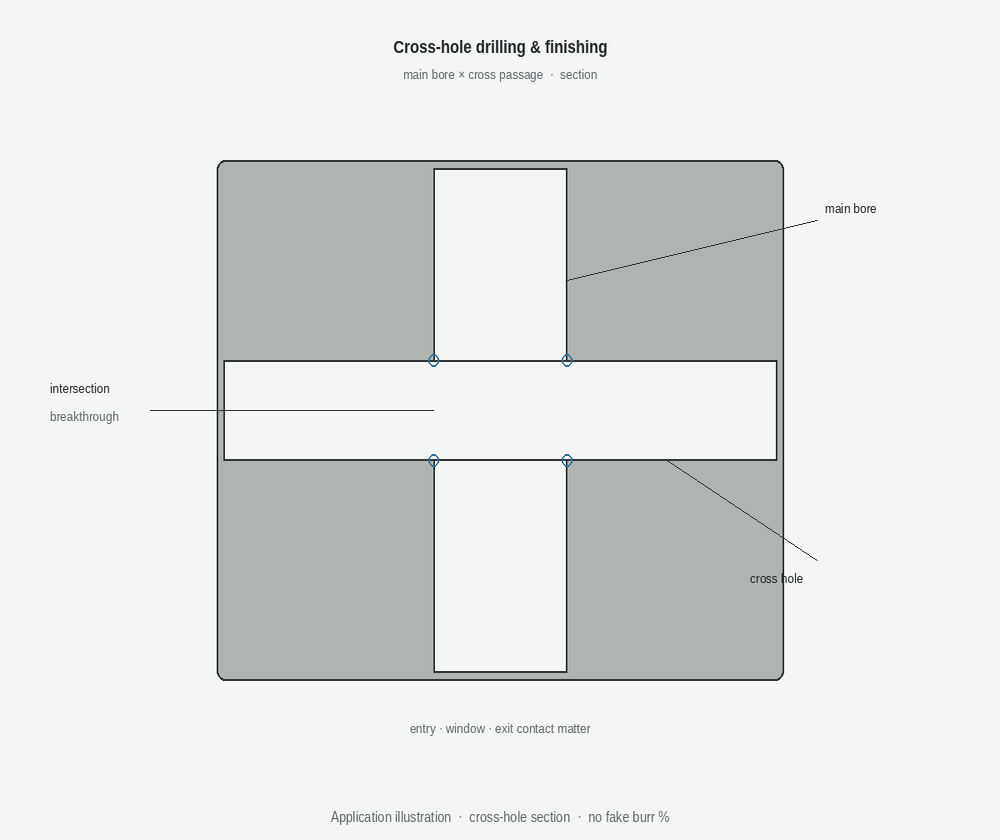
Short failure table → Knowledge
| Failure signal | Soft-link (do not restate H2s) |
|---|---|
| Entry wander / thin-wall breakout | Inclined / cross / thin-wall drilling |
| Exit burr / intersection tear | Same Knowledge + burr plan on RFQ |
| Finish diameter after interrupt | Blind / through / cross reaming |
| Chip packing in coolant holes | Soft Helical vs straight coolant |
Tool path + product cards
| Need | Open |
|---|---|
| Cross-hole create | Solid Carbide Drill |
| Finish when gauge requires | Custom PCD Reamer |
| Manifold scene (soft) | Hydraulic Manifold Drilling |
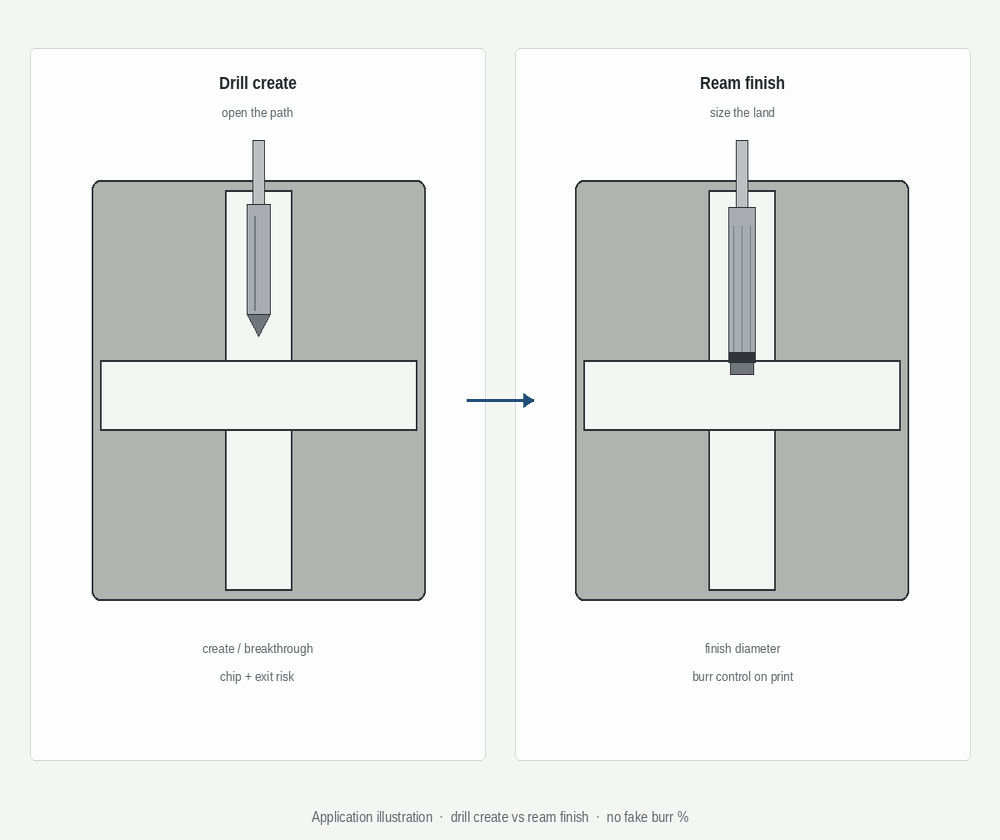
Burr / intersection (application sentence)
Own the exit and intersection on the RFQ: which hole is drilled first, which exit is gauge-critical, and whether finish ream is in scope. Do not promise a fake burr-% chart. Soft diagnosis stays on Knowledge above.
Drawing RFQ (mark intersecting holes)
| Must send | Why |
|---|---|
| Drawing/model + revision; intersecting / cross holes marked | Separates cross features from plain through holes |
| Hole chart: Ø, depth, angle/intersection notes | Freezes drill vs ream scope |
| Which exit / burr characteristics are in acceptance | Burr ownership before sample |
| Material; holder; coolant (TSC yes/no); measured runout if finish | Trial realism |
| Volume band + sample yes/no + written acceptance | First-article before production talk |
Checklist soft: PCD Reamer RFQ Checklist when ream is in scope.
Boundary vs manifold / Knowledge
| Page | Owns |
|---|---|
| Knowledge inclined/cross · blind/cross | Diagnosis essays |
| Hydraulic Manifold Drilling (#13) | Manifold oil-passage scene |
| This page (#20) | Cross-hole application + product + RFQ |
Milling supporting only when a face lands on the same print. No peck full guide here.
Should I ream every cross-hole or only drill?
Drill first. Ream only when the print/gauge demands diameter, roundness, or finish after the intersection. Many cross-holes stay on the create-hole path. Product: Solid Carbide Drill · Custom PCD Reamer.
Where is the full interrupted-hole diagnosis?
On Knowledge: Inclined / cross / thin-wall drilling and Blind / through / cross reaming. This page is the application + RFQ entry—do not expect Knowledge H2s restated here.
How does manifold drilling relate to this page?
Hydraulic Manifold Drilling owns the manifold oil-passage scene. This page owns the generic cross-hole application path and RFQ. Use both when the part is a manifold with intersecting passages.
What must I mark on a cross-hole drawing for RFQ?
Intersecting holes, hole chart with intersection notes, which exits/burrs are in acceptance, material, coolant/holder notes, and sample list. Upload via Custom Cutting Tool RFQ.
Send the drawing—we’ll map intersecting / cross-hole paths
Mark intersecting and exit-critical holes. Engineering RFQ only—no public price list.