
When to Use Two or Three Flutes and 118°, 140°, or 150° Point Angles
The RFQ line says "carbide drill Ø8" and nothing else. Sometimes the buyer adds "the 140° three-flute, same as last time." Nobody has written down what the hole actually is: the material and its condition, how deep it goes, whether it is blind or through, whether the drill enters a flat face or a cast slope, and whether coolant comes through the tool or only from a flood nozzle. Quote the wrong flute count and a deep blind hole packs with chips. Quote the wrong point and the drill walks on entry, pushes a thin wall, or leaves a blind hole short at full diameter. The usual next move is a new grade or coating, and the same geometry mistake goes back on the spindle.
This page settles the two choices behind that Ø8 line: two flutes or three, and a 118°, 140°, or 150° point. For each one you get the conditions that favor it, the scrap you see when it is wrong, and what to check on your own diameter, rigidity, and coolant. It ends with the fields to put in the RFQ so the recommendation can be checked against the first parts.
Start with two flutes when chips are long or sticky, the hole is deep or blind, or the setup is only moderately rigid; move to three flutes when chips break short, as in cast iron, and the machine and fixture are stiff enough to use the extra guidance. Treat 140° as the common carbide starting point, go to 118° when you need lower thrust and an easier entry and can accept a more fragile point, and keep 150° for jobs where short chips and a flatter tip matter more than thrust. Whatever you choose, confirm it on the first holes with chip photos, entry position, and a look at the lip corners, and reset the program depth if the point angle changed.
2 Flute vs 3 Flute Drill: Chip Space, Thrust, and Rigidity
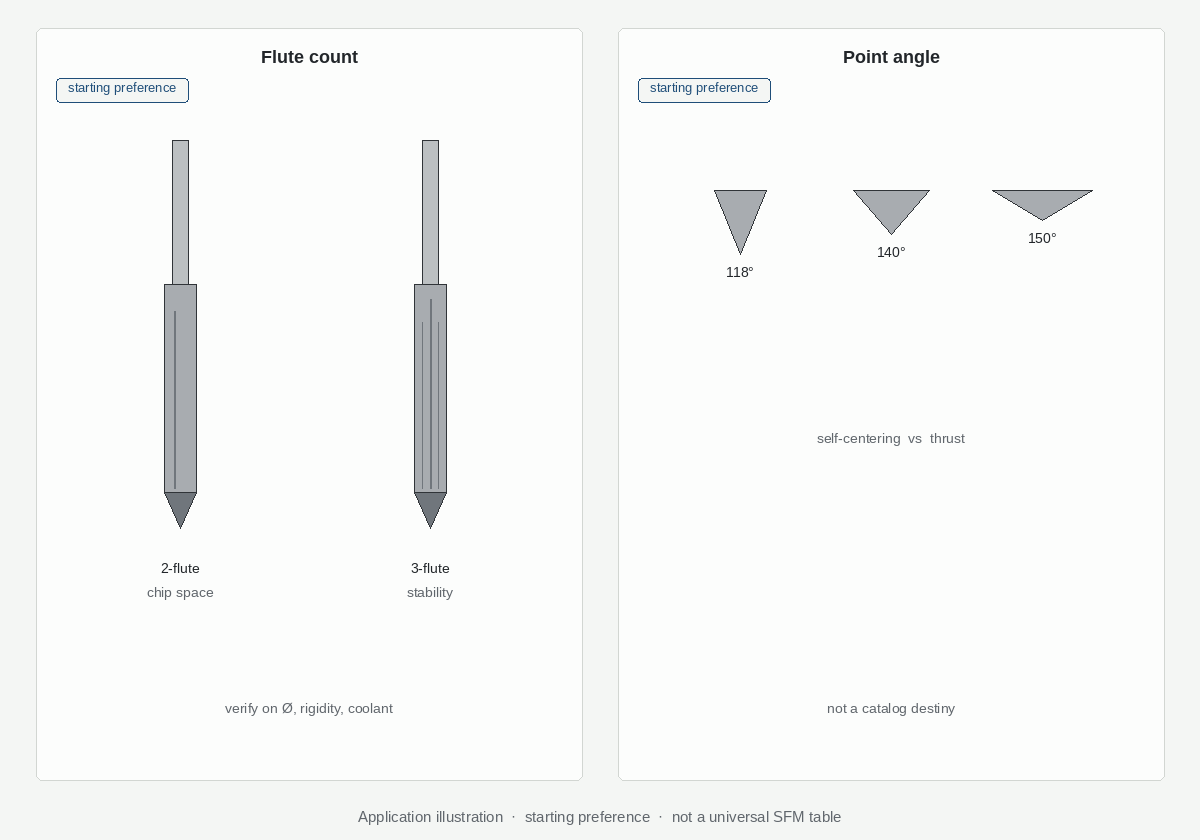
Flute count trades chip room against support. Two flutes give each chip more room to leave the hole. Three flutes add a third cutting edge and a third margin on the hole wall, which helps guidance, but each flute is narrower and the drill pushes harder on the spindle and the part.
| Starting choice | Conditions that favor it | Watch-outs | Check on first parts |
|---|---|---|---|
| 2-flute | Long or sticky chips (most aluminum alloys, low-carbon steel, austenitic stainless); deep or blind holes that tend to pack; moderate rigidity or thin, lightly held parts | Less wall guidance than a 3-flute drill on a stiff setup; can mark the hole mouth when runout is high | Chip form photos, packing history, L/D, coolant path |
| 3-flute | Short-breaking chips (gray cast iron; ductile iron only when its chips break short); rigid machine, holder, and fixture; roundness or position matters; high part volume | Narrower flutes pack earlier in sticky material or deep blind holes; more axial thrust | Assembled runout, stickout, chip clearance at depth, spindle load |
When a 2-flute carbide drill is the safer start
Pick two flutes as the starting point when the chips come off long, stringy, or sticky, when the hole is deep or blind and every chip has to travel back up the flutes, and when the machine, fixture, or stickout is only moderately rigid. Two flutes also put less axial load on a thin part or a light fixture. The cost is guidance: on a stiff machine with short chips, a 2-flute drill can leave a hole that is less round than a 3-flute drill would. Material behavior for these jobs, such as edge build-up in aluminum or work-hardening in 304, is covered in the aluminum drilling playbook and the stainless work-hardening playbook, and parts above the normal hardness range should go through the hardened steel hardness window first.
When a 3-flute drill earns its place
Three flutes make sense when the chips break short on their own, with gray cast iron as the usual example, when the machine, holder, and fixture can take the extra thrust, and when roundness, straightness, or position matters more than maximum chip room. The third margin gives the drill more contact with the hole wall, which is where the better guidance comes from, and the extra cutting edge pays off most on long production runs. The same narrow flutes pack sooner in sticky material or a deep blind hole, so 3-flute carbide drills for steel are usually specified with through-tool coolant. If the machine only has flood coolant, read when through-coolant is worth it before you commit to three flutes.
Scrap signs that point to flute count
- Flutes packed when the drill comes out, or wall scratches from trapped chips: fix chip room first, and work through the chip packing checklist before anyone suggests adding a flute.
- Lobing or chatter marks with short chips on a stiff setup: this is where a 3-flute drill is worth discussing, but only after assembled runout has been measured.
- Marks at the hole mouth while one flute stays clean: check assembled runout and stickout before blaming two flutes or three.
- A blind aluminum hole that ran well on a 2-flute drill and started failing after stock quietly changed to 3-flute: compare flute volume, not coating color.
Drill Point Angle 118° vs 140° (and 150°): Thrust, Chips, and Point Length
Point angle sets how the cutting lips meet the work, how thick the chip is at a given feed, and how hard the drill pushes on the spindle, the part, and the fixture.
| Point | Tendency | Often chosen when | Does not replace |
|---|---|---|---|
| 118° | Lower thrust, thinner and longer chips, easier entry; more fragile point | Softer materials, older prints that call it out, thin or lightly held parts | A spot or pilot on a steep slope; the hardness check on hard steel |
| 140° | Thicker, shorter chips that break and clear well; more thrust; the common carbide default | General production drilling in steels and many other materials on rigid setups | A material, L/D, and entry check on deep blind aluminum or hardened parts |
| 150° | Flatter still: shortest point length, thickest chips, highest thrust of the three | Specific hard-material jobs or a drawing callout, validated on the first holes | A pilot or spot when the walk comes from the fixture |
118° vs 140° on carbide drills
118° is the traditional point on HSS drills and still appears on older prints. 140° is the common default on solid carbide drills. At the same feed per revolution, the sharper 118° point makes a thinner, longer chip with lower thrust, and it enters the work more easily. The trade is a point that chips more easily and a long chip that is harder to break and clear. 140° makes a thicker, shorter chip that breaks and evacuates more easily, but the drill pushes harder, so it needs a rigid setup and a part that can take the axial load. On a sloped or cast face, or on a thin wall that deflects under thrust, the angle is only one part of the entry plan; spot, entry feed, and support are covered under inclined, cross-hole, and thin-wall entry.
Where 135° split points and 150° points fit
135° is a common angle on split-point drills and is often listed alongside 140° for stainless and general steel work. For an RFQ, treat 135° and 140° as the same family and ask what the split or web thinning does at the center, because that decides centering more than the few degrees between them. 150° is flatter again: a shorter point, thicker chips, and more axial thrust. It is usually a deliberate choice for a specific hard-material job or a drawing callout rather than a default, and entry position should be checked on the first holes. How the split, web thinning, and chisel edge affect centering is explained in solid carbide drill geometry.
Point angle changes blind-hole depth
Point length, the distance from the tip to where the drill reaches full diameter, follows directly from diameter and angle: Lp = (D/2) ÷ tan(A/2). For a Ø8 drill that gives about 2.40 mm at 118°, 1.66 mm at 135°, 1.46 mm at 140°, and 1.07 mm at 150°. These figures are geometric, not measured, and a real tip with thinning or a corner chamfer will differ slightly. In practice, if a blind hole is programmed to the tip and a 140° drill is swapped for a 118° drill without changing the program, full-diameter depth comes up about 1 mm short. Going the other way, the full diameter runs about 1 mm deeper than before, which matters when the floor is close to a cross hole or an outside wall. Update the Z depth whenever the point angle changes, and state on the RFQ whether the drawing depth is to full diameter or to the tip. If the floor itself has to be flat, a pointed drill is the wrong tool; see flat-bottom carbide drills for blind holes.
Print callout vs catalog default
- If the drawing specifies a point angle, quote against it, or propose a written alternative with the reason (thrust, slope, hard entry).
- If the drawing is silent, write the starting point angle from the table above together with the check plan: position, a lip-corner photo, and spindle load if the plant tracks it.
- Do not copy an "always 140°" line into an RFQ without material, L/D, and entry notes.
Choosing Flute Count and Point Angle Together: Material, Hole Type, Entry
Many wrong drills come from deciding in the wrong order: someone buys a series because the label says stainless, and a geometry that packs in a deep blind hole is still on the spindle. Work in this order:
- Hole type and entry: blind, through, or stacked; L/D; flat face, slope, or cast skin; flood or through-tool coolant.
- Flute count and point angle from those conditions, using the two sections above. Write down the starting choice and what you will check on the first parts.
- Series by material: grade, coating, and stock family from choose carbide drill series by material.
- Material-specific rules when the scrap mode is work-hardening, a hardness limit, or aluminum sticking to the edges, using the playbooks linked earlier on this page.
- A custom drill when no stock flute and point combination fits the hole. Send the same fields.
Example RFQ lines (anonymous wording examples, not customer cases):
- "Blind hole in 6061-T6, L/D about 5, stringy chips, flood coolant only. Prefer a 2-flute start; point angle open, please recommend and validate for packing."
- "Through hole in 304 with a history of work-hardening, rigid BT40 machine, through-tool coolant available. Discuss a 140° or 135° split-point start; flute count to follow chip photos."
- "Sloped cast entry, current 118° drill walks. Need an entry plan (spot or pilot, entry feed) before any series change."
None of these lines contains a speed or feed. They fix the conditions, so the series choice and the first-article acceptance have something to be checked against.
When Flute Count and Point Angle Are Not the Real Problem
Some holes fail for reasons a different flute count or point angle will not fix. Check these before asking for a new geometry:
- Runout and stickout. A drill that cuts mostly on one lip marks the hole mouth and cuts oversize with two flutes or three. Measure assembled runout and stickout first; holder choice is covered in stickout, runout, and toolholders.
- Depth and chip escape. If chips pack at the same depth every time, the cycle and the coolant delivery usually matter more than the flute count. Deep holes are covered in deep-hole carbide drilling: L/D, peck, and chip escape.
- Entry. A drill that skates on a cast skin or a slope needs a spot, a pilot, or a prepared face. Point angle changes the first contact, not the surface the drill lands on.
- Hardness out of range. When the part is harder than the drill's working window, grade and edge preparation come before flute count or point angle.
- Speeds and feeds. The wrong cutting speed or feed per revolution changes chip form enough to look like a flute problem. Starting values by material are on carbide drill speeds and feeds.
What to Send XRZ for a Flute and Point-Angle Recommendation
A useful recommendation starts from the hole and the chips it makes, not from the last drill on the purchase order. This is how we handle it:
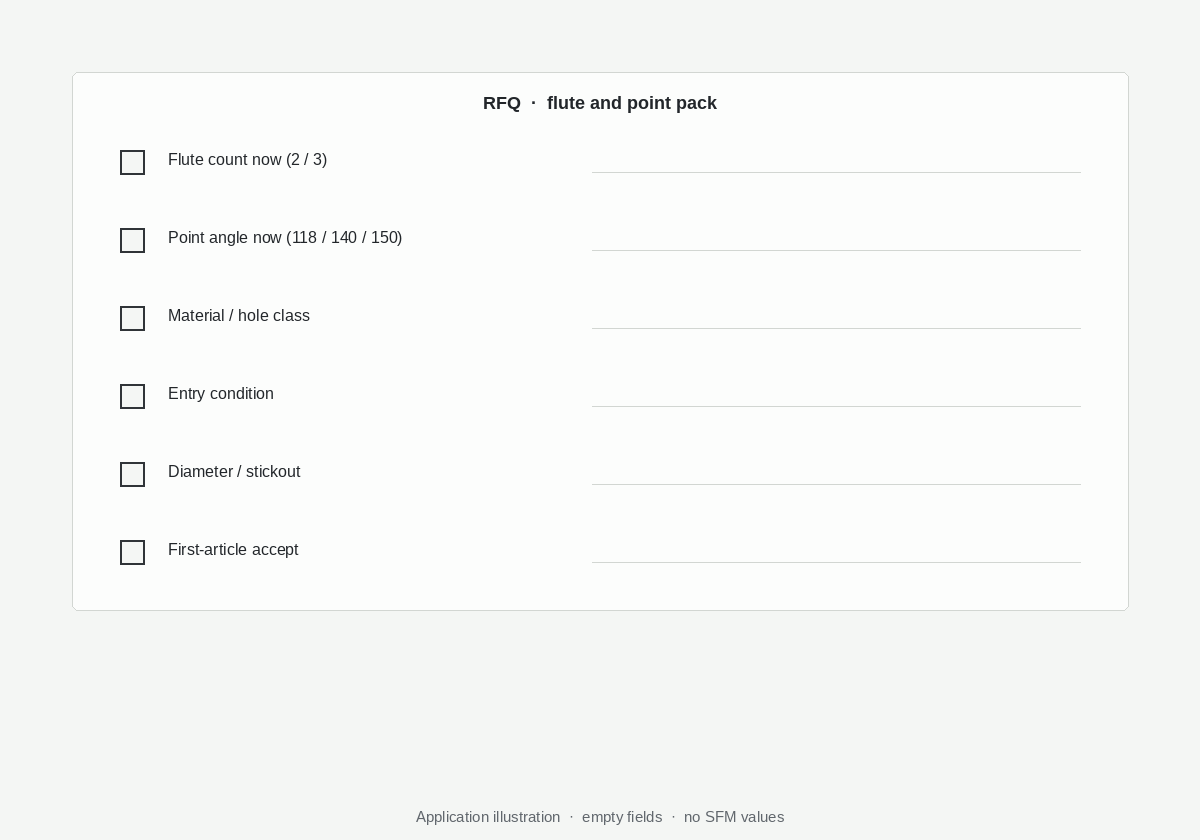
- We receive the material (grade, condition, and hardness if known), hole type, entry notes, Ø × depth, coolant, the current scrap mode, and any flute count or point angle the print calls for.
- We write the acceptance with you: hole size and position, chip form, entry walk, any thrust or spindle-load limit the plant watches, and a photo of the lip corners after an agreed hole count.
- We freeze the flute and point revision and the program offsets on the sample run before volume (sample validation).
Flute and point fields for the RFQ
- Material and condition (HRC or HB if hardened; Si content if aluminum; write "unknown" if unknown)
- Hole type: blind, through, or stacked; L/D
- Drawing depth: to full diameter or to the drill point
- Entry: flat, sloped, or cast face; whether a spot or pilot has been tried
- Chip evidence: packing, stringy, powdery, or burnt
- Flute count and point angle requested, or "recommend from conditions"
- Machine rigidity, stickout, and measured runout if available
- Coolant: flood or through-tool; pressure, or "unknown"
- Photos of the lips and the hole mouth from scrapped parts
Frequently Asked Questions
Is a 3-flute drill always better than a 2-flute drill?
No. On a rigid setup with short-breaking chips, a 3-flute drill gives more guidance, which helps roundness and position. In sticky material or a deep blind hole the narrower flutes pack first, and a packed hole loses more quality than a third margin can win back. Decide from chip photos, L/D, and machine rigidity.
Is 118° or 140° better for a carbide drill?
Neither is better in general. 140° is the common starting point on solid carbide drills: it makes thicker, shorter chips that clear well, at the cost of more thrust. 118° lowers thrust and enters more easily, but the point is more fragile and the chips run longer. Choose from material, entry condition, and setup rigidity, confirm on the first holes, and reset the program depth if you change angle.
Does point angle replace a spot or pilot drill?
No. Point angle changes how the drill first touches the part; it does not fix a skating face, a soft fixture, or a pilot step that does not match the drill. Entry setup is covered in pilot hole and entry control, and when to pilot drill before a carbide drill explains when a pilot is actually needed.
What flute and point data should an RFQ include?
Material and condition, hole type and L/D, whether depth is to full diameter or to the tip, entry condition, chip and scrap evidence, the flute count and point angle you want (or "recommend from conditions"), coolant type, stickout and runout if measured, and photos of the lips and the hole mouth.
Next step
What you should get back is a condition sheet both sides read the same way, a written first-article acceptance, and an engineer who still picks up the phone when chips pack or the point walks.
- Soft: Solid carbide drill RFQ checklist
- Product: Solid Carbide Drill
- Hard: Custom Cutting Tool RFQ