
Monday’s first-off walks off location or snaps a solid carbide tip on entry, and the shop reaction is either “always pilot first” or “skip the extra tool and take the risk.” Both habits cost: an unnecessary pilot burns cycle on every hole that already had a square face and controlled location; a skipped pilot on slope, hard skin, long stick-out, or a large diameter step walks or breaks the tip before the lot settles.
This page is the pilot trigger gate: when a pilot (or controlled step-down) is required versus when direct entry with the production carbide drill is OK. Shop cue → check first → don’t default pilot for every hole. It is not the pilot/spot entry-control playbook (Carbide drill pilot hole — entry control)—Soft once; do not merge or 301; do not restate that page’s step / angle / runout essay. Point and flute live on Solid carbide drill geometry. Peck is a different trigger (When peck drilling is required). Through-coolant owns delivery (Through-coolant solid carbide drill). If the drill already snapped, sort causes on the breakage checklist or the why drills break hub. Five jobs, five pages.
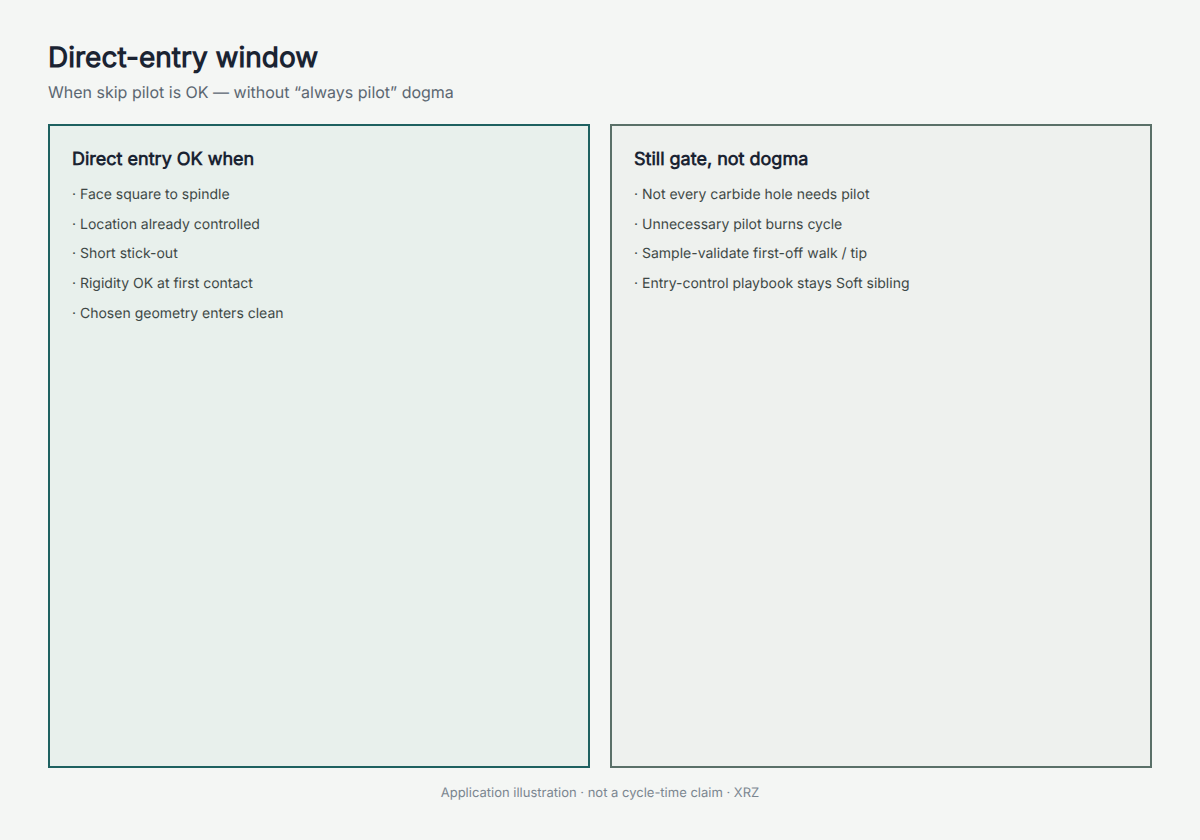
Pilot before a solid carbide production drill when entry position, face condition, or setup rigidity would otherwise walk or snap the tip—or when diameter must be stepped safely. Skip pilot when the face is square, location is already controlled, stick-out is short, and the chosen geometry can enter cleanly. This page is the pilot gate only; match point and flute on the geometry guide; trigger peck and through-coolant on their own pages; use breakage pages if the drill already failed.
Position and entry cues (slope, skin, pre-hole walk)
Shop signal: First hole walks off print location; roundness at the mouth is oval or stepped; entry on cast skin, weld, slope, or a pre-drilled / cored hole that does not center the tip; corner chip or tip snap timed to first contact—not mid-depth pack.
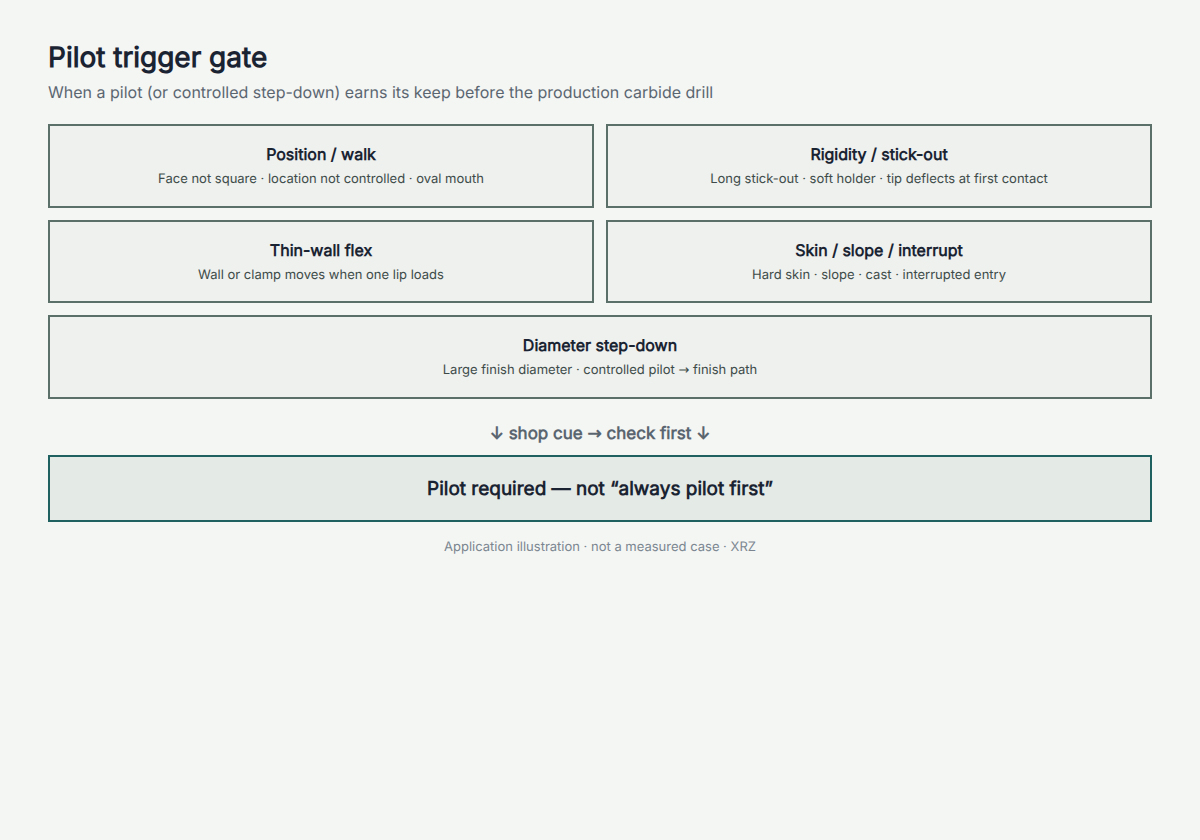
Check first: Is the face square to the spindle? Is location already fixtured or previously spotted/piloted? Does the entry surface present a slope, hard skin, or interruption that loads one lip first? For interrupted or cross-hole approach Soft the cut-path page—do not merge: Carbide drill interrupted cut / cross-hole. Flat-bottom blind geometry Soft when the print demands a flat floor: Flat-bottom carbide drills for blind holes.
Don’t default pilot from “carbide = fragile” alone: Solid carbide is stiff and can enter clean when the face is square, location is controlled, and the point can take both lips evenly—an always-pilot habit just burns Tuesday’s cycle. Pilot earns its keep when position or entry condition would otherwise walk or shock the tip. How to size the pilot, set spot vs pilot roles, and manage entry load Soft once on the sibling—do not paste that playbook here: Carbide drill pilot hole — entry control.
Rigidity, stick-out, and thin-wall clamp
Long stick-out, weak holders, or thin-wall / soft-fixture flex at entry raise the same risk as a bad face: the tip deflects before both lips cut, then walks or chips—first-off will show the walk before the cycle-time argument does. This page flags rigidity as a pilot-gate cue, not a fixture encyclopedia.
Shop cues before you freeze direct entry:
- Stick-out long enough that deflection at first contact is visible or measurable
- Thin wall or clamp that moves when the drill loads one lip
- Holder / interface that already shows runout or chatter on other tools
Boundary: Pilot can reduce entry walk when the setup is soft; it does not invent spindle rigidity or cancel a bad holder. Optional Soft when stick-out / runout / toolholder is the main cue: Carbide drill stick-out, runout, and toolholders. Entry-control Soft for how pilot interacts with runout once the gate says yes: Carbide drill pilot hole — entry control—Soft once; no merge.
Diameter step-down: when to step vs finish-diameter direct
Large finish diameters often need a controlled pilot → finish path so the production carbide drill does not take the full radial load (and walk risk) on first contact. Small finish diameters on a square, located face with short stick-out often run finish-diameter direct.
Shop signal: Finish diameter large enough that a single-pass entry historically walks or snaps; print or process already calls a step; prior tools left a pilot that the finish drill must follow cleanly.
Check first: Is the step a position/rigidity need, or habit? Can the chosen finish geometry enter clean at finish diameter on this face and setup? Is the pilot diameter and depth noted so the finish tool centers without a dangerous step (sibling owns that detail).
Boundary: This page decides whether to step. How to avoid a dangerous pilot step, and how spot vs pilot differ Soft: Carbide drill pilot hole — entry control. Hole-route context Soft: Hole machining process route. If the drilled hole later hands off to PCD ream, one Soft line only—don’t steal reamer OWN: PCD reamer pre-hole quality.
Pilot ≠ peck ≠ through-coolant (boundary)
Pilot, peck, and through-coolant answer different questions:
| Decision | Owns | Does not own |
|---|---|---|
| Pilot (this page) | Whether entry position, face, rigidity, or diameter step requires a pilot / step-down before the production carbide drill | Peck cycle recipe; coolant channel design; point-angle tables |
| Peck (Soft) | Whether chips need a retract window before the next engagement | Default pilot for every hole |
| Through-coolant (Soft) | Whether tip delivery must be internal for heat and chip push | Pilot gate or peck gate |
A deep sticky hole may need peck (and maybe through-coolant) without needing a pilot if location and face are already controlled. A shallow hole on slope or long stick-out may need a pilot with continuous feed. Soft peck gate: When peck drilling is required. Soft deep-hole L/D · chip when depth class is already in play: Deep-hole carbide drilling. Soft coolant: Through-coolant solid carbide drill. Soft geometry when the question is point/flute, not pilot: Solid carbide drill geometry.
What to put on a drill RFQ
Do not paste the full field table here—point Soft and send the drawing. Notes that usually decide pilot vs direct entry on an XRZ screen:
- Hole diameter (and any pilot / step diameters and depths if known)
- Face condition (square / slope / skin / pre-hole) and how location is controlled
- Stick-out, holder type, and thin-wall or fixture notes if flex is in play
- Material / condition (hardness, cast skin, weld)
- Current habit (direct entry / spot / pilot → finish) and where walk or tip damage first appears
- Photos of walked mouths, chipped tips, or entry faces if already failed
Soft field map: Solid carbide drill RFQ checklist. Soft sibling when the RFQ is specifically an entry-control problem: Carbide drill pilot hole — entry control. If the drill already snapped, Soft causes first: Solid carbide drill breakage causes. Hard submit: Custom cutting tool RFQ.
Frequently Asked Questions
Do all carbide holes need a pilot first?
No. Pilot is not default for every solid carbide hole. Skip pilot when the face is square, location is already controlled, stick-out is short, rigidity is OK, and the chosen geometry can enter cleanly. Pilot when position, entry condition, setup flex, hard skin / slope / interrupt, or a large-diameter step would otherwise walk or snap the tip. Soft entry-control playbook once the gate says yes: Carbide drill pilot hole — entry control.
How is pilot different from peck drilling?
Pilot owns entry position / face / rigidity / diameter step before the production drill. Peck owns a retract window when chips cannot leave before the next engagement. A hole can need one, both, or neither. Soft peck trigger: When peck drilling is required. Soft deep-hole L/D · chip when depth is the main cue: Deep-hole carbide drilling. This page stays the pilot gate.
Does pilot replace choosing the right point angle?
No. Pilot does not invent a missing point or flute match. Wrong geometry can still walk or chip after a clean pilot. Soft geometry (point / flute) separately: Solid carbide drill geometry. Soft entry-control for how pilot and entry load interact: Carbide drill pilot hole — entry control—do not merge with this gate.
What pilot diameter / step notes belong on a drill RFQ?
Finish diameter and depth; any pilot or step diameters and depths already in the process; face condition and location control method; stick-out / holder / thin-wall notes; material and skin notes; current direct-vs-pilot habit and where walk or tip damage first shows; photos if any. Soft the field pack: Solid carbide drill RFQ checklist. Then upload for an XRZ engineering screen: Custom cutting tool RFQ.
Next step
Soft (read before you freeze pilot vs direct entry)
- Soft sibling (entry-control playbook · Soft once): Carbide drill pilot hole — entry control
- Geometry (point / flute ≠ pilot gate): Solid carbide drill geometry
- Peck trigger ≠ pilot: When peck drilling is required
- Deep-hole L/D · chip: Deep-hole carbide drilling
- Coolant delivery: Through-coolant solid carbide drill
- After a snap: Solid carbide drill breakage causes · hub Soft once: Why solid carbide drills break
- Interrupt / cross path: Carbide drill interrupted cut / cross-hole
- Flat-bottom blind: Flat-bottom carbide drills for blind holes
- Stick-out / runout / holders (optional): Carbide drill stick-out, runout, and toolholders
- Hole route: Hole machining process route
- RFQ fields: Solid carbide drill RFQ checklist
- Drill→ream handoff (one Soft line): PCD reamer pre-hole quality
- First-article close: Sample Validation Process
Product (architecture after the gate)
- Solid carbide drill — Discuss Your Tooling Requirements
Hard (drawing → tooling discuss → RFQ)
Send Your Drawing with diameter steps, face/location notes, stick-out, and material for an XRZ engineering screen. Quick RFQ → RFQ at Custom cutting tool RFQ. Stay through first-article under agreed acceptance—when the same entry still walks after a tool swap, close the loop with Sample Validation Process and the RFQ.