
Tuesday’s deep or sticky hole raises the same fear: chips pack in the flute, torque climbs at a repeatable depth, and a solid carbide drill snaps before the lot finishes. The opposite habit is just as expensive—default peck on every hole past a rough L/D rule, even when chips already clear and the tip stays cool, so cycle time dies for no process reason.
This page is the peck trigger gate: when peck is required versus when continuous drilling can stay. Shop signal → check first → don’t default peck for every L/D. It is not the deep-hole L/D + peck-execution + chip-escape essay (Deep-hole carbide drilling)—Soft once; do not merge or 301. Coolant delivery is a separate decision (Through-coolant solid carbide drill). If the drill already snapped, sort causes on the breakage checklist. Interrupted or cross-hole cut path Soft: Interrupted cut / cross-hole. Five jobs, five pages.
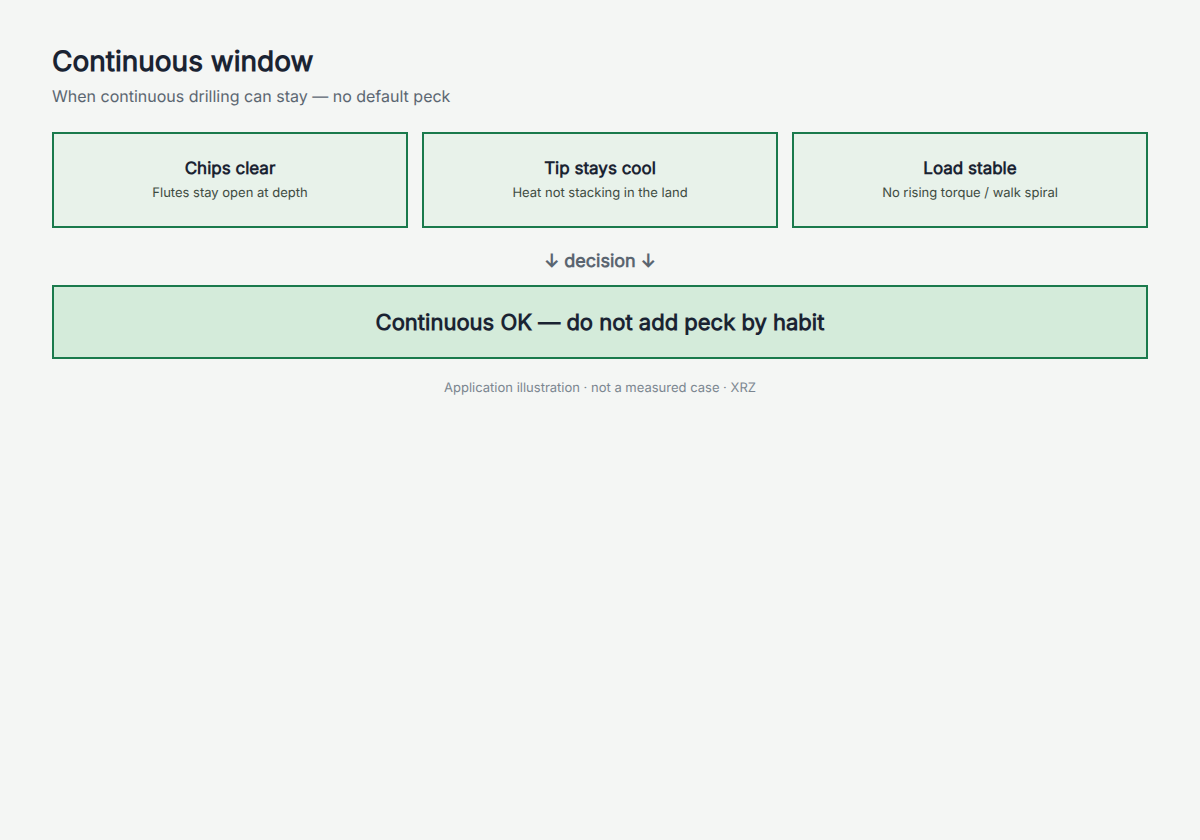
Peck drilling is required when chips cannot leave the flute before the next engagement—deep sticky cuts, weak coolant reach at the tip, or approach into interruptions—not as a default for every hole past an arbitrary L/D. Continuous drilling can stay if chips clear, load stays stable, and the tip stays cool. Sort peck triggers here; run L/D and peck-cycle execution on the deep-hole page; decide through-coolant on its own page; use the breakage checklist if the drill already snapped; treat interrupted or cross-hole cut path as its own Soft, not as this trigger gate.
Chip-pack and depth cues (when peck earns its keep)
Shop signal: Torque or spindle load rises at a repeatable depth; flutes show welded, crushed, or colored chips; break in the fluted body after “it was fine near the mouth”; chips that look continuous but leave the hole packed.
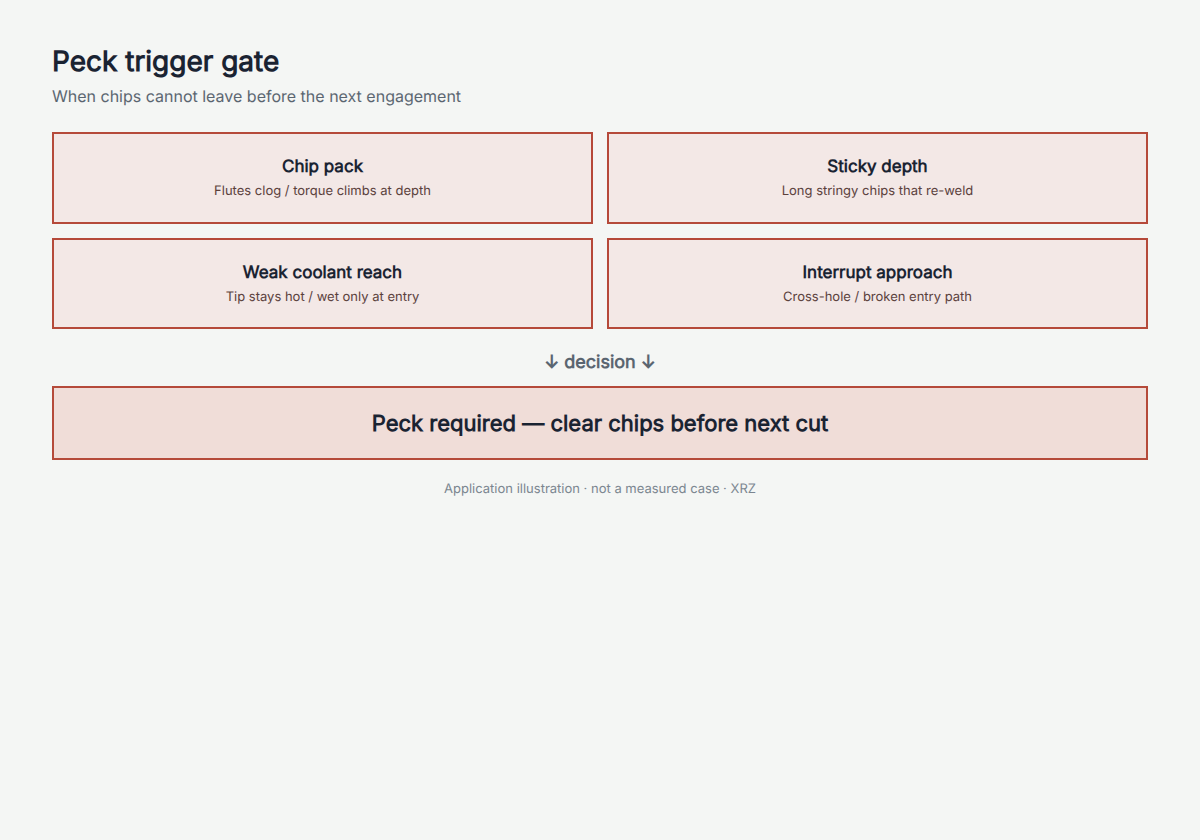
Check first: Can chips leave before the next engagement? Blind vs through exit; flute loading vs depth; whether a short retract / peck habit already exists and still packs; whether flood only wets the mouth while the tip runs dry.
Don’t default peck from L/D alone: Depth class is a heuristic, not a law. A shallow sticky blind can need peck; a deeper through hole with clear chips and good tip cooling may run continuous. First-off will show pack before the L/D rule does—treat L/D bands as screening, not “every hole past 3×D must peck.”
When chips are already packing and you need a symptom checklist Soft (optional): Carbide drill chip-packing checklist. For L/D bands and how to structure peck cycles once the gate says “yes,” Soft the deep-hole page—do not paste that recipe here: Deep-hole carbide drilling: L/D, peck, chip escape.
Material stickiness and coolant reach
Sticky stainless, gummy aluminum, or heat that welds chips in the flute raises peck need even when the print depth looks “not that deep.” Coolant that never reaches the tip has the same effect: chips soften, reweld, and pack.
Shop cues before you freeze continuous:
- Material notes (work-hardening, Si%, cast skin) that historically make long chips or built-up edge
- Real delivery at stickout—channels, rotary union, holder path—not only “coolant on” at the entry
- Heat-colored chips or blue margins while the machine still looks wet
Peck can interrupt the pack cycle; it does not invent coolant pressure or replace a through-coolant decision—wet mouths with dry tips still pack on the next first-off. Soft coolant gate: Through-coolant solid carbide drill. This page does not restate that essay.
Interrupted entry and cross-hole approach
Approaching a cross-hole, window, or other interruption changes chip shape and load mid-pass. A continuous program that was stable in solid material can pack or shock at the interruption even when L/D looked safe.
Shop signal: Break or torque spike timed to the interruption depth; chips change form at the window; corner chip after the flute leaves full wall support.
Check first: Exact depth of the feature vs programmed engagement; whether a controlled retract / peck before the interruption is needed; fixture backup and remaining wall at breakthrough.
Boundary: This page flags interrupt approach as a peck-trigger cue. The cut-path and interrupted-cut playbook Soft: Carbide drill interrupted cut / cross-hole—do not merge. Hole-route context Soft: Hole machining process route. If you are also screening a one-body create+finish tool, one Soft line only: When to use a combination drill-reamer—don’t stack combo essays here.
Peck vs through-coolant (boundary)
Peck and through-coolant answer different questions:
| Decision | Owns | Does not own |
|---|---|---|
| Peck (this page) | Whether chips need a retract window before the next engagement | Coolant channel design, TSC vs flood catalog choice |
| Through-coolant (Soft) | Whether tip delivery must be internal for heat and chip push | Default peck recipe for every deep hole |
Through-coolant can reduce pack risk by pushing chips and heat out; it does not automatically cancel peck when geometry, stickiness, or interruptions still trap chips. Peck does not replace a missing coolant path. Soft: Through-coolant solid carbide drill. Deep-hole execution Soft when both depth class and coolant are already in play: Deep-hole L/D · peck · chip escape.
Program notes to put on a drill RFQ
Do not paste the full field table here—point Soft and send the drawing. Notes that usually decide peck vs continuous on an XRZ screen:
- Hole type (through / blind / cross / interrupted), diameter, depth, and approximate L/D as a heuristic
- Material / condition (stickiness, hardness, skin notes)
- Current peck habit (none / short retract / full retract) and where torque first rises
- Coolant method (flood / mist / TSC) and what you observed at the tip
- Chip photos, packed-flute photos, or break hole-number if already failed
- Holder / stickout if runout or long projection is in play
Soft field map: Solid carbide drill RFQ checklist. If the drill already snapped, Soft causes first: Solid carbide drill breakage causes. Hard submit: Custom cutting tool RFQ.
Frequently Asked Questions
Does every hole deeper than 3×D need peck?
No. Treat ~3×D (or any catalog depth class) as a screening heuristic, not a law. Some deeper through holes clear chips and stay cool under continuous feed; some shallower sticky blinds pack early and need peck. Trigger on chip leave, tip cooling, and interrupt approach—not on a fixed L/D slogan. For L/D band context and peck-cycle structure once the gate says yes, Soft: Deep-hole carbide drilling.
Can through-coolant replace peck?
Not by itself. Through-coolant owns delivery to the tip; peck owns a retract window when chips still cannot leave before the next engagement. TSC can reduce pack risk; interruptions, sticky chips, or blind geometry can still require peck. Soft coolant decision: Through-coolant solid carbide drill. This page stays the peck trigger gate.
How is this different from the breakage-causes page?
Breakage causes owns the six-cause checklist after a snap (walk, pack, runout, shock, point, coolant reality). This page owns when peck is required vs when continuous can stay—before or without a broken tool. The deep-hole page owns L/D bands, peck execution, and chip-escape practice. Soft-link all three; do not merge or 301.
What peck / depth notes belong on a drill RFQ?
Depth and approximate L/D (as heuristic), hole type including interruptions, material/stickiness notes, current peck or continuous habit, depth where torque or pack first appears, coolant method and tip observation, plus chip or break photos if any. Soft the field pack: Solid carbide drill RFQ checklist. Then upload for an XRZ engineering screen: Custom cutting tool RFQ.
Next step
Soft (read before you freeze peck vs continuous)
- Sibling execution: Deep-hole carbide drilling — L/D, peck, chip escape
- Coolant delivery: Through-coolant solid carbide drill
- After a snap: Solid carbide drill breakage causes
- Interrupt / cross path: Carbide drill interrupted cut / cross-hole
- Chip-pack symptoms (optional): Carbide drill chip-packing checklist
- Hole route: Hole machining process route
- RFQ fields: Solid carbide drill RFQ checklist
- Combo window (one line): When to use a combination drill-reamer
Product (architecture after the gate)
- Solid carbide drill
Hard (drawing → tooling discuss → RFQ)
Upload depth, material, coolant method, and peck/continuous notes for an XRZ engineering screen. Stay through first-article under agreed acceptance—when the same depth still packs after a tool swap, close the loop with Sample Validation Process and Custom cutting tool RFQ.