
Chips are wrapping in the flute, the margin looks heat-stained, and the hole size starts to wander—yet the nozzle still “looks wet” at the entry. Process and purchasing argue the same Tuesday question: is flood or mist enough on this solid carbide drill, or do we need through-coolant (TSC) before the next batch scrap?
This Knowledge page owns the decision gate: when through-coolant is required on solid carbide drills versus when flood/mist can still be rational, which shop signals push the call, and which RFQ fields XRZ needs to quote. Deep-hole peck execution stays on Deep-hole carbide drilling (L/D, peck, chip escape); blank channel geometry (helical vs straight) stays on Helical vs straight coolant holes. Packing triage soft: Carbide drill chip-packing checklist. Hole-route context soft: Hole process route. XRZ reviews L/D, material/chip type, hole chart, and machine coolant delivery—then first-article / sample validation—not a slogan that every carbide drill needs TSC. Quality soft: Manufacturing Quality Evidence.
Through-coolant on a solid carbide drill is required when chip evacuation and edge heat cannot stay stable with flood or mist alone—typically when depth, chip packing, or closed-hole heat start to drive diameter drift, burnish, or breakage risk. Flood can still be rational on shallow, open-chip jobs in friendly materials. XRZ treats L/D, material/chip type, hole type (blind/through/cross), and machine coolant pressure/filtration as RFQ gates—not a slogan that every carbide drill needs TSC. Coolant-channel geometry (helical vs straight) is a separate design choice after through-coolant is justified.
Short answer: when through-coolant is (and isn’t) mandatory
Treat through-coolant as required (or strongly preferred) when:
- Chip evacuation at depth fails under flood/mist—packing, bird-nesting, or burnished walls show up before the print tolerance fails.
- Edge heat / margin discoloration / diameter drift appear in closed or deep sections where external nozzles never reach the tip.
- Blind holes, interrupted cross-holes, or sticky chip types leave no reliable exit path for flood-washed chips.
- The spindle / holder path can actually deliver coolant through the tool; buying a “TSC drill” without TSC on the machine does not invent delivery.
Flood or mist can still be rational when:
- Holes are shallow, chips clear openly, and heat stays controlled in a friendly material.
- The process already runs stable pecks and acceptable size with verified external delivery—and scrap is not coolant-delivery led.
- Machine TSC is unavailable and the team accepts shorter reliable depth / more pecks rather than forcing a through-tool slogan.
There is no XRZ hard rule “above L/D = X → must use through-coolant.” Depth class and peck execution soft: Deep-hole carbide drilling. Breakage after packing soft: Why solid carbide drills break.
Flood / mist vs through-coolant — what each actually fixes
| Delivery | What it usually fixes | What it does not fix |
|---|---|---|
| Flood / mist | Entry wetting, splash cooling on shallow open holes, chip wash near the mouth | Reliable tip cooling and chip push at depth in closed / deep cuts |
| Through-coolant (TSC) | Coolant at the cutting zone + chip push out the flutes when channels and pump work | A broken spindle path, clogged outlets, or wrong peck / geometry plan |
| Label “through-coolant capable” alone | Tells you the blank/tool has channels | Guarantees your machine delivers pressure/flow at stickout |
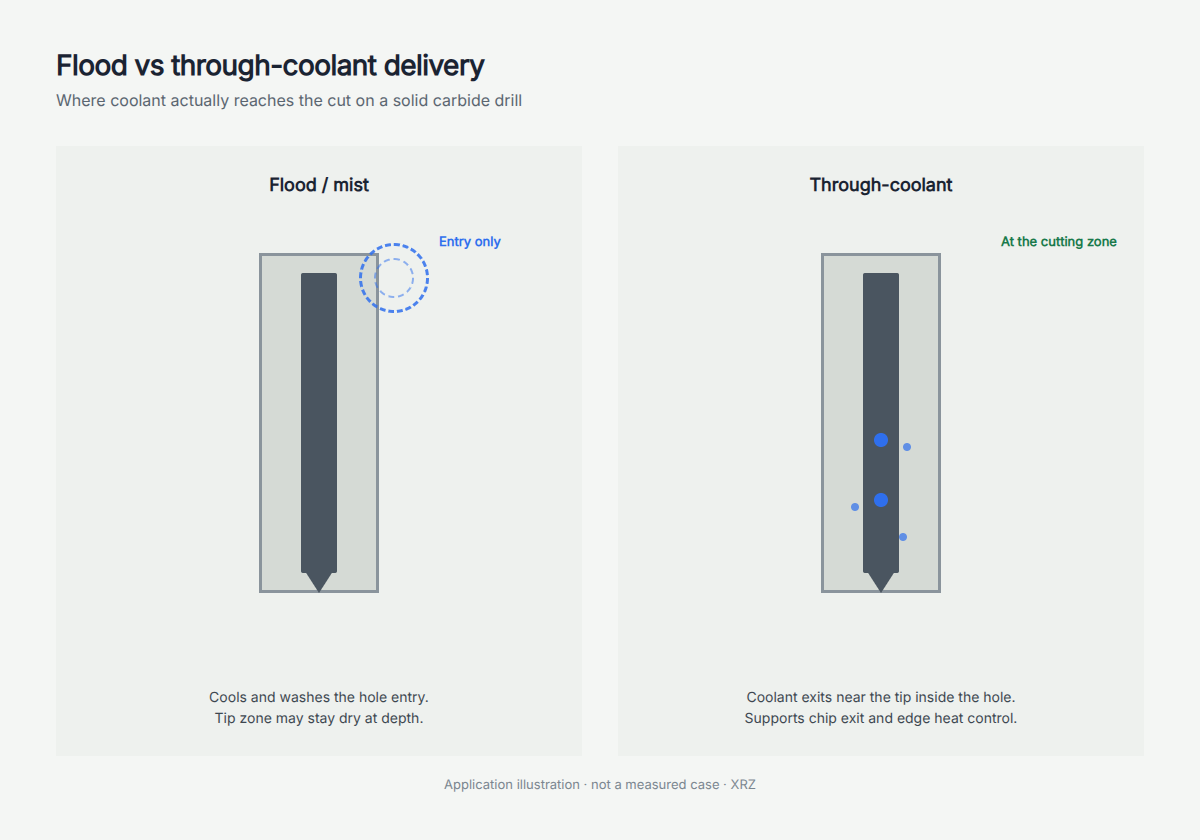
Flood that looks fine at the entry can still leave a dry tip. Through-coolant that looks fine on the gauge can still be dry at the outlets after filter, rotary union, or holder losses. XRZ reads delivery as a system—tool channels + machine path—not a catalog checkbox. For minimum-quantity lubrication, see MQL drilling and reaming tool requirements.
Product boundary when TSC is real on the machine: Through-coolant carbide drill · family: Solid carbide drill.
Triggers that push you to through-coolant
Use these as shop heuristics (inference)—not a fake bar chart or fixed L/D law.
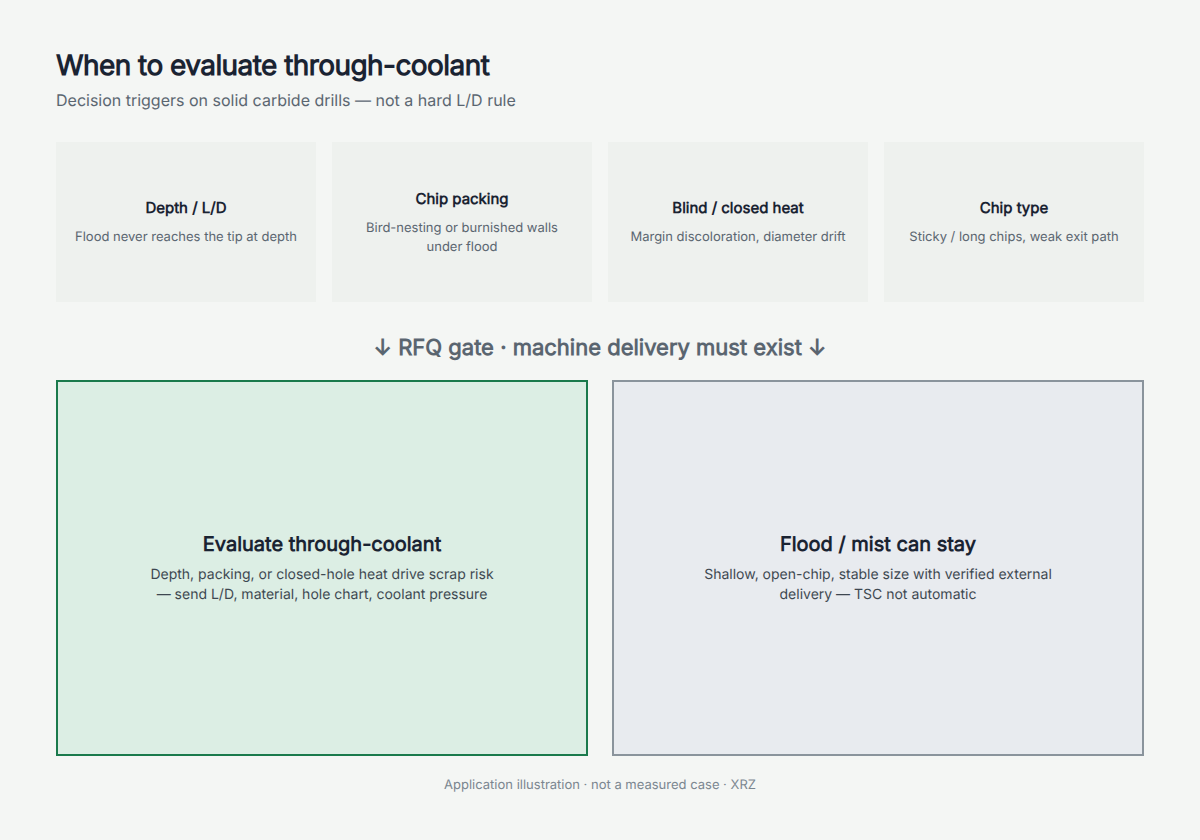
Depth / L/D
As depth rises, external nozzles lose reach. When chips stop clearing and heat marks climb the margin after the first diameters, through-coolant enters the conversation. Exact peck bands and escape rules stay Soft on Deep-hole carbide drilling—do not treat this page as a peck encyclopedia. Depth-class product Soft: Deep-hole carbide drill.
Chip packing
Packed flutes, bird nests at exit, or sudden torque spikes after a clear start are packing signals—not “buy a different coating first.” Triage Soft: Carbide drill chip-packing checklist.
Blind / closed / cross holes
Blind bottoms and interrupted cross features trap chips; flood often never reaches the zone that fails. Note blind / through / cross on the hole chart before freezing delivery.
Heat at the edge
Blue chips, burnished walls, thermal notch near the margin after “wet-looking” entry → delivery failed in the cut. That is a through-coolant (or process-depth) gate, not a mystery grade story.
Chip type / material
Long, stringy steel chips and sticky stainless behave differently from short-breaking aluminum. Flood that “works on aluminum” can still fail when chip form changes—even at similar L/D. Put material and chip notes on the RFQ; do not invent a universal material cutoff here.
When flood can still be rational
Flood or mist remains a fair call when:
- The print is shallow, chips clear without packing, and size/finish hold without heat marks.
- Material and chip form cooperate (short chips, open exits).
- Machine TSC is absent and the team deliberately runs shorter depth / more pecks with verified external wetting—expectation matches delivery.
- Scrap mode is entry/fixturing/runout led, not tip-dry packing—fix those first (Soft: Why solid carbide drills break).
Do not force a through-coolant SKU as a slogan when the spindle path is sealed dry. Prefer geometries and flute volume that tolerate the actual delivery method, then RFQ honestly with “TSC unavailable.”
Milling on the same holemaking line stays Soft support only: Milling as a supporting process—this page does not restate mill catalogs.
Do not confuse with peck strategy or coolant-hole geometry
Three different decisions get mixed in RFQs:
| Decision | Owns the answer | Soft link |
|---|---|---|
| Need through-coolant vs flood? | This page — process delivery gate | — |
| How to peck / escape chips at depth? | Deep-hole L/D · peck · chip escape | Deep-hole carbide drilling |
| Helical vs straight holes in the blank? | Channel layout after TSC is justified | Helical vs straight coolant holes |
Peck frequency does not replace missing tip coolant. Helical rod photos do not replace pump pressure. Justify through-coolant first; then choose peck plan and blank channel style on their own pages. Gun-drill / BTA systems are out of scope here—this page stays on solid carbide drill delivery decisions.
Machine side: pressure, filtration, foam — RFQ must-ask
(Heuristic class · inference—not XRZ measured plant tables.)
Before blaming point angle or coating—Tuesday’s “gauge says OK” still leaves dry outlets at stickout:
- Confirm coolant exits both (or all) tool outlets at intended stickout—paper/hose observation per plant practice.
- Record machine setpoint and what the tool likely sees after filters, rotary union, and holder losses.
- Note filtration state, recent filter changes, and foam / air-ingestion that starve flow.
- Change one delivery variable at a time; attach photos of chips and outlets.
| RFQ field | Why it matters |
|---|---|
| TSC available? (yes / no / unknown) | Separates tool capability from machine path |
| Coolant pressure setpoint (bar) or unknown | Delivery fact—empty beats invented |
| Flow available / unknown | Pressure alone does not prove volume at tip |
| Filtration / foam notes | Sudden pack after filter change is a supply story |
| Holder / stickout / rotary-union path | Losses between gauge and outlets |
| Outlet check done? (yes/no + photo) | Dry outlets + “gauge OK” ≠ geometry failure |
No fake L/min or bar charts presented as XRZ shop measurements. Application targets belong in RFQ review and sample validation.
What to send XRZ (through-coolant drill RFQ pack)
| Must send | Why |
|---|---|
| Controlled drawing + revision; hole chart (Ø · depth · blind/through/cross) | Freezes L/D and exit path |
| Material / condition + chip-form notes | Chip packing / heat gate |
| Current delivery: flood / mist / TSC / unavailable | Matches tool to machine |
| Coolant pressure / flow or unknown + filtration notes | Machine-side honesty |
| Scrap mode: packing · heat · size drift · breakage | Decision evidence |
| Volume band + peck practice today (short note) | Expectation without peck encyclopedia |
| Sample / first-article yes-no + written acceptance | Validate before production talk |
Field map Soft: Solid carbide drill RFQ checklist. Intake: Custom Cutting Tool RFQ. Products: Solid carbide drill · Through-coolant carbide drill · depth Soft: Deep-hole carbide drill. Service loop: drawing → engineering screen → first-article / sample validation → production revision control. Quality soft: Manufacturing Quality Evidence. No public prices on this page.
Hard CTA: Send Your Drawing (through-coolant vs flood · L/D · material · hole chart · coolant delivery notes)
Frequently Asked Questions
### Is through-coolant always required above a fixed L/D?
No. L/D raises the priority of evaluating tip delivery and chip escape, but XRZ does not publish a hard “above X×D → must TSC” plant rule on this page. Depth, chip type, hole type, and real machine delivery decide together. Peck and deep-hole execution Soft: Deep-hole carbide drilling (L/D, peck, chip escape).
Flood works on aluminum but fails on steel chips—when do I switch?
Switch when packing, heat marks, or size drift appear under the same external delivery after the chip form changes—stringy steel / sticky stainless often need tip push that flood cannot give at depth. Put material and chip notes on the RFQ; triage Soft: Carbide drill chip-packing checklist. Do not invent a universal alloy cutoff here.
Through-coolant vs helical/straight coolant holes in the drill body?
Different layers. Through-coolant = process need for coolant through the tool vs flood. Helical vs straight = blank channel geometry after that need is justified. Channel compare Soft: Helical vs straight coolant holes in carbide drills. Product: Through-coolant carbide drill.
What coolant pressure / filtration fields belong on the RFQ?
Send TSC available (yes/no/unknown), pressure setpoint or unknown, flow if known, filtration/foam notes, holder/stickout path, and whether outlets were checked at stickout. Empty fields beat invented numbers. Full field map: Solid carbide drill RFQ checklist → Custom Cutting Tool RFQ.
Next step
- Soft — Depth / packing / channel / route / breakage context: Deep-hole carbide drilling · Helical vs straight coolant holes · Chip-packing checklist · Drill RFQ checklist · Hole process route · Why solid carbide drills break.
- Product — Solid carbide drill · Through-coolant carbide drill · depth Soft: Deep-hole carbide drill.
- Hard — Send Your Drawing / Quick RFQ with L/D, material, hole chart, and coolant delivery notes.
Do not guess “need through-coolant” from a catalog checkbox. Run the decision gate, separate peck and blank-channel choices, then stay through first-article when chips or heat talk back—with sample validation and Manufacturing Quality Evidence in the loop.