
Short answer. Spot/pilot and first-contact conditions often decide whether a carbide drill walks, chips at entry, or breaks in the first diameters. Match pilot diameter and depth to the finish drill; control runout and workholding before changing grade. Deep holes still follow chip-escape rules (deep-hole). Send entry photos, pilot size, and L/D. XRZ aligns the print, writes sample acceptance before first metal, and stays on first-off (sample validation · drill RFQ checklist → Custom Cutting Tool RFQ).
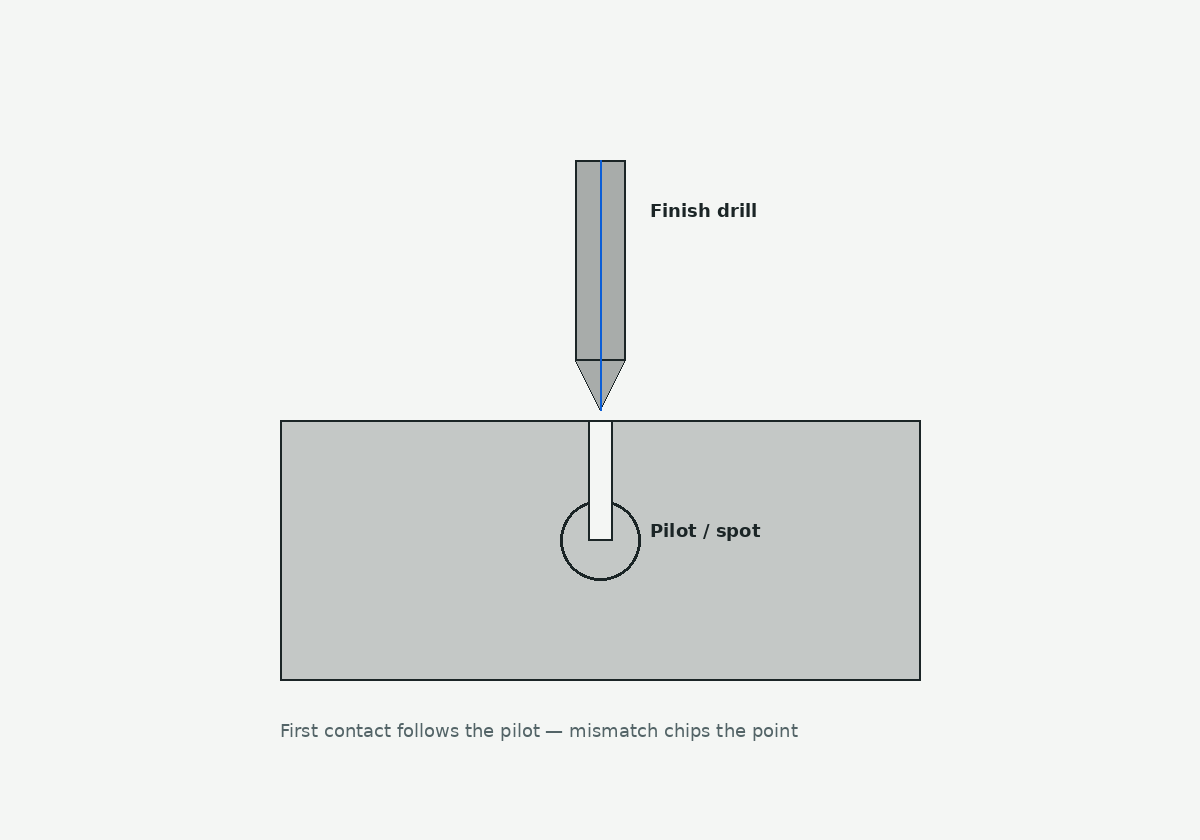
Opening
A solid carbide drill that chips only in the first diameters—or walks into an oversize bellmouth—often fails at entry, not at mysterious mid-depth “grade weakness.”
This page is a pilot-hole and entry-control playbook for solid carbide drilling: when a spot or pilot helps, when it creates a dangerous step, and how to stabilize first-contact load before you change carbide grade. It is not a deep-hole peck encyclopedia (deep-hole L/D, peck, chip escape), not an exit-breakout guide (exit breakout & burr control), and not a reamer allowance article (reamer allowance).
When a Pilot or Spot Helps—and When It Creates a Step That Chips
| Situation | Pilot/spot often helps | Pilot/spot can hurt |
|---|---|---|
| Hard entry / cast skin / angle | Spot to establish center and reduce walk | Oversized spot that leaves a shoulder the finish lips hit |
| Long L/D start | Short, concentric pilot for guidance | Deep pilot with poor concentricity—finish drill follows the error |
| Precision position | Controlled spot under good spindle | Soft fixture; pilot cannot fix a moving part |
| Interrupted entry | Plan entry strategy with interrupted-cut rules | Blind faith pilot through a window without shock plan |
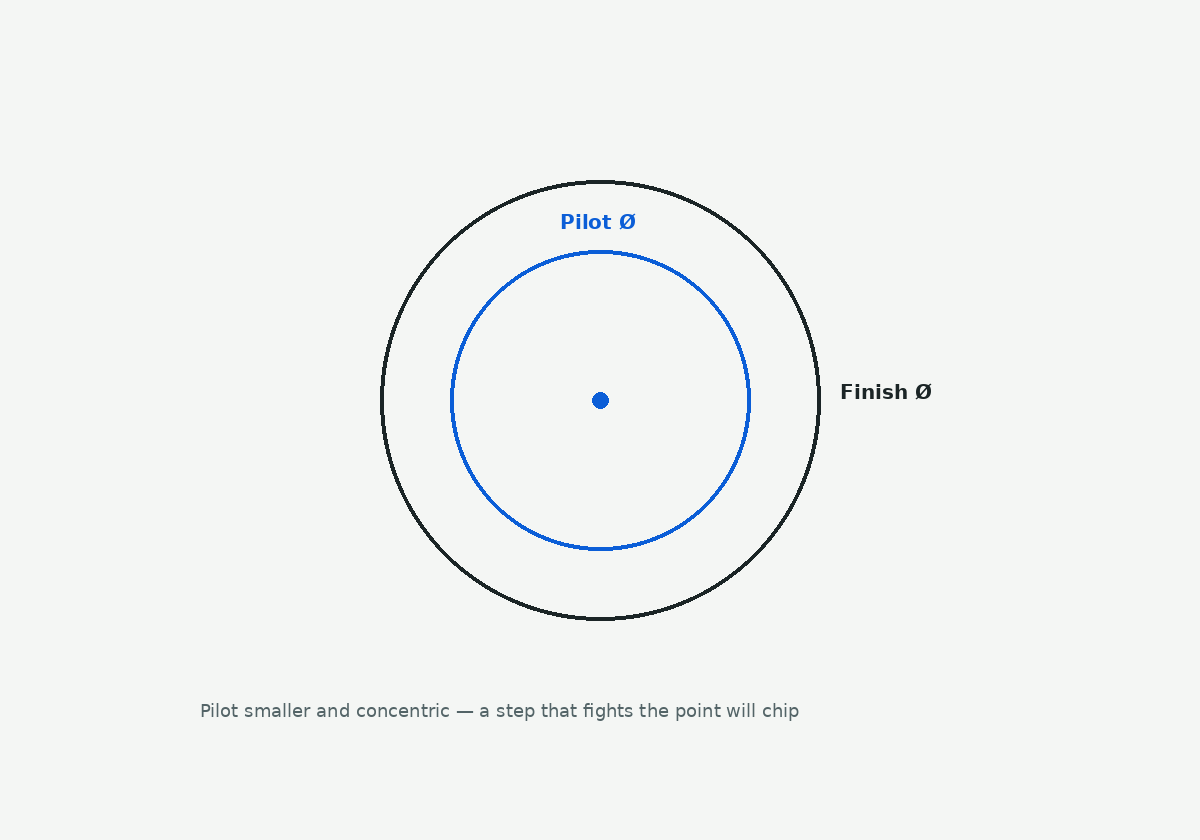
Rule of thumb (inference): the pilot should leave the finish drill a smooth engagement, not a square step that shocks both lips. If the finish drill chips only on entry lips, photograph the step and measure pilot Ø vs finish Ø before resizing the finish grind.
Entry Load: Chamfer, Angle Match, Interrupted Starts
First-contact load rises when:
- Spot/pilot angle fights the finish point (mismatched cones).
- Chamfer or countersink leaves an abrupt land.
- The drill enters on a slope, weld, or interrupted face (interrupted cut / cross-hole).
Stabilize workholding and programmed approach; do not “sneak feed” past a crash that the photo already explains. Exit-side breakout is a different page—exit breakout & burr control—do not mix exit fixes into entry RFQs.
Alignment and Runout Before Feeds
Measure assembled runout at production stickout before debating SFM. A pilot cut under high runout teaches the finish drill to follow an orbit. Setup practice: Stickout, runout & toolholders. Oversize diagnosis after a “new” drill: Oversized holes with a new carbide drill.
No universal feed table on this page.
Hand-Off: Deep-Hole, Through-Coolant, Breakage
| If the failure is… | Go here |
|---|---|
| Packing / peck / L/D past entry | Deep-hole L/D, peck, chip escape |
| Flood vs TSC delivery | When flood coolant is not enough |
| Snap / heat break after entry | Why solid carbide drills break |
| Finish ream stock after create hole | Reamer allowance · Pre-hole quality (reamer path—not drill pilot) |
Products: Solid Carbide Drill · Through-Coolant Carbide Drill · Deep-Hole Carbide Drill.
RFQ Fields for Entry Problems
Send:
- Entry photos (bellmouth, lip chip, step)
- Spot/pilot Ø, depth, and tool used (or “none”)
- Finish drill Ø, point angle if known, stickout/runout
- L/D and blind/through
- Fixture notes and interrupted-entry sketch if any
- Drawing + material
Checklist → form: Solid Carbide Drill RFQ Checklist → Custom Cutting Tool RFQ.
Entry chips look like a grade problem until the photo shows the step. Send the entry shots; XRZ stays on first-off until the step, runout, or interrupted face has a name (sample validation).
Frequently Asked Questions
Do I always need a pilot before a carbide drill?
No. Many holes start successfully with a proper spot or direct entry under good runout. Use a pilot when walk, hard skin, or alignment risk justifies it—and size it so the finish drill engages smoothly.
How should pilot diameter relate to the finish drill?
Keep the pilot concentric and sized so the finish point takes a controlled cut—not a square shoulder hit. Exact Ø relationships are application-specific; send both diameters and photos in the RFQ rather than copying a universal percentage chart.
Why does the drill chip only at entry?
Common causes: mismatched spot/pilot step, runout at first contact, interrupted or angled entry, or excessive first-contact load. Mid-depth packing is a different failure—see deep-hole and breakage pages.
What entry data belongs in an XRZ RFQ?
Entry photos, pilot/spot size and depth, finish drill Ø, measured runout/stickout, L/D, fixture notes, and drawing → drill RFQ checklist → RFQ. ---
The best ending is not a new grade sticker. It is an entry that matches the photo, a quote that matches the drawing, and someone still answering when first-off chips for a boring reason.
Next steps:
Deep-hole L/D, peck, chip escape ·
Why solid carbide drills break ·
When flood coolant is not enough
Solid Carbide Drill ·
Drill RFQ Checklist ·
Custom Cutting Tool RFQ