
The traveler says “PCD for aluminum,” but the scrap photos disagree. 6061 leaves a burr trail; ADC12 eats the edge mid-shift; A390 glazes and then chips; a CFRP stack frays when the same “sharp” hone that worked on 6061 is copied over. Grain size and edge preparation are not a brand slogan—they change wear mode, edge strength, and exit quality. Picking one PCD setup for every Si band is how RFQs turn into silent scrap.
This page owns PCD-internal starting bands: fine vs coarse grain and hone/chamfer/polish tendencies by aluminum Si band (6061 · A356/ADC12 · A390) plus CFRP edge tendency. It does not rewrite Si% → PCD vs carbide for reaming—that page decides material class; this page decides which PCD grain/edge to trial inside PCD. Speed/feed stays on its own page; CFRP stack and delamination stay on the CFRP challenges page.
Fine vs coarse PCD grain and hone/chamfer/polish change wear mode, edge strength, and burr tendency—but the right pick depends on Si content, abrasiveness, and whether the cut is continuous metal or fiber stack. Treat recommendations as starting bands to validate on your diameter, rigidity, and coolant—not copy-paste SFM tables. Send alloy/Si% (or stack layup), bore IT, and failure photos. XRZ proposes a starting band in writing, freezes sample accept, and stays on first-off (sample validation · how PCD reamers are made · RFQ checklist).
1. What grain size and edge prep actually control
Skip what the edge is actually doing, and the alloy table is just names. Lock the levers first:
| Lever | Tends to influence | Failure you see when it is wrong |
|---|---|---|
| Finer PCD grain | Sharper edge possible; often better finish potential on less abrasive alloys | Edge may chip sooner under abrasive Si or interrupt shock |
| Coarser / mixed grain | Wear resistance on abrasive Si; tougher edge under abrasion | Finish and burr may worsen if the edge is left too blunt for the alloy |
| Light hone / keen edge | Lower cutting force; less burr on ductile Al | Micro-chipping on high-Si or interrupted fiber |
| Heavier hone / chamfer / reinforced edge | Edge strength under abrasion and shock | Higher force, possible burnish/burr if overdone on soft Al |
| Polish / edge finish | Chip flow and built-up edge tendency on sticky Al | Not a substitute for wrong grain on A390-class abrasion |
All rows are industry-consensus heuristics labeled inference. They are not XRZ-measured absolute micrometre hone tables. Diameter, machine rigidity, coolant, and pre-hole still move the result. For whether PCD belongs at all vs carbide at a given Si%, use aluminum silicon content: PCD vs carbide reaming—then come back here for grain/edge inside PCD.
Vc and feed bands live on PCD reamer cutting speed and feed for aluminum; do not steal that encyclopedia into a grade RFQ.
2. Alloy map (heuristic): low / mid / high Si → grain and edge tendency
Label clearly: inference / starting band. Alloy names below are common RFQ shorthand; confirm Si% from the material cert—castings labeled “ADC12” can sit in a band, not a single number.
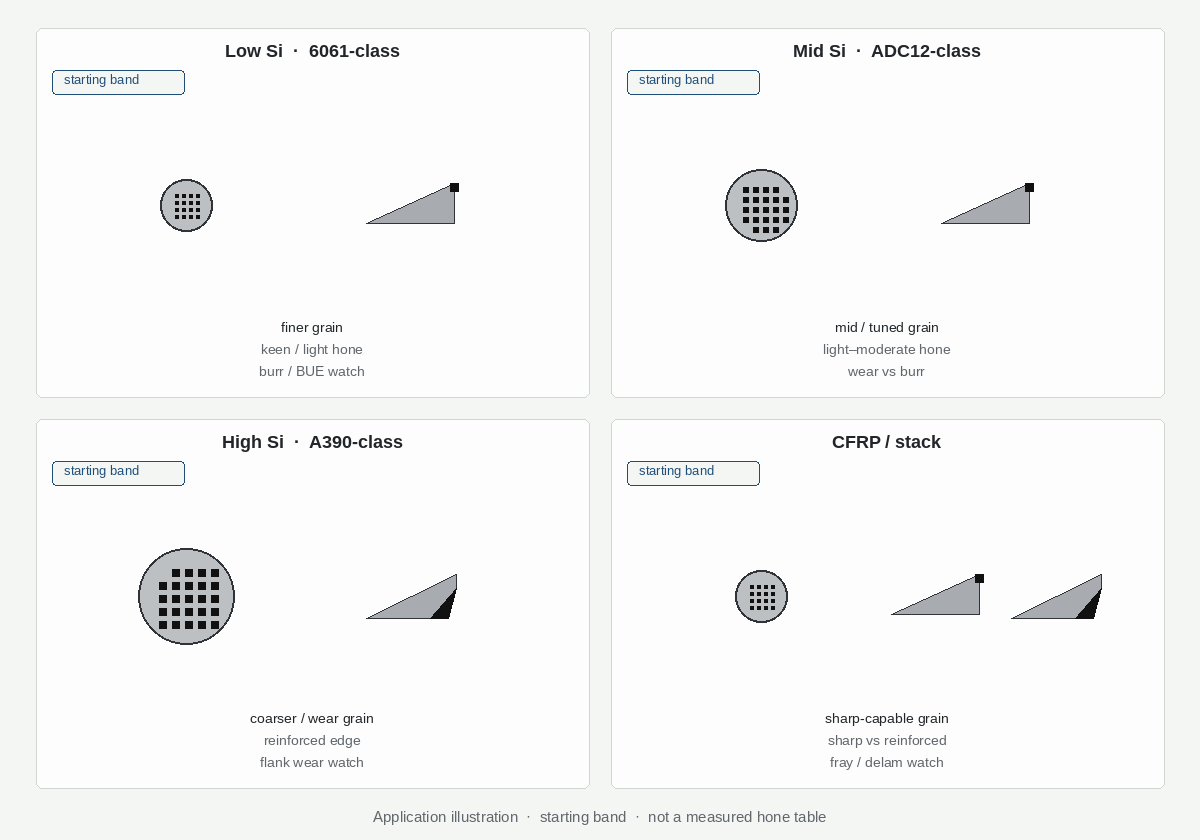
| Alloy band (examples) | Si / abrasion tendency | Grain starting band | Edge prep starting band | Must validate |
|---|---|---|---|---|
| Low Si wrought-ish (e.g. 6061-class) | Lower primary Si abrasion; ductile, burr-prone | Finer grain often preferred for finish | Keen / light hone; avoid over-blunting | Burr height, Ra, BUE photos; do not copy A390 hone here |
| Mid Si cast (e.g. A356 / ADC12-class band) | Moderate abrasive Si; common automotive housings | Mid or application-tuned grain—balance wear vs edge | Light-to-moderate hone; polish if BUE shows | Wear land growth vs chip/burr; Si% from cert |
| High Si (e.g. A390-class band) | High abrasive Si; edge wear accelerates | Coarser or wear-oriented grain tendency | More reinforced edge / hone vs razor; still not a fake µm table | Flank wear photos, chipping vs polish, IT drift over sample lot |
| CFRP / fiber stack | Fiber abrasion + peel/fray risk—not metal Si | Often fine, sharp-capable grain for clean fiber cut—trade-off vs durability | Sharp vs reinforced: sharp favors clean fibers; reinforce if edge dies early—see CFRP page | Entry/exit fray, delam depth, edge photo after N holes |
Gates (write them before volume):
- Material cert (alloy + Si% or layup) matches the band you assumed.
- Sample lot shows the scrap mode you meant to fix (burr vs wear vs chip vs fray).
- Diameter, holder runout, and coolant are the production stack—not a lab arbor.
- First-article accept list is written (sample validation).
How the edge is ground and inspected on a new tool is process context on how PCD reamers are made—soft link; this page does not rewrite grind SOP.
3. CFRP / stack: sharp vs reinforced—and what this page does not own
CFRP is not “high-Si aluminum with different chips.” Fiber orientation, binder, and stack exits drive fray and delamination. This page only states a grain/edge tendency: start sharp enough to cut fibers cleanly; reinforce if the edge micro-chips or rounds too fast; validate on the real stack.
Do not rewrite laminate strategy, peel-up control, or full CFRP process encyclopedia here. Open PCD tools: CFRP machining challenges for stack and delam. Soft-link it from every CFRP RFQ that also asks for grade.
If one traveler mixes aluminum bores and CFRP holes, treat them as two grade/edge decisions—see FAQ—unless a controlled trial proves one setup covers both scrap modes.
4. Why one PCD setup does not copy across alloys
Copying a “winning” 6061 hone onto A390 (or the reverse) fails for mechanism reasons, not superstition:
- Wear mode changes with Si abrasiveness. Low-Si scrap is often burr/BUE; high-Si scrap is often flank wear then chip. The same keen edge that clears 6061 can die early on A390-class Si.
- Edge strength vs sharpness is a trade-off, not a free upgrade. Heavier prep buys strength and can buy burnish on soft Al.
- Machine and Ø change the load. A fine edge that survives on a rigid short stickout may chip on a long projection—even in the same alloy.
- Cost per accepted hole cares about the scrap mode you actually have, not the catalog grade name. Soft context: cost per accepted hole.
So the RFQ should carry failure photos + cert, not only “use PCD.”
5. RFQ fields + sample validation + service loop
A catalog grade name is not a process. The useful path:
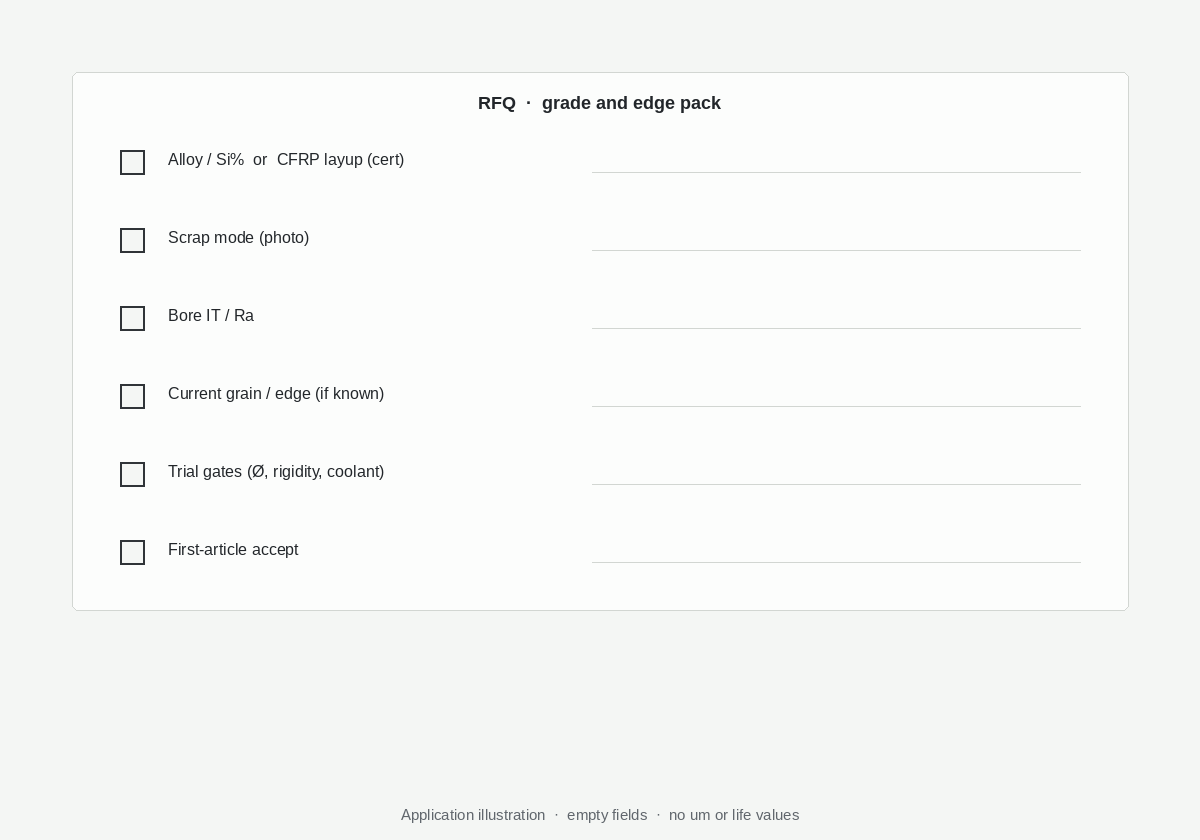
- Receive material certs (alloy/Si% or CFRP layup), bore IT/Ra, scrap mode photos, current grain/edge if known, diameter and machine notes.
- Propose a starting band (grain + edge prep tendency)—written as trial gates, not a life-% claim.
- Written acceptance on the sample lot; stay on first-off until the scrap mode moves the right way (sample validation).
Grade / edge RFQ pack
- Alloy designation + Si% from cert (or CFRP stack / resin note)
- Bore Ø, IT, Ra, hole type if it changes edge shock
- Current tool grade/edge (if any) and scrap photos
- Coolant, holder class, typical stickout
- Annual volume and whether regrind is in scope
Fields: PCD Reamer RFQ Checklist → Custom Cutting Tool RFQ. Product family: Custom PCD Reamer.
Frequently Asked Questions
Is finer PCD always better for aluminum finish?
No. Finer grain often helps finish potential on lower-abrasion alloys, but on high-Si abrasive aluminum a finer, razor edge can chip or wear in a mode that ruins finish mid-lot. Match grain to Si band and scrap mode; validate Ra and wear photos on your Ø—not a slogan.
What changes from ADC12 to A390 for edge prep?
Expect a shift toward more wear-oriented grain and a more reinforced edge as primary Si abrasion rises—still as a starting band, not a copy-paste micrometre table. Confirm Si% on the cert; A390-class scrap is often flank wear then chip, while mid-Si cast may still show BUE/burr. Trial gates and first-article accept before volume.
Can the same grade serve aluminum and CFRP?
Rarely as a default. Aluminum Si abrasion and fiber fray/delam are different scrap mechanisms. One setup only after a controlled trial proves both modes stay in accept. Keep CFRP stack tactics on CFRP machining challenges; use this page for the grain/edge tendency note.
What material data should an RFQ include for grade selection?
Alloy + Si% from cert (or CFRP layup), bore IT/Ra, scrap photos, current grade/edge if known, Ø/machine/coolant, volume → RFQ checklist → sample validation → Custom Cutting Tool RFQ. For PCD vs carbide at Si%, start at Si content PCD vs carbide.
Next step
The best ending is not one hone copied across 6061, ADC12, A390, and CFRP. It is a starting band that matches the scrap photo, written sample accept, and someone still answering when the first-off burrs or chips.