
A port tap snaps at the bottom of a blind hole in an aluminum valve block that already carries every other feature. On the next housing nothing breaks, yet the thread gauge stops short of the depth on the drawing, because the tap's lead and the drill point used up the room below the thread. Both problems were decided one step earlier, when the tap drill size and the drilling depth went onto the routing.
In aluminum housings and manifold blocks, size the tap drill and the drill depth first. Thread milling is the safer route for blind holes threaded close to the bottom, thin walls, high-value parts and threads that need size compensation. Tapping is faster for high-volume through holes. For high-silicon aluminum, consider a PCD thread mill.
If your threads are in ferrous parts, see the solid carbide thread mill.
Tap Drill Size Comes First
For a cutting tap in ISO metric threads, the usual tap drill is the nominal diameter minus the pitch, which matches the drill sizes ISO 2306 lists for these threads. An M8×1.25 thread takes a 6.8 mm drill, and an M10×1.5 thread takes an 8.5 mm drill. The drilled hole becomes the minor diameter of the internal thread, so the drill belongs to the thread callout as much as the tap does.
A forming tap cuts no chips. It pushes the aluminum into the thread shape, so it needs a larger hole than a cutting tap of the same size, and the cutting-tap drill leaves it too much metal to displace. Take the hole size for a forming tap from the supplier's data for that exact tap. If the routing may switch between cutting and forming taps later, the drill has to change with it.
For thread milling, choose the drill against the minor-diameter limits on the drawing. The thread mill is sized to enter that hole and orbit inside it, cutting the flanks and the root as it travels along the helix. A drill that suits a cutting tap usually suits a thread mill too, which keeps both options open on the same port; check it against the drawing before you rely on that.
Hole size in aluminum also drifts with the drill. Built-up edge on a worn drill can open the hole, and an oversize hole leaves shallower thread flanks. Neither a tap nor a thread mill puts that metal back, so a thread short on engagement often traces back to the drill.
The Blind-Hole Depth Budget
A blind threaded hole usually carries two depths on the drawing: the full-thread depth and the drill depth. The space between them is a budget, and several things draw on it:
- The drill point. The hole reaches full diameter only above the point cone. Below that, there is not enough diameter to thread.
- The tap lead. The first threads on a tap are ground back into a chamfer so it can start in the hole. They cut incomplete threads, so the tap has to travel past the full-thread depth by the length of its lead.
- Room under the tap. Chips that fall or are pushed ahead of the tap need somewhere to collect, and the tapping cycle needs space to stop and reverse before the tap touches the bottom.
Work the budget from the top down. Start at the full-thread depth, add the lead and the clearance of the tap you plan to run, then add the drill point. That total is the drill depth to the point tip; if the drawing gives drill depth to full diameter, leave the point out of the sum. Compare it with what is below the hole: a floor, a cored cavity or another passage. If the drill would break through or leave too little wall, the tap does not fit the hole as drawn.
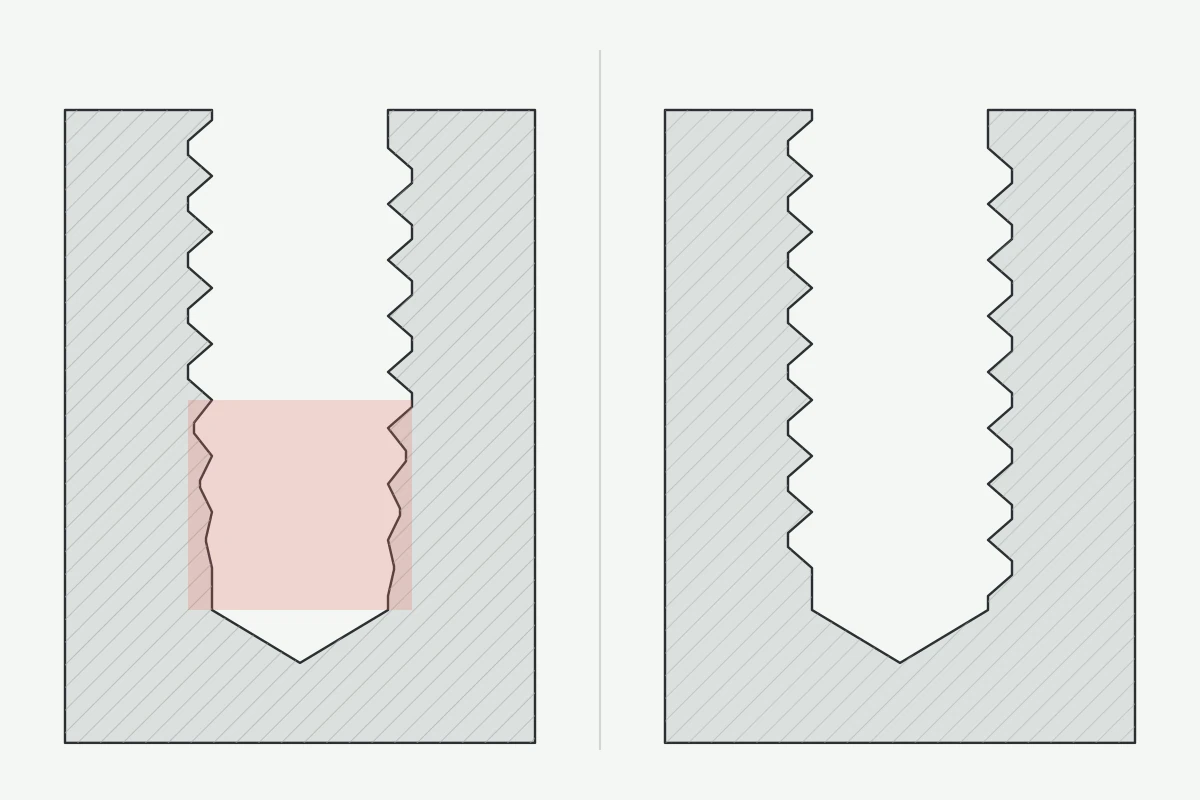
A thread mill has no lead to allow for, so its full thread can reach nearer the floor of the full-diameter section. It still needs clearance under its end tooth and space for chips. When the floor is the limit, a flat-bottom drill can remove the point cone and give that depth back to the thread; see flat-bottom carbide drills for blind holes.
Thin Walls, High-Value Housings and Manifold Ports
The drill and the depth budget decide whether a tap can reach the thread. Three conditions on aluminum housings decide whether a tap should be used at all.
Thin walls and bosses. A tap engages the full circle of the thread at once and carries the whole cutting torque into the wall. Around a port close to an outside face, or in a thin boss on a cast housing, that torque can push the wall out of shape, and the thread or the sealing face moves with it. A thread mill engages a short arc at a time while the machine carries it around the hole.
High-value housings. The port threads are often among the last features cut on a housing. A tap broken in a blind port of a finished part is hard to remove without marking the thread. A thread mill's body is smaller than the minor diameter of the thread, so a broken one has clearance around it and usually comes out more easily. When the gauge shows the thread running small, a radial offset change in the program opens it on the same part and holds it on the next ones. An oversize thread cannot be recovered that way.
Manifold ports and cross holes. In a manifold block, oil passages often break into a port or its pre-hole. The drill meets the intersection first, and that entry is a separate problem covered in carbide drill interrupted cuts and cross holes. Afterward a tap entering the threaded section loses support on one side at the opening, while a thread mill passes the gap on each orbit.
Tapping still earns its place on thick-walled through holes, on parts where a lost thread costs little, and on long runs where a cutting tap already holds the gauge. For the drilling side of oil passages, crossings and port steps, see hydraulic manifold drilling.
Wrought vs High-Silicon Aluminum
Treat wrought and high-silicon aluminum as two separate thread jobs.
Wrought aluminum. Alloys machined from bar, plate or extrusion are soft and ductile. Chips come off long and sticky, built-up edge forms on drills and taps, and chips that pack a blind hole are a common cause of a torn thread or a seized tap. The tool decision here turns on chip control and edge condition. For thread milling in wrought aluminum, send the thread callout and alloy so the tool can be reviewed against the part before one is chosen.
High-silicon aluminum. Cast housings with high silicon content carry hard particles that wear cutting edges quickly. On a thread tool, the thin teeth that form the thread wear first, so the form loses shape and the size drifts during the lot. That is where a PCD thread milling cutter fits. How silicon content changes drilling and reaming on the same housing is covered in high-silicon aluminum hole machining.
What to Send
With these details, the drill and the thread tool can be specified as one operation:
- Thread callout: standard and designation, pitch and tolerance class
- Full-thread depth and drill depth as drawn
- Through or blind, and how much material or space is left below the hole
- Aluminum alloy designation, and whether it is a high-silicon casting
- Wall thickness around the port, and any passages that cross it
- Batch size
- Whether the machine can interpolate X, Y and Z together
Send the thread callout, hole depth and alloy through the custom cutting tool RFQ; we review the drill and the thread tool together.
Frequently Asked Questions
What tap drill size should I use for an M8 or M10 thread in aluminum?
For a cutting tap, use the nominal diameter minus the pitch: a 6.8 mm drill for M8×1.25 and an 8.5 mm drill for M10×1.5, following ISO 2306. A forming tap needs a larger hole, so take its size from the tap supplier's data. For thread milling, check the drill against the minor-diameter limits on the drawing.
How much extra depth does a blind tapped hole need?
There is no single figure. Add up what sits below the last full thread: the tap's lead, room for chips and for the tapping cycle to stop, and the drill point below the full-diameter section. Take the lead from the tap you will run and the depth limits from the drawing. A thread mill needs less of this budget because it has no lead, and a flat-bottom drill removes the point cone.
Why thread mill a thin-wall aluminum housing instead of tapping it?
A tap applies torque around the whole thread at once, which can distort a thin boss or a port near an outside face. A thread mill cuts a short arc at a time, its size can be adjusted in the program, and a broken one has clearance around it in the hole, so a finished housing is less likely to be lost. On thick walls, through holes and long runs, tapping is usually faster.
When does a thread in aluminum need a PCD thread mill?
When the part is high-silicon aluminum, typically a cast housing, and the silicon wears conventional thread tools so the form and size drift during a lot. PCD keeps its edge in that abrasive material. Send the alloy designation with the thread callout; threads in wrought aluminum are reviewed from the same information.