
On the High-Si Al finish station, carbide flanks polish out mid-batch, diameter offsets stack until the window is gone, and changeovers burn the shift—yet the scrap note still says “Al-Si / ADC12” without naming whether the edge died from abrasive silicon wear, an unstable create-hole, or runout shock. Process and purchasing already know the alloy family; what they need is a callable decision: specify a PCD reamer on the print now, or fix the process and stay on carbide first.
This Knowledge page owns when to specify a PCD reamer for High-Si Al holes: selection gates (Si% is one input—not a hard rule), architecture forks tied to the bore stack (straight / guided / step / combination), and the RFQ pack XRZ needs to quote without guessing. Material abrasion framing stays on Aluminum silicon content — PCD vs carbide reaming; family compare stays on PCD reamer vs carbide reamer; housing application stays on High-silicon aluminum hole machining. Allowance and cost framing soft: Allowance & pre-hole size · Cost per accepted hole. Tool path soft: How PCD reamers are made · Manufacturing Quality Evidence. XRZ reviews the drawing, then first-article / sample validation—not a catalog life multiplier.
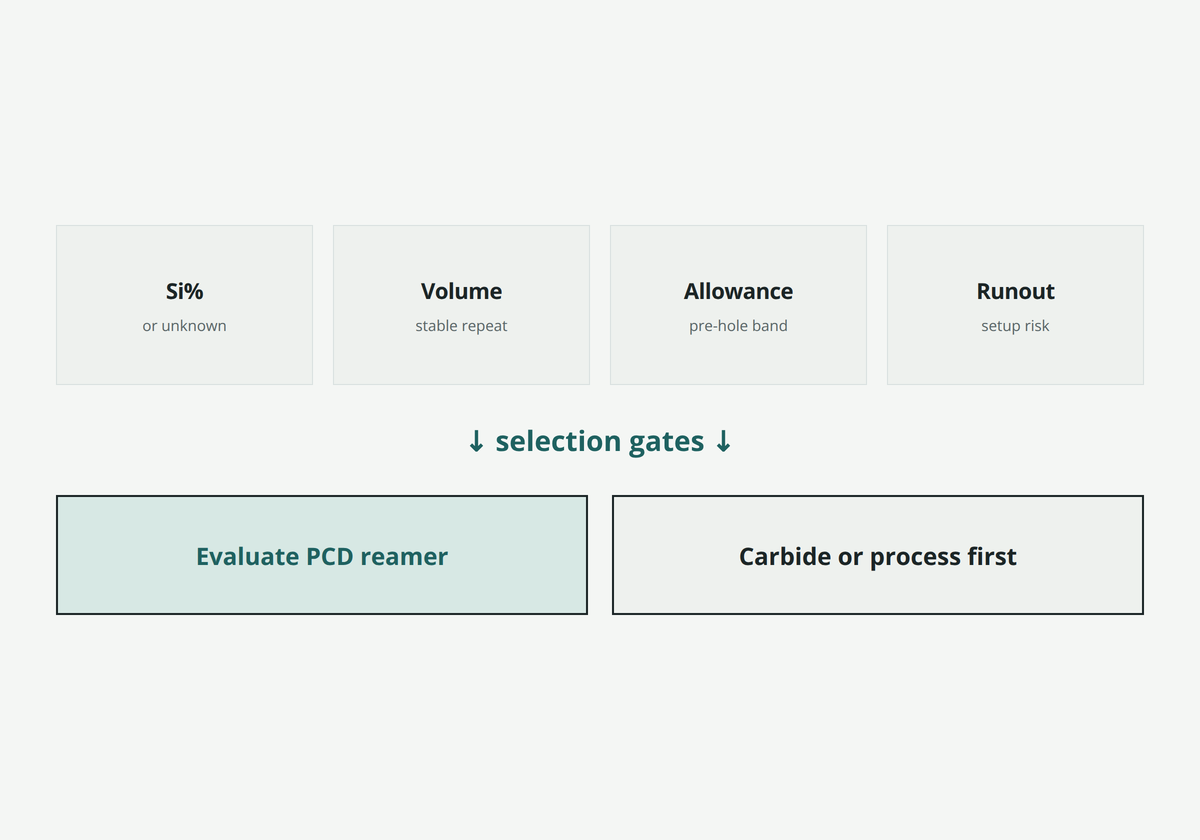
Yes — evaluate / specify PCD for High-Si Al (Al-Si) finish holes when abrasive silicon wear and diameter/finish drift dominate scrap on a stable, repeat bore, and when measured pre-hole allowance, assembled runout, coolant/chip path, and interruption risk are controlled enough for diamond to wear abrasively instead of chip. No — keep carbide or fix process first when volume is low, the print still churns, create-hole/allowance is unknown, measured runout or stickout would overload one edge, or scrap is adhesion/BUE-only without a stabilized coolant and create-hole handoff. Higher Si% raises evaluation priority; it does not auto-select PCD. XRZ screens alloy/Si% (or marks unknown), bore GD&T, create-hole method, scrap mode, volume window, and holder/coolant constraints from the drawing before proposing straight, guided, step, or combination architectures—then validates under agreed acceptance criteria.
Short answer: when a PCD reamer is (and isn’t) the High-Si call
Call PCD into the finish-bore conversation when:
- Scrap mode is abrasive flank polish and/or diameter offset stacking on the Al-Si finish hole—not a one-off adhesion smear or a first-off that never repeated.
- The bore is repeat production (or a locked program window), not a prototype print that still revises weekly.
- Create-hole method and a measured incoming diameter / allowance band exist; coolant delivery and chip path clear abrasive Al chips instead of packing the flute.
- Assembled runout under production stickout is known (or will be measured before trial)—so diamond can wear from Si abrasion, not from unequal edge load.
- Cost-per-accepted-hole thinking (interventions + scrap + changeover burn) favors evaluating PCD under a shared baseline—see Cost per accepted hole—not a remembered life slogan.
Keep carbide (or fix the process) first when:
- Volume is low, drawings change, or dedicated PCD inventory would obsolete before abrasion payback.
- Pre-hole is undefined, allowance unknown, or create-hole quality is the real scrap driver—stabilize the handoff before freezing diamond geometry. Soft: Allowance · Pre-hole quality.
- Measured runout, interruption/cross-hole shock, thin-wall entry, or weak fixturing would chip PCD before abrasive savings appear.
- Failure mode is adhesion/BUE-only and the team has not yet stabilized coolant, edge prep, and create-hole condition.
- Si% is unknown and the scrap story is unclear—mark Si% unknown on the RFQ; do not invent a Si% cutoff as an XRZ plant rule.
Si% depth and vs-family tables: soft only → Si% guide · PCD vs carbide reamer. There is no “Si% above X → must specify PCD” hard rule on this page.
Mid CTA: Send Your Drawing · Discuss Your Tooling Requirements · Quick RFQ (drawing · Si% or unknown · scrap mode · allowance/runout notes)
What “high-silicon aluminum” means for the finishing edge
Tuesday’s carbide flanks still polish out on the same ADC12 / A380-class bore—that is the shop signal, not a catalog Si% slogan. For the finishing reamer, “high-silicon aluminum” means hard silicon particles in the matrix can abrade the edge faster than many wrought low-Si routes. Casting skin, inclusions, and particle distribution still matter; adhesion / BUE can still appear even on abrasive alloys. Treat Si% as an RFQ input that shifts evaluation priority—not as a SKU selector.
Separate scrap modes on the same print so the RFQ does not blur them:
- Abrasive Si wear — flanks polish, size window shrinks mid-batch, changeovers climb while the create-hole looks controlled.
- Unstable create-hole — incoming diameter band wanders, stock too thin (rub) or too thick (overload/pack); diamond would inherit the mess.
- Runout / interruption shock — one edge overloaded, early chip-out, diameter drift that “still looks sharp” on the tip photo.
- Adhesion / BUE — smears and finish marks without clear abrasive polish; coolant and edge prep often move first.
Do not paste a universal % cutoff here. Material hub: Materials — high-silicon aluminum. Housing hole application (live Solutions, flat URL): High-silicon aluminum hole machining.
Signals that push evaluation toward PCD
- Finish-bore scrap notes name polished carbide flanks, diameter offset stacking outside the offset budget, or Ra/size window closing mid-batch on a stable Al-Si program.
- Program volume high enough that changeover burn and scrap dominate tip price under a shared baseline.
- Fit-critical bores (bearing / locating / seal) with stable GD&T and a controlled create→finish handoff.
- Known mid-to-high Si band on the cert—or alloy designation that implies abrasive Al-Si—plus abrasion-led scrap notes (Si% still one gate, not the whole call).
Signals that keep carbide (or process fix) first
- Short lots, print churn, or ferrous / non-qualified PCD routes.
- Measured runout or stickout that loads edges unequally; cross-hole / interruption shock without a guidance plan.
- Allowance unknown or create-hole method undefined—fix the pre-hole band before freezing diamond geometry.
- Si% unknown + adhesion-only complaint: ask for grade/cert and stabilize process before locking PCD.
Specification gates before you lock a PCD reamer
Do not freeze a PCD tip from a remembered alloy name alone. Lock the gates on the print and process notes before you freeze architecture. Missing fields do not ban an RFQ—they keep the PCD vs carbide call provisional. Field map: PCD reamer RFQ checklist. Buying/quality gates: High-quality PCD reamer buying checklist.
Material & Si% on the RFQ
Send alloy grade / condition and Si% when known. If the shop only has “Al-Si / ADC12” on the PO, write Si% unknown and attach the cert or cast spec you have. XRZ still screens the drawing; the recommendation stays provisional until material identity is clear. Soft depth: Si% Knowledge.
Bore function & GD&T
Mark which bores are finish-critical (bearing seat, spool land, locating diameter, seal bore) versus clearance. Diameter tolerance, roundness/cylindricity, surface finish, blind vs through, steps, chamfers, and interruptions decide flute count, guidance, and coolant exits—not a catalog tip alone. Scene soft-links when relevant: NEV pump bearing hole · Aluminum EV housings.
Pre-hole, allowance, create-hole handoff
Reaming finishes a controlled incoming hole. Document create-hole method, measured incoming diameter band, and intended finishing stock. Too little stock risks rubbing; too much overloads the edge and packs chips in abrasive Al. If the create-hole is the scrap driver, fix that handoff before specifying PCD. Soft: Allowance · Pre-hole quality.
Machine, holder, runout, coolant
List spindle interface, holder type, stickout, measured assembled runout under the production setup, coolant route (internal / external / MQL), and filtration practice if known. Catalog geometry is not proof of installed accuracy. Unequal loading from runout chips diamond edges before Si abrasion ever pays back. Chip path must clear abrasive Al—packed flutes raise heat and edge damage even with PCD.
Volume and cost-per-accepted-hole gate
State batch/annual volume window, holes per part, and current scrap mode in plain shop language (flank polish / offset stacking / changeover burn / create-hole wander / adhesion). Tip price alone misleads; interventions, scrap, downtime, and reconditioning belong in cost per accepted hole. Do not paste third-party life multipliers as XRZ promises.
Gate readout (callable): If Si% (or unknown), scrap mode, measured allowance band, and assembled-runout reality are on the pack—and the bore is repeat—evaluate PCD architectures next. If create-hole wander, unmeasured runout, or print churn dominate, keep carbide or process-fix first and still RFQ with those gaps marked so the quote stays provisional.
After gates: Discuss Your Tooling Requirements · Send Your Drawing · Quick RFQ — architecture can wait for the engineering screen.
Tool architecture choices for High-Si Al holes
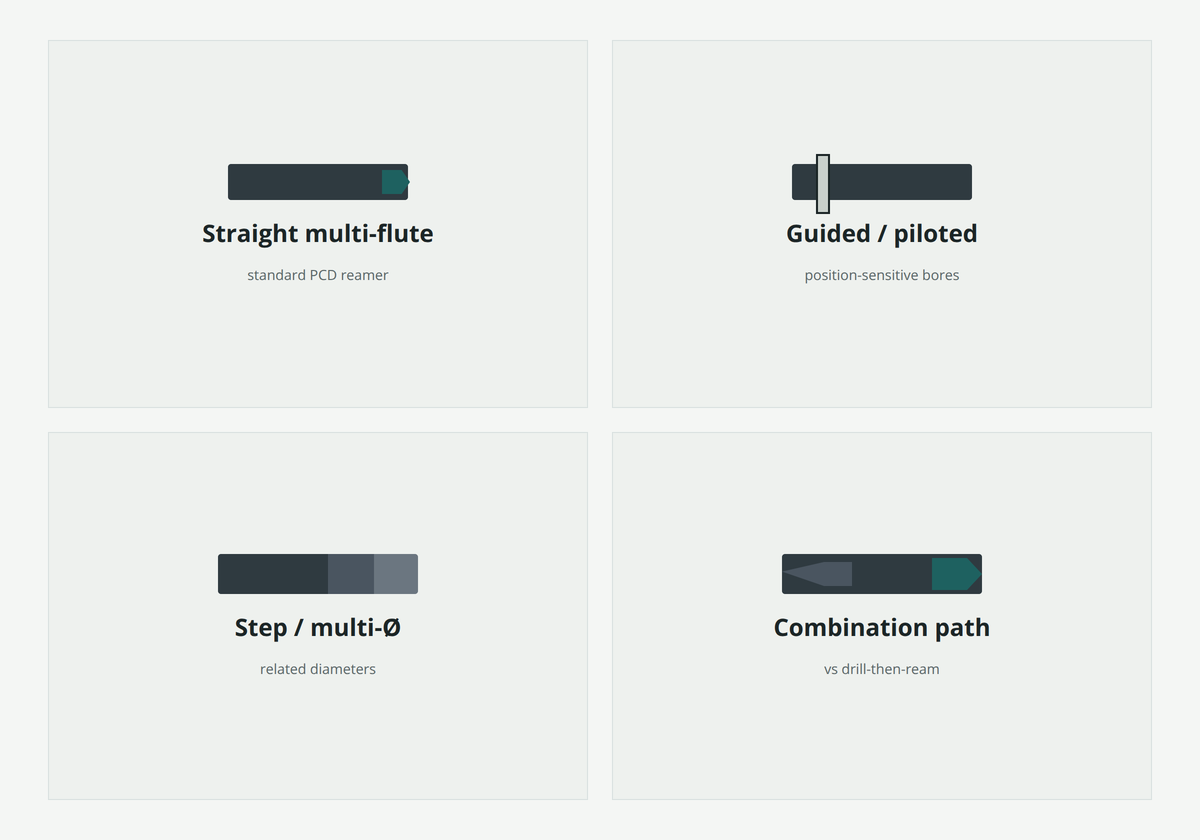
Architecture follows the bore stack—not a single “High-Si SKU” because Si% sounded high. Product home: Custom PCD reamer. Combination fork: Combination drill-reamer. After you map the fork, the next step is an RFQ with the bore chart—not a catalog tip pick.
Multi-flute / standard PCD reamer
When: create-hole already controlled (measured incoming band written), L/D and roundness risk modest, finish-only duty on a stable Al-Si bore, abrasion-led scrap without a guidance demand from depth or form. Default conversation starter when gates are green and the print is finish-only.
Not yet: incoming diameter still wanders lot-to-lot; assembled runout unmeasured under production stickout; or the scrap note is still “first-off only” with no repeat pattern. Fix those before freezing a multi-flute PCD tip.
Guided or piloted
When: L/D, roundness, or entry alignment risk would unload one edge and overload another—common on housing and pump-style bores—and the process can still measure assembled runout. Guidance shares load when the print and process justify it; it does not replace holder/runout control.
Not a substitute for: loose holder, excessive stickout, or unmeasured runout. If the tip chips on entry before Si abrasion shows, measure the setup first; do not “add a guide pad” as a slogan.
Step / multi-diameter
When: related diameters, lands, or chamfers must stay related on one pass and the print freezes those relationships (callouts and datums on the same revision). Soft RFQ pattern: PCD step / form reamer — when and RFQ.
Not because Si% is high: invent a step body only because the bore stack requires related features. If diameters are independent finish stations, keep separate tools and separate RFQ lines.
Combination vs drill-then-ream
Combination when: create+finish stock window, chip space, and coolant path fit abrasive Al-Si on one body, and print stability supports one dedicated tool through sample and early production.
Keep drill-then-ream when: create-hole still wanders, chip volume or coolant path cannot support one body, interruptions pack the create section, or revisions would obsolete a combo before payback. Soft: Combination drill-reamer product. Do not force combo because Si% is high.
Product bridge → RFQ: Map the fork on PCD reamer; if create+finish is on the table, open combination drill-reamer, then Send Your Drawing / Discuss Your Tooling Requirements / Quick RFQ with the bore chart.
Process conditions that decide success (even with PCD)
PCD does not erase bad setup. On High-Si Al, process conditions decide whether diamond wears abrasively or chips early—first-off under the production holder will tell you which one you bought. Treat the checks below as decision conditions on the RFQ and sample plan, not as slogans.
Runout and guidance
Measure: assembled runout under production stickout and holder (not a bench check on a different arbor). Unequal loading polishes one edge and overloads another; diameter then drifts even when the tip “still looks sharp.”
Decide: if runout is unknown or the setup cannot hold a stable assembled value, keep PCD provisional—fix holder/stickout before freezing diamond geometry. Guidance helps when the print demands load sharing; it does not forgive a loose holder.
Coolant and chip evacuation
Measure / state: coolant route (internal / external / MQL), whether the spindle/holder actually delivers it, and filtration practice if known. Abrasive Al-Si chips still need a clear flute path; packed flutes raise heat, finish marks, and edge damage that look like “PCD failed” when the path failed first.
Decide: if chips pack before exit or coolant never reaches the cut, fix delivery/chip space before specifying a finer PCD finish. Soft application context only: PCD aluminum high-speed.
Interruptions / thin wall / EV-auto realities
Name on the print: cross holes, thin walls, and housing interruptions that load the edge in shock. Put the same callouts in the RFQ scrap note so XRZ does not quote a straight multi-flute body into an interrupted path without a guidance or sequence plan.
Soft application pages: High-silicon aluminum hole machining · Aluminum EV housings · NEV pump bearing hole. After abrasive wear (not shock chip-out), regrind / requalify: PCD reamer regrind & reconditioning. (Milling on the same print is supporting only—if a face lands next to the bore, keep it as a process note, not a milling pillar on this page.)
Conditional quality language
Put the drawing targets on the RFQ. Treat the following only as conditional targets / labeled case windows—tied to pre-hole, measured runout, coolant, gauge method, and sample validation—not as universal XRZ catalog guarantees:
| Language (conditional · label required) | How to use on the RFQ |
|---|---|
| IT6 / IT7 diameter class | State print class; confirm under agreed gauges after first-article |
| Assembled runout ≤ 0.002 mm | Setup / acceptance note when the process can measure it—not a tip promise |
| Ra 0.1–0.4 μm | Finish band only when coolant, allowance, and material identity support the trial |
If the print asks tighter or looser, the print wins. Do not advertise unlabeled IT/Ra/runout as plant-wide capability.
Cost per accepted hole, not tip price
Higher PCD acquisition cost can still win when abrasion-led scrap and changeover burn dominate under a shared baseline; carbide can still win on short lots, unstable setups, or print churn. Build the baseline from the same machine, holder, coolant, gauge method, and acceptance window—then count acquisition, tool changes, downtime, inspection/offsets, scrap/rework, and reconditioning. Soft method page: Cost per accepted hole.
What belongs in the shared baseline (verifiable, no invented Nx):
- Named scrap mode today (flank polish / offset stacking / changeover burn / create-hole wander / adhesion)—so you are not comparing “feel” to tip price.
- Volume window and holes per part—so inventory and payback are honest.
- Whether reconditioning is in scope after abrasive wear (not after shock chip-out)—soft: Regrind guide.
Do not paste third-party life multipliers as XRZ promises. If the process gates are still open (unknown allowance, unmeasured runout, print churn), the cost conversation stays provisional—fix gates first or RFQ with those unknowns marked.
Commercial CTA: Quick RFQ · Send Your Drawing · Discuss Your Tooling Requirements with drawing and scrap-mode notes.
What to send XRZ (High-Si Al PCD reamer RFQ pack)
Send the fields that unblock a quote. Missing items keep the recommendation provisional—they do not block the intake.
| Field | What engineers actually send | Why it unblocks the quote |
|---|---|---|
| Drawing | Controlled print/model + revision; finish-critical bores marked (bearing / locating / seal vs clearance) | Freezes finish scope and architecture fork |
| Alloy / Si% | Grade + Si% when known, or “Si% unknown” + cert/cast note | Material gate without inventing a cutoff |
| Bore GD&T | Ø / tol / form / finish; blind–through; steps/chamfers; interruptions/cross-holes called out | Geometry, guidance, coolant exits |
| Pre-hole method | Create-hole process + measured incoming diameter / allowance band | Incoming stock honesty; separates create-hole scrap from abrasive wear |
| Scrap mode | Flank polish / diameter offset stacking / changeover burn / create-hole wander / adhesion—named, not “tool life bad” | PCD vs process-fix decision |
| Volume window | Batch and/or annual band; holes per part | Cost-per-accepted-hole and inventory realism |
| Holder / coolant constraints | Spindle/holder, stickout, measured assembled runout, coolant route (internal/external/MQL), filtration if known | Trial realism; chipping risk before abrasion payback |
| Sample path | First-article yes/no + written acceptance (gauges, IT/Ra/form as on print) | Validate before production talk |
Intake: Custom Cutting Tool RFQ · product: PCD reamer · combo when create+finish: Combination drill-reamer · fields: RFQ checklist. Service loop: drawing → engineering screen → first-article / sample validation → production revision control. Soft evidence: How PCD reamers are made · Manufacturing Quality Evidence. No public prices on this page.
RFQ CTA: Send Your Drawing · Discuss Your Tooling Requirements · Quick RFQ (High-Si Al finish bore · Si% or unknown · scrap mode · allowance · runout notes)
Frequently Asked Questions
When should we specify PCD vs stay on carbide for High-Si Al finish holes?
Specify / evaluate PCD when abrasive flank polish and diameter/finish drift dominate scrap on a stable, repeat Al-Si bore and measured allowance, assembled runout, coolant/chip path, and interruption risk are controlled. Stay on carbide (or fix process first) for low volume, print churn, unknown pre-hole, runout/interruption chipping risk, or adhesion-only scrap without a stabilized handoff. Soft family compare: PCD vs carbide reamer. Housing soft: High-silicon aluminum hole machining.
What does Si% mean for this decision—and what if we only know “ADC12 / Al-Si”?
Si% is one RFQ input that raises the priority of evaluating PCD when abrasion-led scrap appears; it is not an XRZ hard rule “Si% > X → must use PCD.” If you only have “Al-Si / ADC12,” mark Si% unknown, attach any cert/cast note, and still send the drawing with scrap mode and process gates. Soft depth: Si% guide.
What should we send so XRZ can quote a High-Si Al PCD reamer?
Send the controlled drawing (critical bores marked), alloy/Si% or Si% unknown, bore GD&T, create-hole method + measured allowance band, named scrap mode, volume window, and holder/coolant/runout constraints—plus sample yes/no and written acceptance. Upload via Send Your Drawing / Quick RFQ. Checklist soft: PCD reamer RFQ checklist.
What if our process is still unstable—should we RFQ PCD anyway?
Yes, you can RFQ with honest notes: mark unknown allowance/runout, name the scrap mode (create-hole wander vs abrasive polish vs shock chip-out), and say the print or setup is still moving. XRZ will keep PCD provisional and may recommend process fixes or carbide-first while gates close. Do not freeze diamond geometry hoping it will hide unstable create-hole or uncontrolled runout. Soft: Pre-hole quality · Discuss Your Tooling Requirements.
Next step
- Soft — Confirm material / compare / housing / process context: Si% Knowledge · PCD vs carbide · Allowance · Cost per accepted hole · High-silicon aluminum hole machining · How PCD reamers are made · Manufacturing Quality Evidence.
- Product — Custom PCD reamer · combo when create+finish: Combination drill-reamer — then RFQ with the bore chart.
- Hard — Send Your Drawing · Discuss Your Tooling Requirements · Quick RFQ with Si% (or unknown), scrap mode, allowance, and measured runout notes.
Do not guess a “High-Si PCD reamer” from a catalog tip. Name the scrap mode, run the selection gates, pick the architecture fork from the bore stack, then stay through first-article when the edge or diameter talks back—with How PCD reamers are made and sample validation in the loop.