
Short answer. Regrind when wear or a limited chip pattern still leaves enough PCD lip, and the body / guide geometry is salvageable—not when the edge is crashed or the diameter stack cannot be restored to the drawing. Realistic cycle talk depends on stock removed, remaining diamond, and whether pads or pilots need restore; treat any count as program-specific, never a catalog promise. After service, requalify cutting Ø, runout, pad/pilot condition, and edge prep before production release. Send wear photos, the drawing, and the current Ø for an XRZ recondition RFQ. Coated carbide drills are a different lifecycle (recoat decision)—short boundary below, not a second page.
Opening
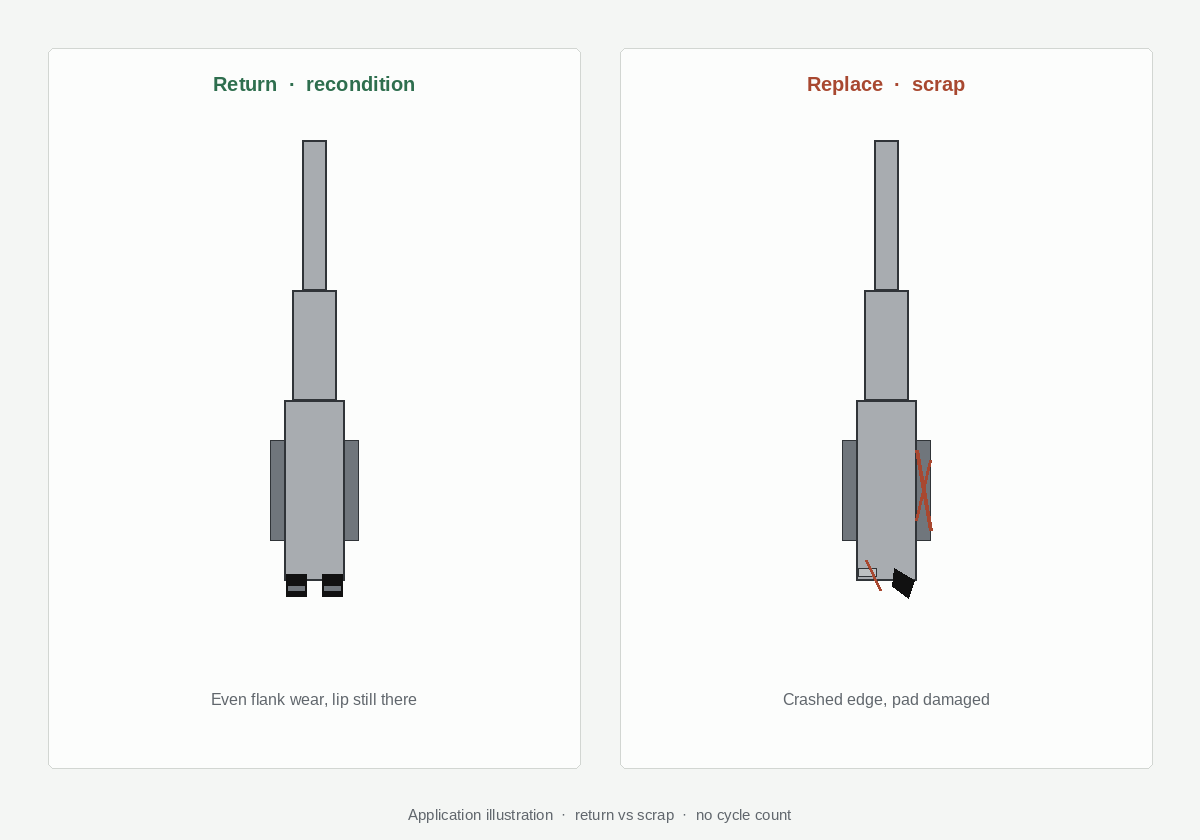
The crib drawer tells the story before the spreadsheet does. One PCD reamer comes back with even flank wear and a lip you can still photograph. The next comes back with a crashed diamond and a pad that no longer sits. The first tool is a recondition conversation. The second is a replace conversation. Running either to failure “to get the last holes” is how the body you meant to save becomes scrap.
This page is the regrind / reconditioning SOP for a custom PCD reamer: when to send the tool back, what “cycles” actually means, what must be requalified after the grind, and how XRZ writes the return-to-release loop. It is not a rewrite of cost per accepted hole—that article owns the spreadsheet. It is not a new-tool manufacturing encyclopedia (how PCD reamers are made). And it will not publish a catalog “N regrinds” number.
1. Return triggers: wear you can restore vs damage you should scrap
Send the tool back when the bore is still talking and the edge is not yet a crash:
| Floor signal | Often a return | Often scrap / replace |
|---|---|---|
| Flank or even land wear | Wear band is readable; enough PCD remains to restore the edge | Wear has eaten through the diamond into the joint or carbide pocket |
| Chip / nick | Local, photographable, away from a pad or pilot land | Corner gone, segment lifted, or crack into the braze |
| Size drift | Bore walks out of the agreed band and offsets are climbing | Diameter stack cannot be restored without violating the drawing |
| Chatter onset | New marks after a long stable window; edge still intact | Body, pad, or holder damage is already visible |
| Pad / pilot | Contact polish only | Pad knocked, scored deep, or no longer round to the axis |
A shop that waits for a bang usually returns a body that can no longer hold the approved revision. Photograph the used edge, the pads, and the bore scrap mode before the tool goes in the box. That pack is what XRZ reads—not a memory of “it still looked sharp.”
Buyer-side questions that belong with the photos live on the high-quality PCD reamer buying checklist (regrind planning is already a quality item there). New-tool grind and inspection context: how PCD reamers are made.
2. What “cycles” means—stock, remaining diamond, economics
“How many times can we regrind this?” is the wrong first question. A cycle is not a coupon. It is a stock-removal event that must leave a usable PCD lip, a restorable Ø / profile, and a body that still matches the approved drawing.
Talk in these three pieces—not in a fixed N:
- 1. Stock you must remove to get behind the wear or nick and restore edge prep. A shallow, even flank costs less diamond than a deep chip.
- 2. Diamond that remains after that stock comes off—plus whether a pad, pilot, or guide land also needs restore.
- 3. Economics vs a new body under the same acceptance set. Reconditioning belongs in cost per accepted hole as a line you fill with plant data. Empty cells are honest. A brochure “lasts N times” is not.
OEM grinding houses measure PCD rotary tools after work: optical or camera/laser diameter, profile, and a visual edge check (VOLLMER, PCD tool know-how—machine-builder practice, not an XRZ life claim). That is the right spirit: remeasure, do not assume the shine is the qualification.
If the only way to “save” the tool is to leave the drawing, the cycle is already over. Retip / rebuild is a different quote from a light regrind. XRZ will say which after incoming inspection—not before the photos arrive.
3. Requalify checklist after the grind
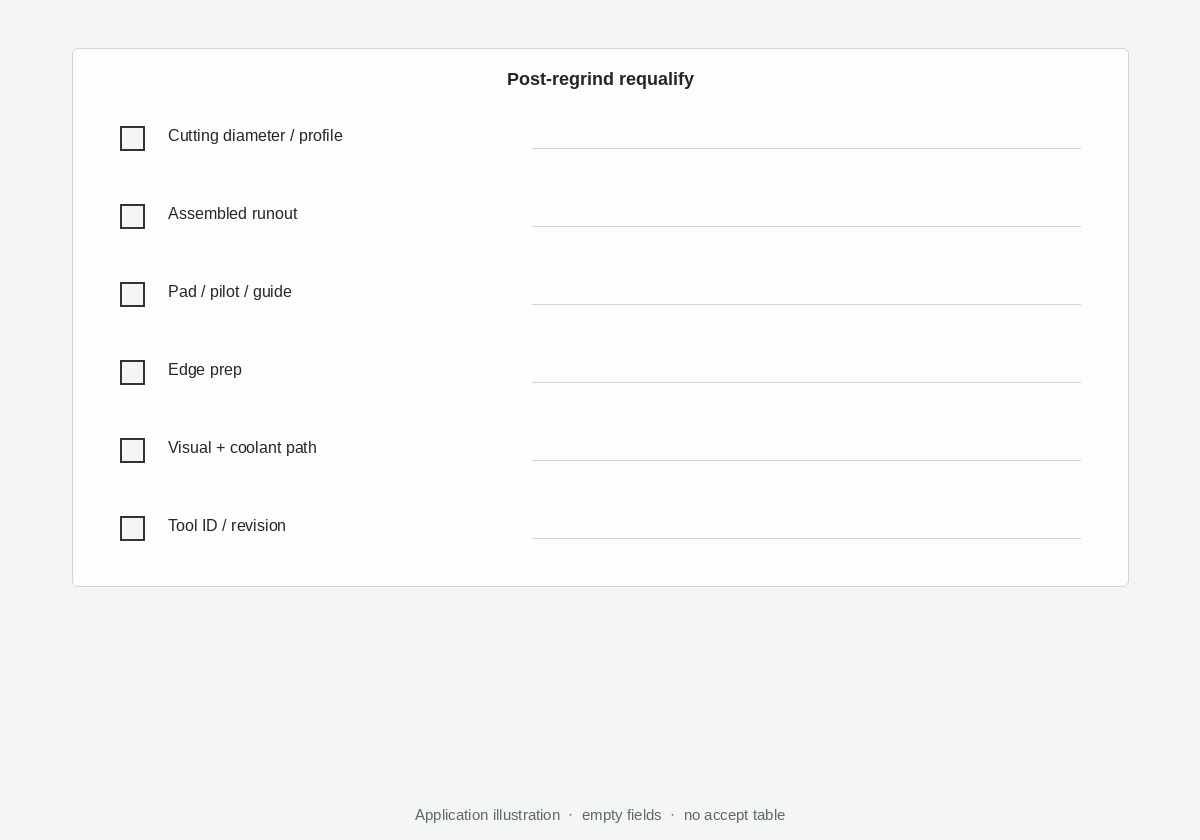
A serviced reamer is not released because it came back in a clean bag. Requalify against the current approved revision before the first production bore:
| Field | What to check | Why it fails in the bore if you skip it |
|---|---|---|
| Cutting Ø / step / profile | Against the frozen drawing; including related steps | Size or relationship drift that looks like “the PCD went soft” |
| Assembled runout | At the agreed position, preferably in the production holder | One edge takes the load; lobing and early chip |
| Pad / pilot / guide | Contact, roundness to axis, damage | The finish edge follows a bad land |
| Edge prep / integrity | Visual + the same prep family you released | Rub, BUE, or a fragile lip that chips on first-off |
| Coolant path | Open, aimed, unblocked after handling | Recut chips, heat smear, scratches |
| ID / revision / service note | Tool ID tied to this grind event | Next return cannot be diagnosed |
Do not paste a universal micrometre accept table here. The number that matters is the one you already froze on the tool drawing and the sample plan. After a regrind, length and Ø can move; re-preset and re-compensate before volume—checklist: PCD reamer presetting and runout .
New-tool inspection language (diameter, runout, edge, coolant) is on how PCD reamers are made. Repeat-order control and “can the serviced tool return to the approved window?” sit on the buying checklist. Plant capability for a custom body: custom cutting tools.
4. Service loop: receive → written acceptance → first-article → release
This is the §八·五 loop. It is a process, not a “dedicated support” sentence.
- 1. Receive the tool. Wear-edge photos, pad/pilot photos, drawing revision, current measured Ø, holder/stickout if the scrap showed up as lobing, and the bore scrap mode.
- 2. Incoming inspect. Remaining PCD, crash vs wear, body/pad condition, whether the diameter stack is restorable.
- 3. Write acceptance before the wheel turns. What will be restored (Ø, edge, pads), what is out of scope this service (life claims, a new contour), and what first-article will prove. Same discipline as sample validation—quantity and gauges in writing, no invented calendar or fee on this page.
- 4. Grind or retip on that written list.
- 5. Requalify the table above.
- 6. First-article / sample on the production holder, coolant, and gauge—not a bench story.
- 7. Release the serviced revision for volume, or scrap/replace if the list cannot be met.
- 8. Stay on the thread if first production pieces disagree. Diagnosis after RFQ is still in scope.
Packet → PCD Reamer RFQ Checklist → Custom Cutting Tool RFQ. Product home: Custom PCD Reamer.
A distributor who stocks the program should send the same photos and the end-user revision ID. Private-label marking does not replace the inspection record.
5. Boundary: coated carbide drill regrind / recoat (not a second page)
A coated carbide drill is a different lifecycle from a brazed PCD reamer. Regrind removes coating from the faces you sharpen. Then you choose: run the grind uncoated, recoat over what is left, or strip → regrind → recoat.
Published steel-drilling comparisons found that reground drills were generally inferior to new tools; among coated tools, only a strip + regrind + new TiAlN path approached new-drill performance. Recoating over the old coating, or leaving the grind bare, did not (da Silva et al., *Proc. IMechE Part B*, 2013, DOI 10.1177/0954405413502199—abstract-level citation; steel twist-drill study; not an XRZ PCD result and not a catalog promise).
Heuristic for the RFQ—not a rule:
| Often worth a recoat conversation | Often a new drill is cleaner |
|---|---|
| Substrate intact; margins still hold the Ø the hole needs | Margins worn or the remaining length will not reach |
| Coating is part of the wear system on that material | Program is short; another grind would obsolete the body |
| Shop can strip cleanly and requalify after coat | Pocket/web damage, crack, or a geometry the grind cannot restore |
PCD reamers are usually not a “strip and PVD again” story; they are remaining-diamond and restore-to-drawing stories. Keep carbide questions on the solid carbide drill path and the solid carbide drill RFQ checklist. Do not open a standalone recoat encyclopedia from this page.
Frequently Asked Questions
When should I send a PCD reamer back instead of running to failure?
When flank wear, a limited chip, size drift, or chatter onset still leaves a readable PCD lip and a salvageable body/guide. Photograph the edge and the bore scrap mode, then send the tool. A crash, a lifted segment, or an unrestorable diameter stack is a replace conversation—running those “a bit longer” usually destroys the body you meant to save.
How many regrind cycles are realistic?
It depends. Agree return criteria and the stock you are willing to give up; there is no universal N. Remaining diamond, how deep the wear or nick sits, whether pads or pilots need restore, and whether the drawing can still be met decide the next service—not a catalog cycle count. Put the real numbers into cost per accepted hole.
What dimensions must be checked after reconditioning?
At minimum: cutting Ø (and steps/profile on the frozen drawing), assembled runout at the agreed position, pad/pilot condition, edge prep, visual integrity, and coolant-path continuity. Then re-preset before volume. The accept numbers are the ones you already wrote—not a website micrometre table.
Do coated carbide drills always need recoating after regrind?
No. Recoat is a decision: substrate, remaining margin Ø, and whether the coating is doing wear work on that job. A published steel-drill comparison favored strip + regrind + new coat over bare grind or coat-over-coat—still not a promise for your material. Ask on the solid carbide drill RFQ; do not treat a PCD reamer service as a PVD story.
CTA
The useful ending is not a promised cycle count. It is a wear photo both sides can read, a written restore list, and a first-article that still has an owner.
- Soft: Cost per accepted hole · How PCD reamers are made · Buying checklist · Custom cutting tools
- Product: Custom PCD Reamer
- Hard: PCD Reamer RFQ Checklist → Custom Cutting Tool RFQ · Sample validation
- After the grind, before volume: Presetting and assembled runout checklist
- Carbide boundary only: Solid carbide drill