
Tuesday’s aluminum bore sizes in band—then QC hangs a thin foil, roll, or flap at the exit and the first blame is a dull reamer edge. The lot keeps running; deburr absorbs the scrap story; nobody sorts whether breakout load, uneven stock at exit, exit strategy, or adhesion actually wrote the lip.
This page is the aluminum exit-burr control gate after reaming: cause gate (breakout load · uneven stock at exit · exit strategy · adhesion) plus what the reamer side can still change versus when a light chamfer or secondary deburr is still required. It is not the finish-stage what-to-check checklist (PCD reamer exit burrs — what to check)—Soft once; do not merge or 301. It is not the pre-hole quality essay (Pre-hole quality) and not the allowance essay (Allowance & pre-hole size)—Soft short cues only. Hole-type exit geometry Soft one line: Blind / through / cross holes. Five jobs, five pages.
Aluminum exit burrs after reaming usually come from breakout load and uneven stock at the exit—not only a worn PCD edge. Stabilize pre-hole and allowance first, control how the reamer leaves the hole, then decide if a light chamfer or secondary deburr is still required. Capture exit photos and material grade on the RFQ; use the inspection pack for acceptance language.
Why aluminum exits raise burrs after reaming
Aluminum at exit is soft enough to push and fold when the finishing edge loses wall support. The lip that shows after ream is often a breakout / edge-load story—not proof that the PCD edge is “dull” alone, and not a license to invent a burr-free life claim.
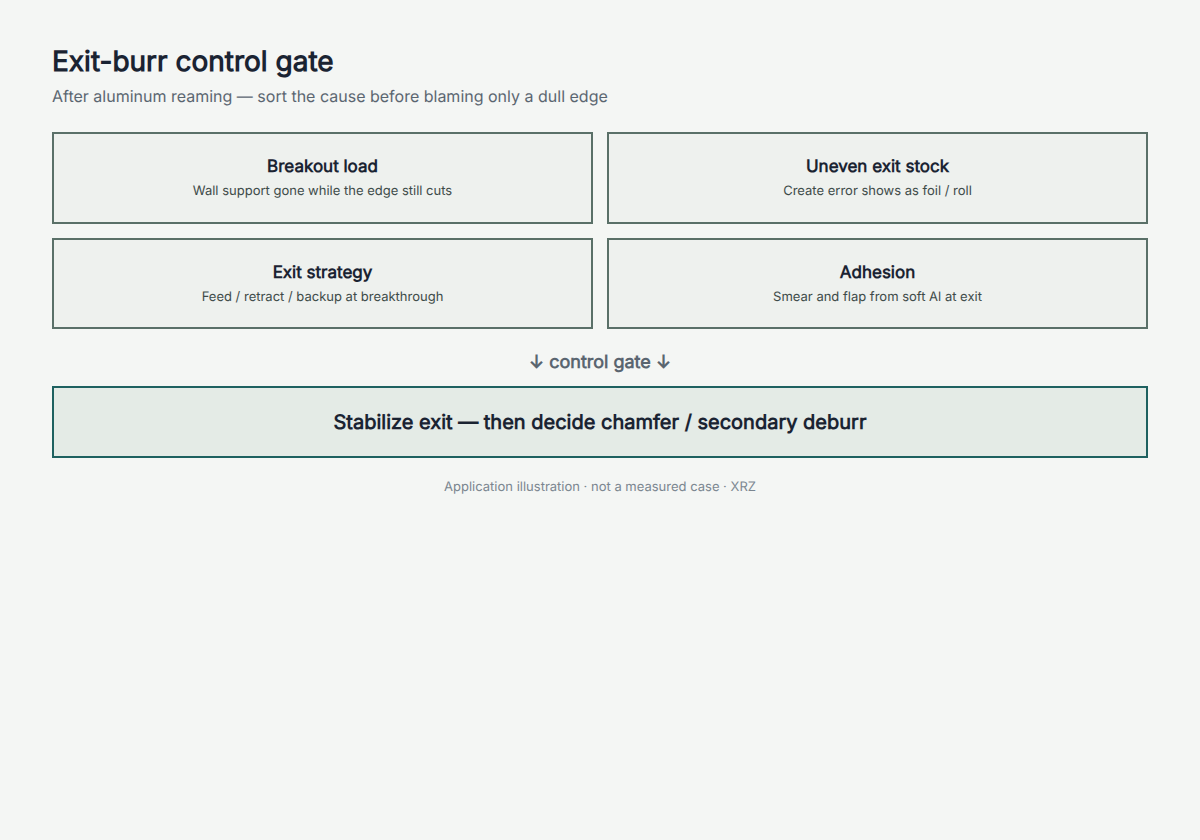
Cause gate (sort in this order on the floor):
| Cause cue | Shop look | First owner on this gate |
|---|---|---|
| Breakout load | Foil or flap timed to breakthrough; wall support gone while the edge still cuts | Exit support · feed / retract at breakout · backup if used |
| Uneven stock at exit | Lip thicker on one clock position; roll where create left more metal | Pre-hole / allowance handoff Soft short—not a full essay here |
| Exit strategy | Burr appears only when dwell, rapid, or climb-out changes; stable size with bad exit habit | How the reamer leaves the hole (feed-out, retract, dwell) |
| Adhesion / smear | Whisker or smear rather than a clean shear; worse on sticky or High-Si Al | Coolant / edge condition / material Soft cue—not a wear encyclopedia |
Create-stage drill exit breakout is a different owner. If the lip already exists before the reamer enters, Soft the drill-side exit page once and fix create first—do not paste peck or breakage recipes here. After-ream lips stay on this gate.
High-Si Al raises adhesion and abrasive wear risk; it does not justify a “burr-free PCD” promise either way. One Soft cue only: When to specify a PCD reamer for High-Si Al.
Pre-hole / allowance cues (short Soft only)
Exit burrs inherit create condition. This page does not restate the pre-hole roundness / lobing / wall-damage essay or the allowance mm band essay.
Short cues only:
- If create left lobing, wall tear, or dirty walls, the finish edge may wipe material into an exit lip—qualify the hole Soft: Pre-hole quality.
- If effective stock at exit is too light (rub/push) or too heavy (force roll), size the band Soft: Allowance & pre-hole size—no universal mm chart on this page.
- Through vs blind vs cross changes where wall support ends; Soft one line for geometry: Blind / through / cross holes.
Stabilize those Soft pages first when the exit lip tracks create error. Then return here for exit strategy and the chamfer / secondary-deburr call.
Exit strategy & edge load
Even with allowance and pre-hole in window, how the reamer leaves the hole can write the lip—first-off photos beat arguing about edge sharpness alone.
Shop signals: Burr appears only after a program change at exit; size stays in band while exit photos worsen; one spindle or one fixture station repeats the flap on Tuesday and Thursday alike.
Check first (reamer-side levers):
- Feed and retract at breakthrough—does the edge still load while the wall disappears?
- Dwell or stop at exit that polishes and pushes instead of shearing
- Backup, fixture pad, or exit support when the print allows it
- Coolant reality at exit (wet mouth, dry breakout) that lets aluminum smear
- Assembled runout / stickout that loads one flute harder at breakout
What reamer-side can change: exit feed habit, edge condition and prep matched to Al adhesion risk, guidance or step architecture when the print and volume justify it, coolant path that actually reaches breakout. XRZ screens those from the drawing and scrap photos—not from a catalog “sharper edge kills all burrs” line.
What reamer-side cannot own alone: a print that demands a sharp unbroken exit edge with no chamfer callout and no secondary break-edge; create stock that is still out of band; a later face or seal op that rolls the mouth after ream. Those push the next section.
When chamfer / secondary deburr is required
A sharper or re-prepped PCD edge does not auto-cancel every exit lip. Add a separate edge-break when:
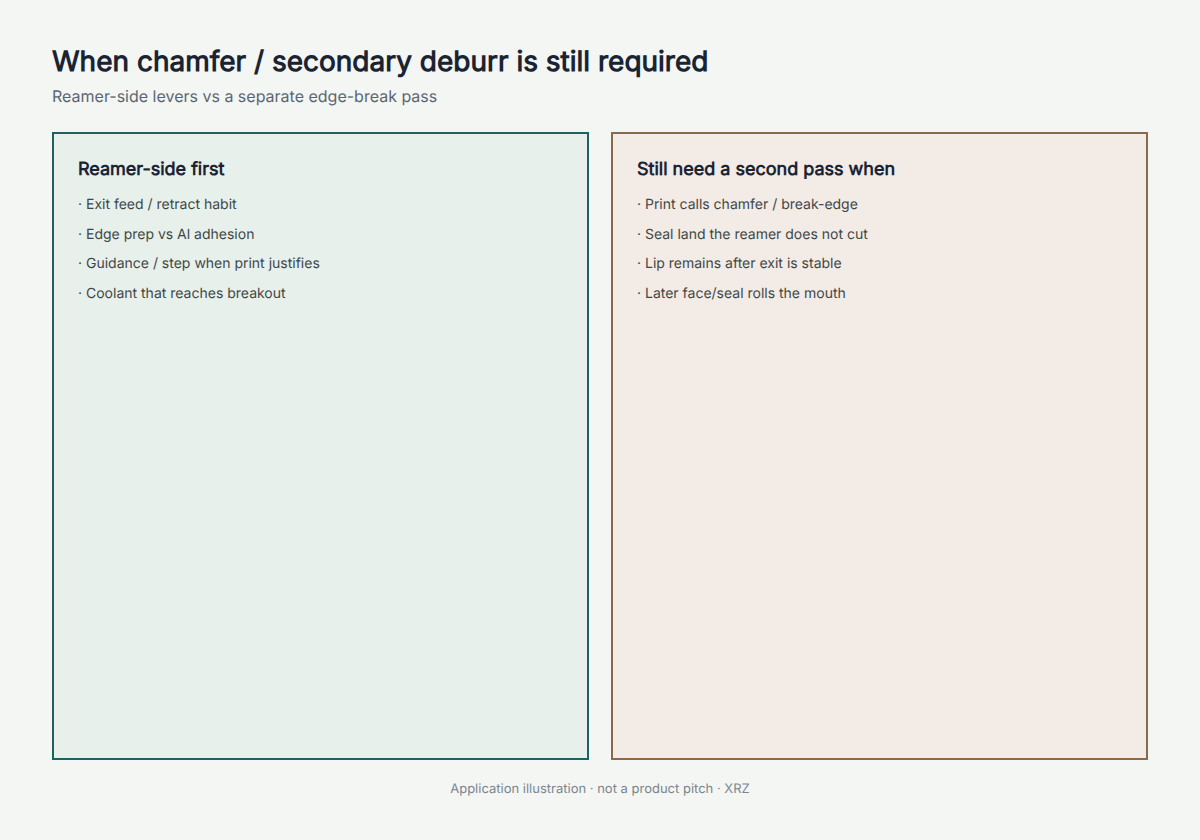
- The print calls a chamfer, break-edge, or seal-land that the reamer geometry does not cut
- Exit foil remains after allowance, pre-hole, and exit strategy are already stable
- Thin wall or cross-exit geometry leaves unsupported metal the finish edge cannot shear cleanly
- Downstream assembly / leak / seating rejects a sharp exit even when diameter is in band
Secondary options (process, not product pitch): light chamfer pass, spot / brush / hand deburr station, or a dedicated break-edge tool in sequence. Soft milling support only—never the pillar CTA: Chamfer mill. Main finish architecture stays on the reamer Product after the gate: PCD reamer.
Do not treat this Knowledge page as a chamfer product pitch or a milling pillar. Do not promise “burr-free” or “zero burr” from either the reamer or the chamfer alone—capture exit evidence and agree acceptance language instead.
RFQ / inspection notes
Do not paste the full field table here—Soft the checklists and send the drawing. Notes that usually decide the exit-burr gate on an XRZ screen:
- Alloy / condition / Si% when known (or mark unknown); sticky vs abrasive scrap notes
- Hole type (through / blind / cross), diameter, and where the lip sits (full circle vs clock position)
- Create method + current finish reamer (carbide or PCD) and exit program habit (feed-out / dwell / retract)
- Allowance / pre-hole notes if already measured—Soft depth on those pages, not here
- Exit photos (before/after finish if possible); foil vs roll vs smear description
- Print chamfer / break-edge callouts—or “none, sharp exit required”
- Acceptance language needed (visual, touch, functional)—Soft the pack, do not invent plant rules
Soft field map: PCD reamer RFQ checklist. Acceptance language Soft (long URL only): PCD reamer inspection pack — what to require. Hard submit: Custom cutting tool RFQ.
Frequently Asked Questions
Can a sharper PCD reamer alone kill exit burrs?
Not reliably. A fresher edge can reduce smear and push when adhesion or edge condition is the driver, but breakout load, uneven stock at exit, and exit strategy still write lips on aluminum. Sort the cause gate first; then decide if reamer-side levers are enough or if a chamfer / secondary deburr is still required. No “burr-free PCD” claim on this page.
How is this different from pre-hole quality?
Pre-hole quality owns create-hole condition before the reamer (roundness, lobing, wall damage, dirty walls). This page owns the exit-burr control gate after reaming—breakout load, uneven exit stock, exit strategy, adhesion, and the chamfer / secondary-deburr call. Soft-link both; do not merge. Allowance Soft stays short: Allowance & pre-hole size. Live finish checklist Soft once: Exit burrs — what to check.
When must we add a chamfer pass?
When the print calls an edge break the reamer does not cut; when exit foil remains after pre-hole, allowance, and exit strategy are already stable; or when assembly / seal rejects a sharp exit even with diameter in band. Soft supporting mill only: Chamfer mill—never the pillar CTA. Main Product after the gate: PCD reamer.
What exit evidence helps an RFQ?
Exit photos (before/after finish if you have them), alloy/Si% or unknown, hole type and lip location, create + finish tools, exit program habit, allowance/pre-hole notes if measured, and chamfer/break-edge callouts (or “sharp exit required”). Soft the field pack: PCD reamer RFQ checklist. Soft acceptance language (long URL): Inspection pack — what to require. Then upload for an XRZ engineering screen: Custom cutting tool RFQ.
Next step
Soft (read before you freeze the exit-burr call)
- Live sibling checklist: PCD reamer exit burrs in aluminum — what to check
- Pre-hole (≠ exit gate): PCD reamer pre-hole quality
- Allowance short: Allowance & pre-hole size
- Hole type / cross exit cue: Blind / through / cross holes
- High-Si when-to (one cue): When to specify PCD reamer for High-Si Al
- RFQ fields: PCD reamer RFQ checklist
- Inspection (long URL only): PCD reamer inspection pack — what to require
Product (architecture after the gate)
- Main: PCD reamer
- Supporting (milling · never pillar): Chamfer mill
Hard (drawing → tooling discuss → RFQ)
Upload hole type, material grade, exit photos, and chamfer/break-edge notes for an XRZ engineering screen. Stay through first-article under agreed acceptance—when the same exit still flaps after a tool or program change, close the loop with Sample Validation Process and Custom cutting tool RFQ.