
A new PCD reamer is about to go on the machine, and the shank on its drawing is still blank. The spindle already has an ER collet chuck or a hydraulic chuck, or, on the turning center, a floating holder left over from the last job. The reamer is ground to its drawing, so once the shank and interface are fixed, they stay fixed. A wrong holder shows up later as bore size that wanders, finish that won't hold, and a tool that needs a new setup every time it comes out of the spindle.
On a machining center, a PCD reamer usually runs best in a high-precision hydraulic chuck or a shrink-fit holder. Use an adjustable-runout holder when the assembly has to be corrected on the machine. Use a floating holder only when the spindle axis and the hole axis are out of line and can't be brought back, which is the typical case on lathes and turning centers. The holder sets the reamer's shank, length and coolant route, so name it in the RFQ first.
If you need the drill side of stickout and holder choice, see carbide drill stickout, runout and toolholders.
What the Holder Has to Do for a PCD Reamer
A PCD reamer takes a small allowance with several edges at once, so each edge removes only a thin chip and any radial error in the assembly is a large share of it. One edge cuts more, the others rub, and the error goes straight into bore size and finish. That is why holder runout ranks high among the variables in how PCD reamers control hole accuracy and surface finish.
For a finishing reamer, the holder has four jobs:
- Low runout at the cutting edges, for the assembly, not the figure printed for the holder alone.
- Repeatability. After the tool comes out for a check or a regrind, it should run the same way without a long reset.
- Damping. The finishing cut is light, and an assembly that rings marks the wall; a holder that absorbs some vibration helps. If the bore already shows marks, start with PCD reamer chatter diagnosis before changing the holder.
- Coolant to the edges. Production PCD reamers often have internal coolant channels, so the holder has to pass coolant to the shank end without leaking.
Hydraulic, Shrink-Fit, Adjustable or Floating: What Each Gives
The two holders that move are easy to confuse. An adjustable holder is set once on the machine, after the reamer is clamped, to bring runout down, and then locked; during the cut it is as rigid as any other holder. A floating holder keeps moving during the cut so the reamer can follow the pre-hole, and it cannot correct where that hole is.
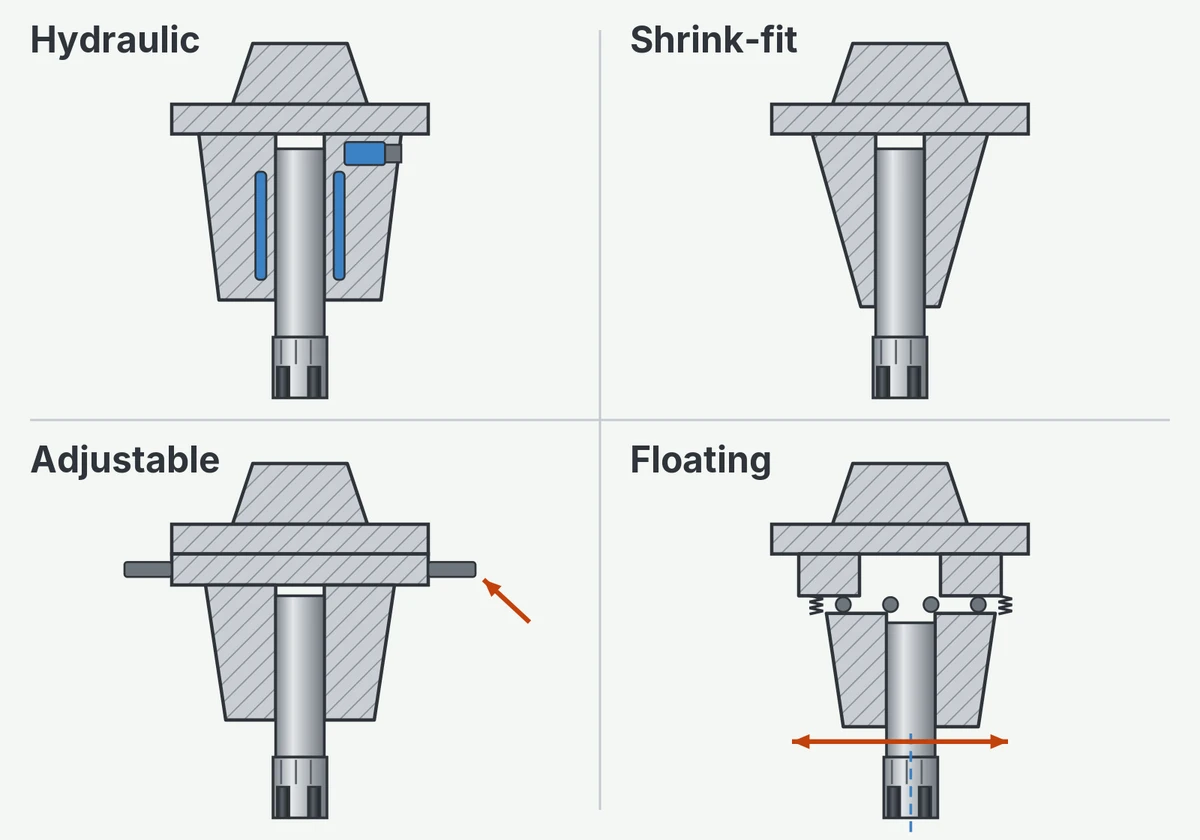
| Holder type | What it gives you | Where it fits | What it puts on the reamer drawing |
|---|---|---|---|
| Hydraulic chuck | Oil pressure expands a thin sleeve around the shank: good concentricity, repeatable clamping, damping, tool change with a key | Finish reaming on machining centers, especially where tools come out often for checks | Plain shank at the holder bore size with its tolerance; minimum clamped length; shank end that suits the length screw and coolant seal |
| Shrink-fit holder | Interference fit after the nose is heated: rigid, concentric, slim nose. Needs a heating unit; one shank diameter per holder | Reach past fixture walls; shops that already run a shrink station | Plain shank with a tight tolerance; shank material stated; minimum clamped length |
| Adjustable-runout holder | Screws on the holder or an adapter push the clamped tool back onto the spindle axis; set once on the machine, then locked | Long or stepped reamers, tight bores where the clamp alone is not enough | Shank to suit the clamp inside it; extra gauge length; reamer and holder kept as a set |
| Floating holder | Lets the reamer move sideways, and on some designs tilt, to follow the pre-hole during the cut; cannot correct hole position | Lathes, turning centers, any machine where spindle and pre-hole can't be aligned | Shank to suit the holder; a lead that centers the tool; float unit length added to the stack |
| ER collet chuck (workable, not first choice) | Clamps a range of diameters; result depends on collet, nut and cleanliness, and runout can change at every tool change | Short reamers, trials, low volume | Plain shank inside the collet range |
Side-lock holders push the shank to one side with a set screw, which adds runout, so leave the clamping flat off a finishing reamer unless side-lock is what you will run.
Between hydraulic and shrink-fit there is rarely a wrong answer on a machining center; pick the one your shop can keep clean, set and repeat. If a hydraulic chuck takes a smaller shank through a reduction sleeve, that sleeve is one more interface, and for through-tool coolant it must be a sealed type.
Floating Holders: When They Help and Where They Stop
On a lathe or turning center, the reamer sits in a turret station that rarely lines up exactly with the spindle axis. A rigid holder forces the reamer to cut across to its own axis, and the hole opens at the entry. A floating holder gives the reamer room to follow the pre-hole instead.
What a floating holder can't do:
- It follows the pre-hole axis and does not correct it. A drilled hole that sits off position or wanders along its depth passes both faults on to the bore. When position is the requirement, fix the drilling or bore the hole.
- It does nothing for runout inside the tool. Error in the reamer or its clamp still reaches the bore.
- On a horizontal spindle it needs to center itself. The tool's weight pulls a free float downward, so the reamer meets the hole off center. Use a self-centering design on horizontal setups.
- The float resistance has to suit the cut. Too free and the reamer wanders as it enters; too stiff and it acts like a rigid holder. Either can leave a bell mouth or an oversize bore; separating that from other causes is covered in reamer cutting oversize causes.
With a floating holder the reamer's lead does the centering, so the lead has to be symmetric, and a clean pre-hole chamfer helps it start on axis. Where the spindle already lines up with the pre-hole, a floating holder has nothing to compensate.
How the Holder Choice Shapes the Reamer Drawing
The interface and shank are set on the tool drawing to your spindle and holder. In practice the holder decides five things on that drawing.
Shank Type and Shank Diameter Tolerance
Hydraulic and shrink-fit holders clamp a plain cylindrical shank, so the drawing needs the shank diameter and its tolerance written out; h6 is the usual class for these clamps. Pick the shank diameter to match holder bores you already have, not the cutting diameter. A reamer that cuts larger than its shank steps up to the body, and one that cuts smaller gets a neck. Shrink-fit normally clamps carbide shanks; if the reamer body is steel, confirm with the holder supplier that a steel shank of that diameter clamps and releases before the drawing is frozen. If you run several reamer sizes on one line, a common shank diameter lets one holder size cover them.
Clamped Length, Overall Length and Stickout
Every hydraulic and shrink-fit holder has a minimum clamped length, and the shank must be at least that long. The reamer's overall length is that clamped shank plus the stickout from the holder face to the tip. Set the stickout from the bore depth and fixture clearance, then choose the holder nose, for example a slim shrink-fit nose or an extended holder, before you make the reamer longer. Reach added in the holder stays on the machine; reach added to the reamer has to be ground into every replacement. If the holder sets length with a screw behind the shank, the shank end has to be flat and square.
Coolant Route
Through-tool coolant runs from the spindle center through the holder's length screw into the shank end, then down internal channels to exits at the lead or along the flutes, if the holder provides that path. Some steep-taper holders take coolant in through the flange instead of the spindle center, but they still have to deliver it to the shank end. If the machine and holder give only external coolant, the reamer is drawn without channels and relies on nozzles that must reach the edges at your stickout. Whichever route you choose, it has to be the same on the drawing, in the holder and at the machine.
Adjustable Holder, Adjustable Reamer and Adjustable Boring Head
These three do different jobs:
- An adjustable-runout holder changes where the reamer runs. It is set once after clamping to bring the cutting edges back onto the spindle axis, then locked. It does not change the reamer's diameter.
- An adjustable reamer, with blades or a body that can be reset, changes the cutting diameter.
- An adjustable boring head moves a single cutting edge to set a bore diameter. It is a boring tool, not a holder for a reamer. When to bore instead of ream is covered in reaming vs boring for precision holes.
If you plan an adjustable-runout holder, decide at the same time whether the reamer needs a diameter adjustment of its own. Two adjustments mean two settings to make and record at every tool change; often the grind can hold the diameter and the holder can take care of runout.
Compensation After Regrind
A regrind shortens the reamer and can move its diameter within the band, and the tool then has to be set again in its holder. On an adjustable-runout holder, the old setting belonged to the old clamp, so it has to be adjusted again. If the plant restores gauge length after regrind by pulling the tool further out of the holder, the clamped length gets shorter each time. Leave enough shank on the drawing that the tool still meets the holder's minimum clamped length after the last regrind you plan for. Service and requalification are covered in the PCD reamer regrind and reconditioning guide. How assembled runout is measured and accepted on the machine is in PCD reamer presetting and runout.
What to Send About Your Spindle and Holder
With these in the RFQ, shank, length and coolant route can be settled before the reamer is drawn:
- Machine type: machining center or turning center, vertical or horizontal spindle
- Spindle interface by standard name and size, for example HSK, BT, CAT or SK
- The holder you plan to use (hydraulic, shrink-fit, adjustable-runout, floating or ER), its bore size, its minimum and maximum clamped length, and whether runout can be adjusted
- Coolant: through the spindle or external, whether the holder passes it to the shank end, and the pressure range you run
- How and where you measure runout today, if you do
- The bore: diameter and tolerance, depth, through or blind, and how close it sits to fixture walls or part features
- Workpiece material
The full field list for a quote is in the PCD reamer RFQ checklist. Tell us your spindle and holder, and we design the reamer shank to match, with the tool drawing sent back for your sign-off before grinding. For the reamer itself, see custom PCD reamers, then send the data and part drawing through the custom cutting tool RFQ.
Frequently Asked Questions
Is a hydraulic chuck or a shrink-fit holder better for a PCD reamer?
On a machining center both work well for finish reaming. A hydraulic chuck changes tools with a key at the machine and damps vibration, which helps the finish. A shrink-fit holder is stiffer and slimmer at the nose for reach past fixtures, but it needs a heating unit and each holder takes one shank diameter. Choose the one your shop can keep clean, set and repeat, then draw the reamer shank for it.
When should I use a floating reamer holder?
Use one when the pre-hole and the spindle do not share an axis and the machine cannot be corrected, which is typical on lathes and turning centers. The holder gives the reamer room to follow the pre-hole. Errors in the pre-hole's position or straightness still carry through to the bore, and so does runout in the tool. On a horizontal spindle, choose a self-centering design so the tool's weight does not pull it off the hole axis.
Do I need an adjustable-runout holder for a PCD reamer?
Not always. A good hydraulic or shrink-fit holder is enough for many bores. Use an adjustable-runout holder when runout at the cutting edges has to come down further than the clamp alone allows, for example on long or stepped reamers. It is set once on the machine after clamping and then locked, so it corrects where the reamer runs, not its diameter, and it has to be set again each time the tool is reclamped.
What does the holder change on the reamer drawing?
It sets the shank type and diameter tolerance, the minimum clamped length, the overall length and stickout, the coolant entry at the shank end, and whether the reamer needs a diameter adjustment of its own. It also decides how much shank must be left for resetting length after regrinds. Name the holder in the RFQ so these are fixed before the reamer is ground.